


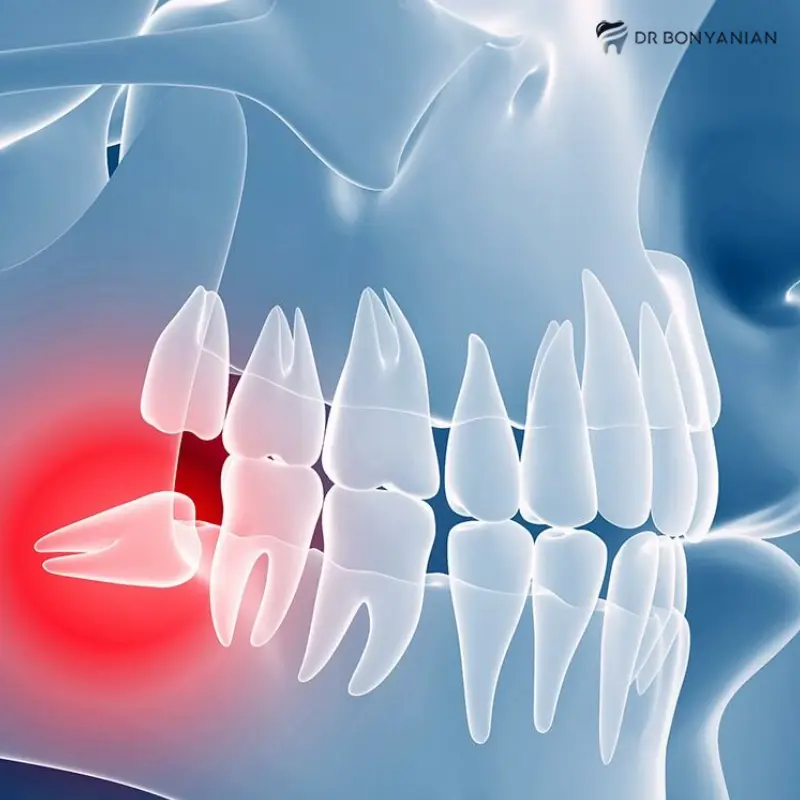
Under what conditions is wisdom tooth extraction necessary? When:
- The wisdom tooth is impacted.
- It’s partially impacted and traps food constantly.
- It’s putting pressure on adjacent teeth.
- There’s severe decay in the wisdom tooth or neighboring teeth.
- A cyst or tumor develops around the impacted wisdom tooth.
- There’s recurrent pain, swelling, or gum infection (pericoronitis) around the wisdom tooth.
- Orthodontic treatment requires creating sufficient space for tooth alignment.
- There are problems with chewing or opening and closing the jaw.
- The tooth erupts horizontally or at an angle, lacking normal growth.
You’ve surely heard someone say: “I had my wisdom tooth pulled, and my jaw still hurts!” Or perhaps you’ve had your own unpleasant experience with the partial eruption of these teeth.
The wisdom tooth is an uninvited guest that sometimes causes trouble instead of help! But why do we need to extract it? Is wisdom tooth extraction always necessary? Or do we always need dental surgery to remove this tooth?
In this article from Dr. Bonianian’s dental clinic website, we are going to cover everything about wisdom tooth extraction in simple yet precise language. So, stay with us until the end of the article to learn more about this topic.
Where is the wisdom tooth?
The wisdom tooth is the last molar in each dental arch, usually located at the very back of the mouth in both the upper and lower jaws. These teeth, typically four in number (two upper, two lower), usually erupt between the ages of 17 and 25, an age traditionally associated with the onset of intellectual maturity and “wisdom”.
Due to their position at the back of the mouth, wisdom teeth often lack sufficient space for full eruption and may appear impacted (unerupted), partially impacted, or at an abnormal angle.
This situation can lead to problems such as pain, gum inflammation, pressure on adjacent teeth, and even infection. Therefore, awareness of the location and growth status of wisdom teeth plays an important role in preventing serious complications.
Where is the wisdom tooth?
The wisdom tooth is the third and last molar on each side of the upper and lower jaws, located at the very back of your mouth. Most adults have four wisdom teeth—one in each corner of the mouth. They usually emerge between the ages of 17 and 25, a time often associated with the onset of maturity, hence the name “wisdom” teeth.
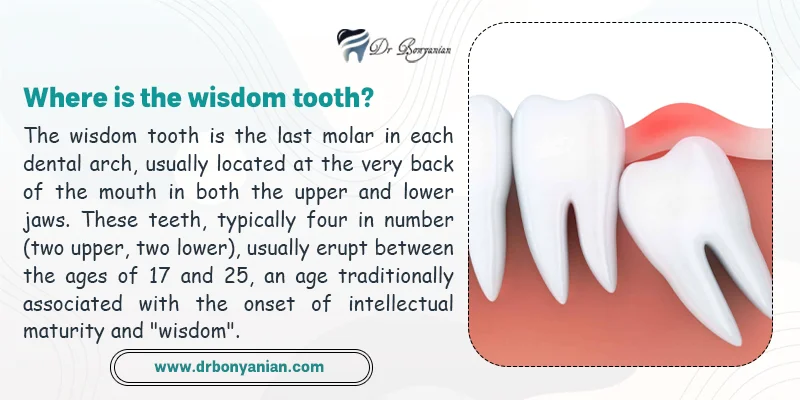
Because they are the last teeth to erupt, they often lack enough space to come in properly, which can lead to them being impacted (trapped in the jawbone or gums), crooked, or only partially erupted, potentially causing pain, infection, or crowding of other teeth.
[Image illustrating wisdom teeth placement would go here]
Is wisdom tooth extraction necessary?
Wisdom tooth extraction isn’t always necessary, and for some people, these teeth erupt fully and healthily without causing problems. However, in many cases, due to various reasons like lack of space, improper growth, or the likelihood of complications, extracting wisdom teeth is recommended.
Below, we outline the most important conditions where wisdom tooth extraction becomes necessary, along with explanations.
1. If the wisdom tooth is impacted.
When a wisdom tooth doesn’t fully emerge from the gum and remains trapped within the jawbone or under the gum tissue, it’s called an impacted wisdom tooth. This condition can lead to the formation of cysts, infection, damage to the roots of adjacent teeth, and even bone loss in the jaw. Often, impacted wisdom teeth present symptoms like pain, swelling, or infection and require surgical removal.
2. If the wisdom tooth is growing crookedly or at an angle.
Sometimes, a wisdom tooth grows angled towards other teeth or even towards the inside of the jaw. This type of eruption can exert pressure on adjacent teeth, causing them to shift, damaging their roots, or even leading to bone resorption. In such situations, extracting the wisdom tooth is recommended to prevent further damage.
3. If you experience recurrent pain and gum inflammation.
In some cases, the wisdom tooth only partially emerges from the gum, leaving a portion still covered. This condition, known as “partial eruption,” can trap food particles and bacteria under the gum flap, leading to inflammation, infection (pericoronitis), and chronic pain. If these inflammations recur, extracting the wisdom tooth is the best option.
[Image illustrating pericoronitis or jaw pain could go here]
4. Decay or damage to the wisdom tooth or adjacent teeth.
Due to their location at the back of the mouth, cleaning wisdom teeth is difficult. This increases the risk of decay and infection. Sometimes, the wisdom tooth also causes pressure and damage to the neighboring molar. If the wisdom tooth or adjacent teeth suffer irreversible damage, extraction becomes necessary.
5. Interference with orthodontic treatment or prosthetics.
For patients planning orthodontic treatment, the presence of wisdom teeth might impede the proper movement of teeth or cause relapse after treatment. Similarly, in some patients needing prosthetics or implants, extracting wisdom teeth is necessary to create enough space or prevent future problems.

Extracting the Root of a Lower Wisdom Tooth
Due to its specific location in the jaw, a lower wisdom tooth might not grow fully or could exert pressure on the roots of other teeth. In cases where the wisdom tooth remains impacted or partially impacted, extraction along with its root might be necessary.
If you feel pain, pressure, or inflammation in the back area of your lower jaw, be sure to visit Dr. Bonianian’s dental clinic for a thorough examination. Specialized consultation and precise imaging are performed at our clinic.
Complications of Wisdom Tooth Extraction
If you ask whether wisdom tooth extraction is dangerous, we must say that wisdom tooth extraction usually doesn’t lead to long-term complications. However, removing an impacted wisdom tooth sometimes requires a surgical procedure involving an incision in the gum tissue and bone removal.
Complications from this procedure rarely include the following:
- Dry socket: A painful condition where the post-surgical blood clot dislodges from the extraction site (socket), exposing bone.
- Infection: Bacteria accumulating in the socket or trapped food particles causing infection.
- Damage: Injury to adjacent teeth, nerves, jawbone, or nearby sinuses.

Complications of Not Extracting Wisdom Teeth
Dr. Bonianian explained the complications of not extracting wisdom teeth as follows:
If a wisdom tooth lacks sufficient space to grow but isn’t extracted, you might face complications such as:
- Damage to adjacent teeth
- Decay of the wisdom tooth or neighboring teeth
- Infection and abscess
- Chronic jaw pain and headaches
If your wisdom tooth hasn’t been extracted yet and you occasionally feel pain or discomfort, this is a warning sign. It’s best to visit Dr. Bonianian’s dental clinic to prevent more serious problems.
Benefits of Wisdom Tooth Extraction
- Prevention of teeth crowding
- Reduced likelihood of decay and infection
- Improved oral hygiene
- Reduced pressure on the jaw and adjacent teeth

How to Prepare for Impacted Wisdom Tooth Surgery?
The dentist may perform the procedure in the office. However, if your tooth is deeply impacted or if the extraction requires a complex surgical approach, your dentist might refer you to an oral and maxillofacial surgeon.
In addition to numbing the area with local anesthesia, the surgeon might administer sedation intravenously (IV) to help you relax during the procedure.
Questions Related to Wisdom Tooth Extraction
Questions you might want to ask your dentist or oral surgeon include:
- How many wisdom teeth need to be removed?
- What type of anesthesia will I receive?
- How complex do you anticipate the procedure will be?
- How long is the procedure expected to take?
- Has the impacted wisdom tooth caused damage to other teeth?
- Is there a risk of nerve damage?
- What other dental treatments might I need later?
- How long will the full recovery and return to normal activities take?
Our specialists at Dr. Bonianian’s dental clinic are ready to answer your questions. For a free dental consultation, you can contact us via the form below.
Preparing for Impacted Wisdom Tooth Surgery
Wisdom tooth extraction is almost always performed as an outpatient procedure. This means you go home the same day.
Hospital or dental clinic staff will provide you with instructions on what to do before the surgery and on the day of your scheduled surgery. Ask these questions:
- Should I arrange for someone to drive me home afterward?
- What time should I arrive at the dental clinic or hospital?
- Do I need to avoid eating food or drinking fluids or both (fasting)? If so, when should I start?
- Can I take my prescription medications before the surgery? If so, how soon before the surgery can I take a dose?
- Should I avoid any nonprescription drugs before the surgery?
[Image depicting a patient in a dental chair or clinic setting could go here]
Wisdom Tooth Extraction Procedure
Your dentist or oral surgeon may use one of three types of anesthesia, depending on the expected complexity of the wisdom tooth extraction and your comfort level. Options include:
- Local anesthesia: Your dentist or oral surgeon administers local anesthesia with one or more injections near the site of each extraction. Before giving the injection, the dentist or surgeon will likely apply a substance to your gums to numb them. You’ll be awake during the tooth extraction. Although you’ll feel some pressure and movement, you shouldn’t experience pain.
- Sedation anesthesia: Your dentist or oral surgeon gives you sedation anesthesia through an intravenous (IV) line in your arm. Sedation anesthesia suppresses your consciousness during the procedure. You won’t feel any pain and will have limited memory of the procedure. You’ll also receive local anesthesia to numb your gums.
- General anesthesia: In special circumstances, you may be offered general anesthesia. You might inhale medication through your nose or have an IV line in your arm, or both. Then you lose consciousness. Your surgical team carefully monitors your medication, breathing, temperature, fluids, and blood pressure. You’ll experience no pain and have no memory of the procedure. Local anesthesia is also given to help with postoperative discomfort.
During wisdom tooth extraction, your dentist or oral surgeon:
- Makes an incision in the gum tissue to expose the tooth and bone
- Removes bone that blocks access to the tooth root
- Divides the tooth into sections if it’s easier to remove in pieces
- Removes the tooth
- Cleans the site of the removed tooth of any debris from the tooth or bone
- Stitches the wound closed to promote healing, although this isn’t always necessary.
- Places gauze over the extraction site to control bleeding and help a blood clot form.
Cost of Wisdom Tooth Extraction Near a Nerve
If the wisdom tooth is close to a nerve, its extraction requires special skill and sometimes specialized surgery. The cost of such cases is higher than simple extraction and depends on the complexity, type of anesthesia needed, and the type of surgery.
To get an accurate cost estimate and free consultation, contact Dr. Bonianian’s clinic today or book your appointment online using the form below.
For more information regarding the cost of wisdom tooth extraction, you can also visit the Wisdom Tooth Surgery Cost page.
Is Wisdom Tooth Extraction Necessary for Orthodontics?
Sometimes, yes. In many individuals, to achieve a better outcome in orthodontics, wisdom tooth extraction is necessary. Of course, this issue must be evaluated by a specialist based on imaging and the treatment plan.

Wisdom Tooth Extraction Before Orthodontics
In many cases, extracting wisdom teeth before starting orthodontics is recommended to prevent unwanted tooth movement, provide sufficient space for alignment, and ensure longer-lasting, more successful orthodontic results.
Wisdom Tooth Extraction After Orthodontics
If your orthodontic treatment is complete and your wisdom teeth haven’t erupted yet or are impacted, they might cause teeth to shift again. For this reason, sometimes extracting wisdom teeth after orthodontics is also recommended.
Extracting Horizontal (Sleeping) Wisdom Tooth
A tooth that has grown horizontally within the jawbone (sleeping) must be extracted by a skilled oral surgeon or dentist. This type of tooth usually requires surgery.
At Dr. Bonianian’s dental clinic, this type of surgery is performed using modern technology, complete anesthesia, and with minimal pain and discomfort.
Is Wisdom Tooth Extraction Difficult?
The difficulty of wisdom tooth extraction depends on several factors:
- Tooth position
- Root shape
- Level of impaction
- Proximity to nerves
But don’t worry; with local anesthesia and modern techniques, the extraction process at our clinic will be easy and anxiety-free.
Care After Wisdom Tooth Extraction
[Image depicting post-operative care or a comfortable recovery setting could go here]
If you receive sedation anesthesia or general anesthesia, you’re taken to a recovery room after the procedure. If you have local anesthesia, your brief recovery time likely takes place in the dental chair.
As you heal from your surgery, follow your dentist’s instructions on:
- Bleeding: Some oozing of blood may occur the first day after wisdom tooth extraction. Try to avoid excessive spitting so that you don’t dislodge the blood clot from the socket. Replace gauze over the extraction site as directed by your dentist or oral surgeon.
- Pain management: You may be able to manage pain with an over-the-counter pain reliever, such as acetaminophen (Tylenol, others), or a prescription pain medication from your dentist or oral surgeon. Prescription pain medicine may be especially helpful if bone has been removed during the procedure. Holding a cold pack against your jaw may also help. We suggest reading the related article on pain relievers for toothache.
- Swelling and bruising: Use an ice pack as directed by your dentist or surgeon. Any swelling of your cheeks usually improves in two or three days. Bruising may take several more days to resolve.
- Activity: Plan to rest for the remainder of the day after your surgery. Resume normal activities the next day, but for at least a week, avoid strenuous activity that might result in losing the blood clot from the socket.
- Beverages: Drink lots of water after the surgery. Don’t drink alcoholic, caffeinated, carbonated or hot beverages in the first 24 hours. Don’t drink with a straw for at least a week because the sucking action can dislodge the blood clot from the socket.
- Food suitable after wisdom tooth extraction: Eat only soft foods, such as yogurt or applesauce, for the first 24 hours. Start eating semisoft foods when you can tolerate them. Avoid hard, chewy, hot or spicy foods that might get stuck in the socket or irritate the wound. We have addressed this topic in a separate article on what to eat after wisdom tooth extraction.
- Cleaning your mouth: Don’t brush your teeth, rinse your mouth, spit or use mouthwash during the first 24 hours after surgery. Typically, you’ll be told to resume brushing after the first 24 hours. Be particularly gentle near the surgical wound when brushing and gently rinse your mouth with warm salt water every two hours and after meals for a week.
- Can you smoke after wisdom tooth surgery? If you smoke, don’t do so for at least 72 hours after surgery — and wait longer if possible. If you chew tobacco, don’t use it for at least a week. Using tobacco products after oral surgery can delay healing and increase the risk of complications.
- Stitches: You may have stitches that dissolve within a few weeks or no stitches at all. If your stitches need to be removed, schedule an appointment to have them taken out.
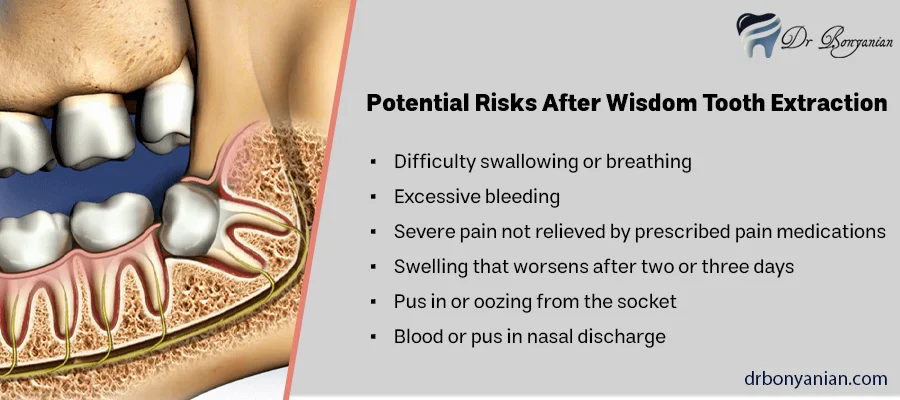
Potential Risks After Wisdom Tooth Extraction
[Image depicting a person experiencing post-operative discomfort could go here]
Contact your dentist or oral surgeon if you experience the following signs or symptoms, which could indicate infection, nerve damage or other serious complication:
- Difficulty swallowing or breathing
- Excessive bleeding
- Severe pain not relieved by prescribed pain medications
- Swelling that worsens after two or three days
- A bad taste in your mouth not removed by rinsing with salt water
- Pus in or oozing from the socket
- Persistent numbness or loss of feeling
- Blood or pus in nasal discharge.
Wisdom Tooth Extraction at Dr. Bonianian Dental Clinic
Dr. Bonianian Dental Clinic, recognized as one of the best dental clinics in Tehran, is ready to provide wisdom tooth extraction services with experienced specialist surgeons. To schedule an appointment, call 021-88539720 or visit us at our address: Unit 7, No. 22, West 6th St., Ahmad Qasir (Bokharest) St., Arjantin Sq., Tehran.
How Long Does Pain Last After Wisdom Tooth Extraction?
Typically, pain after wisdom tooth extraction lasts between 3 to 7 days and gradually decreases. If you still have severe pain or swelling after one week, you should definitely contact your dentist.
Bone Spur Eruption After Wisdom Tooth Extraction
In some cases, small fragments of jawbone may protrude in the surgical area, referred to as “bone spicules.” This condition is usually harmless and resolves on its own or with the help of a dentist.
Pain Management After Lower Wisdom Tooth Extraction
To relieve pain, you can use these methods:
- Prescribed medications
- Ice packs
- Rinsing the mouth with salt water
- Rest and avoiding strenuous activity
Extracting an Erupted Wisdom Tooth
If the wisdom tooth has fully erupted and emerged from the gum, its extraction is usually simpler and performed without surgery.
Extracting a Partially Impacted Wisdom Tooth Without Surgery
In certain specific cases, a partially impacted wisdom tooth can be extracted without surgery, using only special techniques and precise instruments, depending on the position of the tooth and gum.
Final Summary
Wisdom tooth extraction is one of the most common yet sensitive dental treatments. In conditions like impaction, decay, chronic pain, infection, or orthodontic needs, this treatment can prevent more serious future problems.
However, the decision to extract or keep a wisdom tooth must be made under the supervision of a specialist dentist and after careful radiographic evaluation.
At Dr. Bonianian Dental Clinic, we utilize the latest equipment, an experienced team, and adhere strictly to sterilization principles to provide you with a safe, precise, and painless experience.
If you have pain, swelling, or concerns about your wisdom teeth, schedule an examination appointment today. A specialized consultation is the first step towards maintaining the health of your smile!

Dr. Nazi Bonyanian
Dental Surgeon (DDS) — Medical Council Number: 138662
Graduate of Isfahan University of Medical Sciences with over 15 years of experience in implants, laminates, and oral and dental surgery.
Address: No. 22, Unit 7, West Alley 6, Bokharest Street, Argentina Sq., Tehran, Iran
Phone: +98-21-88539720 | WhatsApp: +98-912-514-2202
Email: info@drbonyanian.com
Working Hours: Sat–Wed 09:00–20:00 | Thu 09:00–14:00 | Friday Closed
⚠️ اطلاعات این صفحه صرفاً برای آگاهی است و جایگزین معاینه و تشخیص تخصصی نمیباشد.
