


What is an Immediate Dental Implant?
An immediate dental implant is a relatively new and innovative method in dentistry that allows patients to replace their lost teeth in the shortest possible time.
However, the term “immediate dental implant” has two interpretations. The first is extracting a tooth and placing the implant in the same session, and the second is placing a temporary implant crown immediately after the implant post (base) is installed.
In both interpretations, you achieve a beautiful appearance faster than the usual implant treatment timeline. So, the advantages of this method are numerous. But what about the disadvantages? The complications of immediate implants include the following:
- Loosening of the implant base
- Infection of the immediate dental implant
- Dietary restrictions
- Failure to integrate with the jawbone (osseointegration failure) and loss of the implant
- Developing peri-implantitis
- Increased likelihood of pain and nerve damage
Having beautiful teeth can play a significant role in your facial appearance, but you might need a tooth extraction for various reasons. In such cases, you can use an immediate dental implant, which is a method of placing the implant immediately after tooth extraction, to restore the beauty of your smile.
Dental implants have been established for years as a practical and effective method for replacing lost teeth. This procedure has various types. However, one of the most practical and effective implant methods is the immediate dental implant, which we intend to fully explore in this article from the website of Dr. Bonianian Dental Clinic.
So, to understand what an immediate implant is, its applications, its complications, and whether an immediate implant is the same as a one-day implant, stay with us until the end of this article.
What is an Immediate Dental Implant?
An immediate dental implant is one of the methods for replacing lost teeth, which holds a different place compared to conventional implants in the classification based on timing.
There are two general interpretations of the immediate implant concept, both of which we will explain fully below:
- Immediate dental implant in terms of the time interval between tooth extraction and implant placement.
- Immediate dental implant in terms of installing a temporary crown.
Immediate Dental Implant: Interval Between Extraction and Placement
Based on an article titled “Immediate implants following tooth extraction,” in the immediate implant surgery method, the extracted tooth is replaced with an implant in the same appointment (i.e., during the same tooth extraction session). Of course, we don’t mean a complete, real tooth, but only the implant fixture (which is the core component of the dental implant) placed into the socket created by the tooth extraction within the jawbone.
From this point on, all stages of your dental implant procedure will be similar to a conventional dental implant. This means you need to wait for the base to fuse (osseointegrate) with your jawbone and then proceed to complete the treatment steps.
Immediate Dental Implant: Regarding Temporary Crown Installation
In this interpretation of immediate dental implants, the focus is on using a temporary crown placed on the installed fixture. This means the individual will arrange for a 3D scan and the fabrication of a temporary crown before starting the implant process, so that immediately after the fixture is placed, the temporary crown is attached to the base.
However, you should not forget that this crown will only provide a temporary appearance for your tooth, and you will have no ability to use this crown (like a real tooth) for function. The main advantage of this method is preserving the beauty and appearance of your teeth. That’s why immediate implants are commonly used for front teeth.
An Important Note About Types of Immediate Dental Implants
In both common interpretations of immediate dental implants, the process of the implant base fusing with the jawbone will take approximately 4 to 6 months. This applies whether the base is placed at the time of extraction or after some time!
So, do not be fooled by the term “immediate implant” and do not imagine that this method will gift you a new, healthy tooth in just one day!

Tooth Extraction and Immediate Implant
If you have a severely decayed or damaged tooth, you can ask your dentist to evaluate the condition of your mouth, teeth, and, of course, your jawbone for rapid implant replacement immediately after tooth extraction.
Replacing the implant immediately in the extracted tooth socket makes the treatment process much shorter, and the patient can achieve a beautiful smile and natural tooth function in the shortest possible time.
However, there is no guarantee for the success of this surgical procedure. Because immediate dental implants, placed right after extraction, require very specific and special conditions.
For example, the individual’s jawbone must have sufficient density, the tooth should not be involved with infection; and the implant brand should be specific, exclusively one of the Straumann or Neodent American brands.
Candidates for Immediate Dental Implants | What are the Conditions for Immediate Implants?
Now that you know what an immediate implant is and its interpretations, it’s time to examine who is suitable for immediate dental implant placement.
The immediate implant process requires specific and special conditions. This means not everyone is eligible for immediate implants. The best way to determine this is through consultation and examination by a specialist dentist.
So that the best dental implant method can be performed for you. For this reason, we recommend consulting the best implant specialist you know.
Dr. Bonianian Dental Clinic, with the presence of the best specialists and cosmetic dentists in Tehran, will provide you with all the necessary information regarding immediate implants by holding a free consultation and dental examination session. You can request an appointment using the form below.
General Eligibility Criteria
However, besides examination by a dentist, there are several general features to determine eligibility, some of which we will mention below:
- Having sufficient jawbone density
- Not suffering from diseases such as cancer and severe gum infections
- Complete health of oral tissues and teeth
- Not being pregnant
- Not using medications that interfere with the bone healing process
- High level of oral hygiene and compliance
- Abstaining from smoking and alcohol use (for at least one week before and one week after immediate implant surgery)
- Absence of bruxism (teeth grinding)
- The clinic performing the procedure must be adequately equipped.
The primary condition for performing immediate dental implants is suitable jawbone quality and density. If you possess this characteristic, you can opt for immediate dental implants. Otherwise, you might need to undergo bone grafting for the implant or forgo the immediate implant placement method.

What is a Digital Immediate Implant?
A digital immediate implant is the same as the immediate implant method. However, because it requires digital implant equipment and techniques, it is also referred to as a digital immediate implant.
In this method, using 3D imaging (CBCT) and digital scanning, precise planning for implant placement immediately after tooth extraction is performed.
Is an Immediate Implant Good?
Some patients visiting Dr. Bonianian Dental Clinic are concerned about undergoing immediate implant placement. They want to get a natural-looking and functional tooth “overnight” but fear the method might not be suitable for them. These patients ask us, “Is an immediate implant good?”
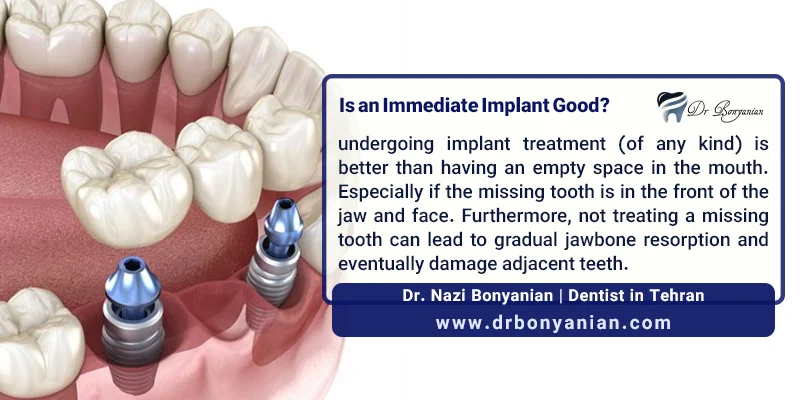
Naturally, undergoing implant treatment (of any kind) is better than having an empty space in the mouth. Especially if the missing tooth is in the front of the jaw and face. Furthermore, not treating a missing tooth can lead to gradual jawbone resorption and eventually damage adjacent teeth.
Of course, other treatment methods like using a dental bridge or denture exist. However, these methods are not pleasant for some individuals, as the prosthesis is not fixed in the mouth and might cause wear over the long term.
But another important point to note is that no one can definitively say whether immediate implants are better or worse than delayed implants. Just as mentioned in the article “Immediate implants following tooth extraction“:
Conclusions. There is not enough reliable evidence proving higher success of immediate implant placement over delayed placement. Post-extraction implants have survival rates similar to implants placed on healed sites.
Stages of Immediate Dental Implant Procedure
If an individual wishes to have immediate implant placement, they need to go through several stages. For example, they must obtain all necessary images for the procedure before starting the treatment process and schedule their appointment with the dentist.
Generally, the stages of immediate dental implant placement are as follows:
- Performing diagnostic tests, including imaging of the mouth and teeth.
- Scanning the teeth.
- Reviewing the scan by the dentist and planning for implant placement.
- Numbing the gum or administering anesthesia to the patient for the procedure.
- Extracting the previously damaged tooth.
- Placing the implant base into the jawbone.
- Installing a temporary crown on the base (if necessary).
Does an Immediate Implant Require Anesthesia?
Immediate implants do not require general anesthesia and can be performed under local anesthesia. Unless the person has a severe phobia of dentistry. In that case, the surgery should be performed in a specialized and equipped dental clinic or a hospital.
Immediate implant surgery under general anesthesia is rarely used and typically reserved for complex cases like extensive surgeries or placing multiple implants simultaneously (full mouth implants).
Suitable Age for Immediate Dental Implant Placement
The immediate dental implant surgery itself does not have stricter or greater age limitations compared to conventional (or delayed) implants. However, generally, the best age for implants is after the jawbone growth has completed, typically after 18 years old. This is because, in younger patients, continuous bone growth might lead to implant displacement or failure.
On the other hand, as long as the patient enjoys good general health and has sufficient bone density in the jaw, implants can be performed at any age.

What are the Benefits of Immediate Implants?
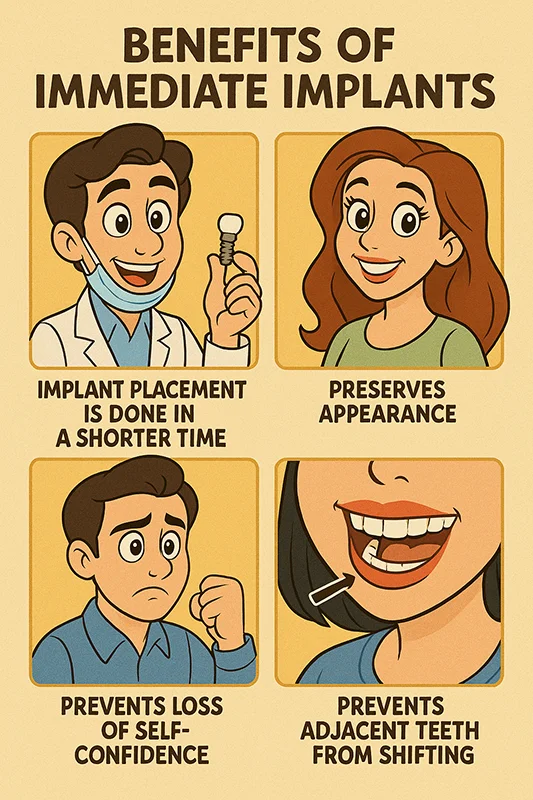
Installing and placing an immediate implant in the mouth offers various benefits for the individual. Below, we will introduce some of the top advantages of immediate dental implants:
- Implant placement is done in a shorter time: The conventional implant method is a multi-stage and lengthy process. But with this method, at least one session is eliminated from your treatment duration.
- Preserves appearance: Maintains the beauty of the teeth (in their previous shape or even more beautiful than before), avoids remaining scars, wounds, and stitch marks on the gum.
- Prevents loss of self-confidence: An empty tooth space leads to decreased self-confidence. But with the help of immediate dental implants, you won’t be toothless and will immediately have a new tooth after the extraction of the previous one.
- Prevents adjacent teeth from shifting: Immediate implants prevent the neighboring teeth from tilting.
Of course, these are not the only advantages of immediate dental implants. Other benefits of this type of implant include, in brief:
- Less invasive surgery and faster recovery
- Better gum adaptation to the crown
- No need for bone grafting in some cases
- Reduced number of visits to the clinic
Immediate Implant for Front Teeth
One of the major applications of immediate dental implants is their use for front teeth. Since losing front teeth can have a significant impact on facial aesthetics and speech, their rapid replacement immediately after tooth extraction and implant placement is crucial.
For example, at Dr. Bonianian Dental Clinic, we have often used the immediate implant method for front teeth for individuals who had lost one of their front jaw teeth and were facing an important event like a wedding or a crucial business meeting within a short timeframe.
Advantages of Immediate Implant for Front Teeth:
- Quick restoration of aesthetics
- Increased self-confidence
- Prevention of jawbone resorption
- Prevention of adjacent teeth shifting towards the created gap
- Prevention of gum recession and infection
Immediate Implant with Laser
Regarding immediate implants with laser, we must say that the primary application of laser in dentistry is for cutting the gum or the area targeted by the dentist. In the immediate implant method with laser, the dentist can use the laser to incise the patient’s gum with the utmost precision and minimal pain and bleeding.
However, since laser (despite its high precision) carries potential unwanted side effects, many specialists in this field do not recommend its use to their patients. Although, if the patient insists on using laser, there is no obstacle to doing so.
Duration of Immediate Implant Treatment
The exact duration of immediate implant treatment depends on various factors. For example, the condition of your jawbone. Because if your jawbone lacks sufficient density to support the implant fixture, you will naturally undergo bone grafting surgery, healing, and recovery period, and finally, the implant base placement surgery again. So, this factor alone will add 4 to 6 months to your treatment timeline.
The next influential factor is the type and brand of the dental implant. You might find it interesting that some dental implant brands show special capabilities in fusing with the jawbone through blood integration. This is because their structure allows for better compatibility with the jawbone. Consequently, the duration of your dental treatment in the immediate implant method will also depend heavily on the type of dental implant used.
Considering all these factors, if everything proceeds smoothly, and no issues like implant base failure or fracture occur along the way, you can benefit from your immediate dental implant after about 4 to 6 months.
What is a Temporary Implant?
The term “temporary implant” is not scientifically or technically correct. Because there is no such thing as a temporary implant in the true sense. Dental implants are metal posts (usually made of titanium) that are permanently placed in the jawbone to replace the tooth root.
What is sometimes mistakenly called a “temporary implant” are actually temporary prostheses or temporary crowns that are installed on the implant until the final crown is ready.
Therefore, it should be noted that the implant base is always a permanent structure, and using the term “temporary” for it is incorrect and misleading.
What are the Disadvantages and Complications of Immediate Implants?
No surgical or non-surgical method in the medical world is without complications and disadvantages. Immediate dental implants are no exception. We can mention the following complications of dental implants:
- Loosening of the dental implant
- Infection of the immediate dental implant
- Dietary restrictions
- Failure to fuse with the jawbone and loss of the implant
- Developing peri-implantitis
- Increased likelihood of pain and nerve damage
- Not suitable for full-mouth implants.
Why is the Probability of Complications Higher in Immediate Dental Implants?
Immediate dental implants carry a higher risk of complications compared to conventional implants. This is because, in this method, the implant base is placed immediately after tooth extraction in the created socket. Therefore, the jawbone might have less time to heal.
Furthermore, this can significantly increase the risk of implant infection and infection in the area of the extracted tooth. Because usually, the tooth that the dentist has to extract has already been significantly affected by infection.
Also, for immediate implant placement, the person needs to have good bone density. Therefore, considering the tooth extraction in the same session and on the same day, the jawbone might not have the high quality and expected standard, consequently leading to complications for the immediate implant.
Considering all these points, we can conclude that immediate dental implants, compared to methods like two-stage dental implants (which are usually recommended by dentists), carry higher risks and complications for the individual.
Who Should Not Use Immediate Implants?
It’s true that dental implant placement is one of the most advanced methods for replacing lost teeth. However, this method is not suitable for everyone.
When we asked Dr. Bonianian about this topic, we received this answer:
There are many individuals who are genuinely not suitable candidates for dental implant surgery. For example, people with a history of systemic diseases, individuals addicted to smoking and other types of tobacco, those with insufficient bone density, and those suffering from gum disease.
These groups include individuals with uncontrolled systemic diseases, people addicted to smoking and various other tobacco products, those with insufficient bone density, and those suffering from gum disease.
Specific Contraindications for Immediate Implants:
- Individuals with Uncontrolled Systemic Diseases:
Diseases such as uncontrolled diabetes, autoimmune diseases, or blood disorders are all conditions that can hinder your healing process after dental implant surgery.
The experience of dentists at our dental clinic shows that wounds and injuries in patients with weakened immune systems usually heal later and slower than in healthy individuals. Thus, this can directly increase the risk of infection or implant failure. - Smokers:
Heavy smoking negatively impacts the wound healing process because nicotine reduces blood flow, hindering proper bone formation around the implant.
Sometimes, smokers are not suitable candidates even for conventional, two-stage implant surgery, let alone immediate implant surgery! Therefore, smokers must either quit smoking before implant placement or minimize its consumption starting one month before surgery and completely cease it three days prior to surgery. - Individuals with Gum Disease:
Gum diseases like periodontitis are conditions that can jeopardize the health of the bone and tissue surrounding your dental implant. Therefore, those suffering from severe gum infections must first treat their disease and then proceed with implant placement. - Those with Insufficient Bone Density:
Implants need strong, dense jawbone to become firm and secure in place. Therefore, individuals lacking sufficient density due to bone resorption might require bone grafting surgery. In such circumstances, immediate implants are not a suitable option for the individual at all. - Individuals with Unsuitable Dental Habits (Bruxism):
Those with destructive habits like bruxism (teeth grinding) exert excessive pressure on their implants. This pressure can lead to premature implant failure or misalignment.
In the case of immediate implants, this constant pressure can disrupt the osseointegration process and lead to failure. Unlike conventional implants which have more time for stabilization and fusion, immediate implants require initial stability, which this extra pressure can compromise. Therefore, this dental habit must be corrected before proceeding with immediate implants, or alternative methods for replacing lost teeth should be used. - Individuals Under Treatment with Specific Medications:
Medications like bisphosphonates, used to treat osteoporosis, can negatively affect the bone healing process in the body.
Additionally, individuals undergoing chemotherapy or radiotherapy in the head and neck region are also not considered suitable candidates for immediate implants.

What is the Difference Between Immediate and Conventional Implants?
Generally, we can highlight the following points regarding the difference between immediate and conventional implants:
- Achieving a natural-looking tooth is faster with the immediate implant method.
- The probability of infection and gum damage is higher with immediate implants.
- The success rate of implant surgery is lower for immediate implants compared to conventional implants.
- The cost of dental implant placement is higher for immediate implants than for conventional implants.
- You can implant multiple teeth using the conventional implant method, whereas immediate implants are only suitable for one or two teeth.
- Although more people seek immediate implants, only 5% of them meet the criteria for this placement method. In contrast, conventional implants are feasible for almost everyone.
Regarding how long dental implants take, we should mention that the stages of conventional implant placement can engage a person for 3 months to a year. Whereas, in immediate implant placement, this treatment period can sometimes be completed in less than 24 hours [Note: This seems contradictory to the 4-6 month osseointegration mentioned earlier; translating as written but retaining the earlier clarification in mind].
Immediate vs. Conventional Implants at a Glance
| Feature | Conventional Implant | Immediate Implant |
|---|---|---|
| Implant Placement Time | Weeks to months after extraction | Immediately after extraction |
| Overall Treatment Duration | Longer (3-9 months or more) | Shorter (can be faster, but osseointegration still takes months) |
| Need for Second Surgery | Usually two-stage | Often single-stage |
| Initial Stability Requirement | Can be placed in less dense bone with preparation | Requires good bone density and suitable conditions |
| Success Rate | Generally very high | Slightly lower in specific conditions |
| Aesthetics (During Healing) | Potential gap or temporary device | Immediate, suitable for aesthetic emergencies |
| Cost | Standard implant cost | Potentially slightly higher |
| Suitable For Whom? | Most people, even with weaker bone (needs grafting) | Healthy individuals with suitable bone and urgent needs |
Cost of Immediate Dental Implants
In the immediate dental implant method, everything is done in one session. Therefore, this requires high expertise, experience, and skill from the dentist. As a result, the cost of immediate dental implants is higher than conventional and long-term options.
You can read about the tariffs and cost of immediate dental implants in the article on immediate implant costs. This article defines all the tariffs related to this dental procedure.
Probability of Treatment Failure for Immediate Implants
The probability of failure for immediate dental implant placement exists for some individuals. For this reason, specialist dentists prohibit certain individuals from undergoing this type of treatment. For example, individuals with insufficient bone density, poor gum quality, users of high doses of cigarettes and other tobacco products, patients with uncontrolled diabetes, osteoporosis patients, patients with immune system deficiencies, those taking specific medications, and also those undergoing chemotherapy and radiation therapy are prevented from getting immediate implants. We suggest you read the article Who Should Not Get Implants?
Care for Immediate Dental Implants
Care for immediate dental implants includes the following:
- The dental crown that will be with you for up to three months is a temporary crown. Avoid chewing hard and sticky foods with this crown.
- Absolutely refrain from using any type of tobacco (cigarettes, hookah, etc.). At least until the end of three months and the placement of the permanent crown.
- Avoid consuming foods at very high or very low temperatures.
- In the initial days after surgery, apply an ice pack to your face.
- Maintain oral and dental hygiene meticulously. (Use a special implant toothbrush and also dental floss).
- Minimize the consumption of sugary foods.
- It is better to keep your head elevated higher than your body during sleep in the first 3-4 days to reduce blood flow to the surgical site and stop bleeding.
Longevity and Lifespan of Immediate Implants
The durability and lifespan of immediate implants depend on several factors, including:
- Implant and Prosthesis Quality: Using reputable implant brands and high-quality prostheses plays a very important role in increasing the lifespan of the implant.
- Dentist’s Skill and Experience: Choosing an experienced and specialized dentist in the field of immediate implants is one of the most effective factors in the success and longevity of immediate implants.
- Post-Placement Care: Strict adherence to instructions and post-placement care for immediate dental implants (such as oral hygiene, suitable diet, and regular dental check-ups) plays a crucial role in maintaining health and increasing the lifespan of immediate implants.
- Patient’s Health Condition: Patients with certain diseases like diabetes, osteoporosis, or smokers are at higher risk of losing their implants compared to others.
However, generally, it can be said that immediate implants, in terms of lifespan, are not different from other dental implant methods. If you ask Are implants lifelong?, we must say that immediate implants, if reputable brands are used and post-care instructions are followed, can last for decades, and even a lifetime, in your mouth.
Performing Immediate Implant Surgery at Dr. Bonianian Dental Clinic
If you have lost one of your front teeth, or need to extract one of the front teeth of your jaw (or even back teeth), you can benefit from a free consultation and immediate dental implant services provided by the specialists at Dr. Bonianian Dental Clinic.
Since immediate implant surgery requires significant sensitivity and precision, you can confidently benefit from the immediate dental implant services at Dr. Bonianian Dental Clinic. This clinic, as one of the best dental clinics in Tehran, utilizing up-to-date equipment and experienced specialists, is ready to provide dental implant services to Tehran residents.
Immediate Implants in Tehran
If you reside in Tehran and are looking for a center to receive immediate dental implant services, you can visit Dr. Bonianian Dental Clinic, located at Unit 7, No. 22, West 6th Street, Ahmad Qasir (Bokharest) Street, Arjantin Square, Tehran.
This dental complex, with the presence of top dentists and dental surgeons from all over Tehran, can perform this procedure for you in the best possible way and with minimal pain and bleeding.
In addition, Dr. Bonianian’s complex offers various other services, including cosmetic dentistry, restorative treatments, root canal therapy, gum disease treatment, pediatric dentistry, implants, orthodontics, etc., to you dear clients.
So, if you need to book an appointment, please call 021-88539720 or enter your information in the field below. Our experts will contact you at the earliest opportunity to reserve your appointment.
3 Days to the Conference, a Broken Tooth, and an Immediate Solution
A few months ago, a young, well-spoken gentleman, who was scheduled to be the main speaker at an international scientific seminar, walked into our clinic with anxiety and worry. Only three days remained until the conference, and his front tooth had broken in a minor accident. He was concerned about his smile’s appearance and his confidence on stage.
After a careful examination of the bone condition and oral health, we decided to use an immediate implant. Immediately after extracting the damaged root, the implant was placed in the jawbone during the same session, and a beautiful, natural-looking temporary crown was designed and fitted for him – without pain, significant swelling, and perfectly harmonizing with his smile.
On the day of the seminar, he delivered his speech with full confidence; he later told us that nobody even noticed the change in his tooth.
This experience clearly shows that if the jaw conditions and the patient’s general health are suitable, performing immediate implants at Dr. Bonianian Dental Clinic can be a lifesaver in critical moments of life.
Final Summary
Immediate dental implants are the best tooth replacement method for individuals who have lost a tooth in the front of their mouth or need to extract one of their front teeth. Immediate implants for front teeth restore the appearance of a natural tooth in the shortest possible time and save you from the social difficulties arising from being toothless.

Dr. Nazi Bonyanian
Dental Surgeon (DDS) — Medical Council Number: 138662
Graduate of Isfahan University of Medical Sciences with over 15 years of experience in implants, laminates, and oral and dental surgery.
Address: No. 22, Unit 7, West Alley 6, Bokharest Street, Argentina Sq., Tehran, Iran
Phone: +98-21-88539720 | WhatsApp: +98-912-514-2202
Email: info@drbonyanian.com
Working Hours: Sat–Wed 09:00–20:00 | Thu 09:00–14:00 | Friday Closed
⚠️ اطلاعات این صفحه صرفاً برای آگاهی است و جایگزین معاینه و تشخیص تخصصی نمیباشد.
