



What is a Dental Implant Fixture? – One of the parts of an implant and an artificial piece made of titanium or Roxolid
that will serve as the base and pillar of your dental implant.
Types of dental fixtures based on their thread model:
- Square
- Conical
- Buttress
- Reverse Buttress
If you have decided to replace your missing tooth using the implant method, it’s a good idea to become a bit more familiar with the structure of the implant and its constituent components. For this reason, specialists at Dr. Bonianian’s dental clinic will familiarize you so you know what an implant fixture is and what types it has. Continue with us, the fixture is the main part of the dental implant.
What is an Implant Fixture?
An implant fixture is a cylindrical piece that is implanted into the jawbone. This piece plays a role similar to the root of a tooth for the implant and acts as a base for connecting the dental crown prosthesis. In essence, the task of bearing the chewing force and supporting other implant equipment is the responsibility of this very fixture.
The image below, in addition to showing all parts of the dental implant, will also show you the fixture and its application:
What is an implant fixture?
An implant fixture is the part of a dental implant that is surgically inserted into the jawbone, serving as an artificial root for a missing tooth. Made from biocompatible materials like titanium, it fuses with the bone through a process called osseointegration, creating a stable foundation for the abutment and crown that complete the tooth replacement.

What is the function of a fixture?
The fixture plays a very important role in dental implants. This small metal piece, usually made of titanium or Roxolid, acts as the tooth root and is implanted into the jawbone to create a strong connection with the jawbone, providing a solid base for the dental crown or artificial tooth.
After the fixture is implanted and fuses with the bone, the dentist places the dental crown on it to give it a natural appearance and function similar to a natural tooth. So, in simpler terms, the fixture acts as the main base and pillar of the dental implant and ensures its strength and durability.
Material of Implant Fixture
Companies manufacturing implant fixtures usually produce this piece from one of two types of metal: titanium or zirconium. Each of these two metal types also has specific features that make the fixture more compatible for individuals with particular conditions and a specific type of implant.
For example, titanium fixtures are the most common type of implant fixture, which are highly biocompatible with the body. For this reason, the probability of implant rejection or infection with this type of fixture is minimized.
In contrast, zirconium fixtures also have very good features. For example, they have a more ideal appearance than zirconium fixtures. Their strength is very high, and due to their lack of electrical conductivity, they reduce the chance of experiencing a metallic taste in the mouth.
However, the decision regarding the best type of fixture and its use depends on the specialist dentist. Because your implant specialist can, by thoroughly and accurately examining your dental conditions, choose the most suitable type of fixture for you.
Types of Dental Implant Fixtures
Different brands manufacturing dental implants and fixtures produce this piece in various types in terms of screw shape, material, and length. However, dental implant fixtures are usually classified based on their thread shape.
A thread is a helical groove that prominently winds around a cylinder (like a screw or pipe). Threads can be inside a piece like a nut or outside it like a screw.
Types of implant fixtures based on their thread model:
Fixtures are generally divided into 4 categories based on thread shape:
- Square
- Conical
- Buttress
- Reverse Buttress

Square Fixture
This type of thread has a larger contact surface with the jawbone. This shape of the fixture increases the initial stability of the implant and is suitable for soft or weak bones. Dentists usually use square fixtures for those who have low bone density.
Conical Fixture
Another type of implant fixture is conical fixtures, which have an appearance similar to a tapered screw. These threads, due to their conical shape, help to compact the jawbone during placement. Conical threads are suitable for immediate dental implants or implants placed in areas with bone deficiency.
Buttress Fixture
This type of thread has grooves or threads at the end of the implant body that help increase the contact surface with the jawbone and the stability of the implant. These threads are longer on one side of the implant than the other, and this very feature can increase the tolerance of vertical loads.
Reverse Buttress Fixture
The reverse buttress fixture is another type of dental implant fixture that has a shape similar to the buttress thread, with the difference that the grooves are exactly in the opposite direction of the buttress thread.
Implant Fixture Screw
The fixture screw is the beating heart and most important part of the dental implant. This screw is usually made of titanium and acts as the artificial root of your new tooth. The dentist places this screw in the jawbone and gives the jawbone time to accept it (and become part of itself).
After the fixture fuses with the bone, which takes about 4 to 6 months, the dental crown is placed on it and gives a completely natural appearance to your teeth.
Application of Implant Fixture
The main application of an implant fixture is to replace the lost tooth root and create a solid base for connecting the dental prosthesis. The implant fixture is placed inside the dental socket that has been lost and inside the jawbone, and over time, it fuses with the jawbone. This causes the dental prosthesis to be firmly and stably placed in its place and prevents it from becoming loose or falling out.
Fixture installation is the first stage of the dental implant process. If the socket resulting from tooth loss is suitable for fixture installation, the fixture is placed inside that socket. However, if there is no suitable socket, the dentist, using a special dental drill, creates a socket inside the jawbone and places the fixture inside it.
Time Required for Fixture to Fuse with Bone
The time required for the fixture to fuse with the jawbone varies between 4 to 6 months. This time depends on various factors, including the following:
- Quality and density of the jawbone: In bones with high density, fixture fusion occurs faster.
- Type of fixture: Fixtures with a larger contact surface with the jawbone fuse faster.
- Dentist’s skill and experience: The dentist’s skill and experience in fixture implantation play an important role in this speed.
- Patient care: Adherence to oral and dental hygiene and avoiding smoking help speed up the fusion process of the fixture.
At Dr. Bonianian’s dental clinic, we guide you to have a strong and durable implant.
Method and Stages of Implant Fixture Placement
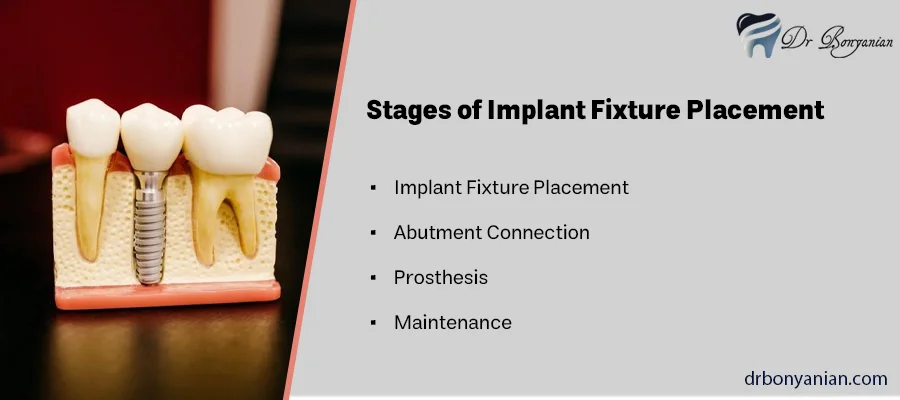
Stage One: Implant Fixture Placement
The first stage in implant placement involves placing the fixtures or small screw-like implants that can be your new tooth roots. After the precise placement of the implant inside the bone, the gum tissue is placed over the implant.
This procedure is performed under local anesthesia and is generally not painful. However, naturally, when the numbness wears off after about three to four hours, you may experience some swelling and discomfort.
Stage Two: Abutment Connection
Once the osseo-integration is complete and the dental implants are firmly attached to the bone to support the new prosthesis (3-6 months), the implant cover is removed in a secondary surgery.
Now the abutment is connected to the implant. The abutment passes through the soft gum tissue and acts as an extension to which the tooth or group of teeth will be attached. Of course, sometimes (single-stage implant) by placing the restorative abutment on the fixture at the time of placement of this piece, this stage is not performed.
Stage Three: Prosthesis
This stage generally involves several visits to the dental office. During these visits, you can talk to your dentist about the appearance and feel you want for your new tooth or teeth.
Impressions are taken of the abutments and your remaining teeth. This enables the dentist to effectively determine the exact position of the tooth or teeth, which will not only be aesthetically pleasing but also exactly like your natural teeth.
Within 2-3 weeks, you should have a new tooth or group of teeth and a completely new natural smile to be proud of!
Stage Four: Maintenance
Just as your natural teeth need regular check-ups and maintenance, you must take care of your new dental implant. Do not forget proper home care along with regular visits to the dentist and dental hygienist, as it is effective for its longevity and durability. Care for dental implants.
Caring for Dental Implant Fixture
If you want to have a strong and completely natural implant, you must take care of your fixture. Especially since in a two-stage dental implant surgery, the fixture remains in your mouth for about 4 to 6 months without any protection.
For this reason, it is better to try to increase the durability and lifespan of the dental implant by observing all care and hygiene tips.
Care for dental implant fixtures is divided into two categories: care in the first 24 hours and care after that. For example, in the first 24 hours after fixture placement, it is better to observe the following points:
- To prevent fixture infection, it is necessary to take medications: Fully consume the antibiotics prescribed by the doctor.
- Absolutely no smoking or consumption of alcoholic beverages is allowed in the first 24 hours: No smoking and alcohol consumption after fixture placement.
- To reduce pain and swelling, use an ice pack: Use an ice pack.
- In the first 24 hours after implant fixture placement, avoid consuming hard and chewy foods: Consume soft foods.
Necessary care after the first 24 hours:
- Using a toothbrush and dental floss to prevent plaque buildup and infection is essential: Adhering to oral and dental hygiene is necessary.
- Using antiseptic mouthwashes helps to clean the mouth and teeth and prevent fixture infection.
- It is necessary to regularly visit the dentist for examination and checking the condition of your fixture: Visit the dentist.
- Avoid chewing hard and tough foods with your fixture tooth: Avoid excessive pressure.
Do not forget that if you observe symptoms such as severe pain, swelling, bleeding, or loosening of the fixture, you should immediately consult a dentist.
Complications of Not Caring for Implant Fixture
Not caring for an implant fixture can lead to unpleasant consequences. Some of these complications include:

Implant Infection
When a person does not take adequate care of their implant fixture, bacteria find the opportunity to accumulate and penetrate around the implant. This bacterial accumulation leads to inflammation and infection in the tissues around the implant, which is called peri-implantitis.
Implant fixture infection can cause pain, swelling, gum redness, pus discharge, and even bad breath. Furthermore, if this infection is not treated, it can lead to bone loss around the implant and ultimately, loosening and loss of the implant.
Therefore, strict adherence to oral and dental hygiene and regular visits to the dentist for professional implant cleaning and examination are of utmost importance in preventing infection and maintaining the health of the implant fixture.
Jawbone Resorption
Another of the most important consequences of not properly caring for an implant fixture is jawbone resorption. This happens when the patient does not observe good oral and dental hygiene or due to gum disease, infection occurs around the implant.
In these conditions, the bones around the implant gradually resorb, and as a result, the stability of the implant decreases. This issue can lead to loosening of the implant, its failure, and ultimately the need for more complex treatments and additional costs. Therefore, strict adherence to the doctor’s instructions and post-implant care are highly important for maintaining the health and longevity of the implant.
Breaking and Loosening of the Implant
As you know, implant fixtures act as a replacement for the tooth root and require healthy and stable jawbone for their success.
So, in case of not observing oral and dental hygiene and the occurrence of infection, the bone around the implant may resorb and weaken. Then, this bone resorption causes a decrease in implant stability and makes it prone to fracture. To the extent that even applying normal and conventional pressures such as chewing a simple snack can cause that fixture to break.
Treatment Failure
Another of the most important complications of insufficient care for the implant fixture is “treatment failure” or, in other words, implant loss. That is, a combination of all factors that can lead to the failure of your dental implant treatment. Factors such as fixture fracture, its loosening, and even jawbone resorption.
Bad Breath
Many people who do not take good care of their dental implant fixture (in the interval between the first and second stages of implant surgery) complain of bad breath.
It is natural that not observing hygiene principles, especially when a foreign body is placed in your mouth, makes your mouth prone to bad breath.
So if you don’t want to have bad-smelling breath (that drives everyone away from you and those around you!), you should, with high precision, observe oral and dental hygiene, especially in the areas around your dental implant.
Gum Bleeding
When a person does not observe good oral and dental hygiene, their gums become inflamed. This gum inflammation then causes the loosening of the supporting tissues around the implant fixture, and as a result, the small blood vessels in this area of the implant are damaged.
Since damage to these blood vessels leads to gum bleeding, you should, after observing any bleeding from the gums after implant placement, consider this issue as a warning sign and immediately consult your dentist for gum treatment.
Feeling Pain and Discomfort
The last complication that arises for individuals due to improper care of the implant fixture is the occurrence of pain and discomfort, which is, of course, not a minor complication.
If you don’t want to endure dental implant pain, it’s better to treat your fixture well from the beginning and take proper care of it.
Choosing a Suitable Implant Fixture
Based on the explanations of Dr. Nazy Bonianian:
Choosing a suitable implant fixture is one of the most important stages in the success of dental implant treatment. This choice should be based on various factors such as the amount and quality of jawbone, the position of the lost tooth, the patient’s overall oral condition, and even their general health status.
The size, length, diameter, and surface type of the fixture (such as surface coating or threads) should be such that they have the maximum compatibility with the patient’s bone condition and provide the best initial stability.
Ultimately, choosing a reputable brand and a reliable implant system can play an effective role in the long-term success of the treatment.
Brands and Countries Manufacturing Implant Fixtures
Brands and countries manufacturing implant fixtures play an important role in the quality, durability, and success of implant treatment.
Today, various countries such as Germany, Switzerland, the USA, South Korea, and Sweden are among the pioneers in producing dental implant systems. Reputable brands such as Straumann (Switzerland), Nobel Biocare (Sweden-USA), Zimmer Biomet (USA), and Osstem or DIO (South Korea), due to high manufacturing quality, advanced research and development, and successful clinical results, have great popularity among dentists.
Korean Implant Fixture
Korean brands are widely used in many countries, especially due to their reasonable price and acceptable quality. Choosing the best Korean implant brand should be done considering the patient’s clinical condition, budget, and specialist’s experience.

Swiss Implant Fixture
Swiss implant fixtures are considered one of the most reputable and high-quality options in the dental implant market. Switzerland, hosting leading implant technology brands such as Straumann, and with extensive clinical research, is recognized globally for its high precision in design, use of advanced SPI alloys (like Roxolid).
Swiss fixtures, usually with advanced technologies such as rough surfaces like SLA or SLActive, which cause an increase in the speed and quality of osseointegration (fusion with bone), are offered.
Although the cost of Swiss implants is higher than some other brands, their high quality, durability, and successful treatment history justify this cost.
Iranian Fixtures
Iranian fixtures have been able to find an acceptable position in the domestic market in recent years with advancements in design and production. These fixtures are manufactured by modeling reputable foreign brands and are more affordable in terms of price compared to foreign samples.
Some Iranian brands such as BM and (Parsayan) TBR have been able to offer products with suitable quality and competitiveness in the Iranian market, especially for patients looking for more economical options.
However, many specialists still prefer to use well-known foreign brands in more sensitive cases or for assurance of long-term durability. Nevertheless, Iranian fixtures, if used correctly and observing surgical and prosthetic principles, can have acceptable performance.
Implant Fixture Placement at Dr. Bonianian Dental Clinic
At Dr. Bonianian Dental Clinic, we perform implant fixture placement using the most up-to-date technologies and globally reputable brands to provide you with the highest success rate and durability.
By accurately assessing each patient’s bone condition and general health, we offer the best treatment plan and are by your side at all stages. If you are looking for a reliable and professional treatment, from initial consultation to the installation of the dental implant crown for replacing a lost tooth, contact us today and book your specialized consultation appointment.
Fixture Failure Before Crown Installation with Successful Rescue at Dr. Bonianian Clinic
In a recent visit to Dr. Bonianian’s clinic, a 45-year-old patient with a history of implant surgery in the lower jaw premolar area came for the final stage of treatment (i.e., crown installation). The patient showed no apparent signs of discomfort, but a pre-prosthetic radiographic examination revealed that the fixture was not fully integrated with the bone and even had a micro-crack in its body.
Given the time elapsed since surgery (about 4 months), complete osseointegration was expected, but further investigation showed that the patient had applied excessive pressure to the implant area in the initial weeks after surgery and had not followed dietary recommendations.
The treatment team decided to completely remove the damaged fixture. This was done with minimal invasion and using specialized tools. The interesting point is that after removal, the bone condition was relatively good, and with a little preparation, re-implantation was possible.
After full consultation with the patient, a new fixture from a Swiss brand with a more suitable length and diameter was placed in the same area. This time, the patient carefully followed post-operative care instructions, and after 3 months, the final crown was successfully installed.
Fixture Coming Out
Loosening, dislodging, and coming out of the fixture is a serious problem that can occur for various reasons. Reasons include pressure applied to the fixture or a sudden blow. Even issues like improper placement (in the wrong spot) by the dentist and post-surgical infection are among the reasons that can cause the implant fixture to come out from its intended location. (Refer to the article “Why is my dental implant loose?“).
If you notice that your fixture has loosened or come out completely, contact your dentist immediately. The dentist, by carefully examining the fixture and your mouth, will diagnose the main cause of the problem and start the best treatment for you.
Note that if the fixture has completely come out of your mouth, you should take it with you to the dentist. This helps the dentist to better diagnose the cause of the problem. Of course, you must be careful that the fixture does not get contaminated.
Finally, if the time between the fixture falling out or coming out from inside your mouth and your dental appointment is long, try to avoid irritating the affected area with your hand or tongue, and applying pressure to it during this interval.
Fixture and Implant Cap Falling Out
Another piece, the abutment, is placed on the fixture. If by implant cap you mean the abutment, then a relatively severe blow has likely been applied to your dental implant. So, in case of this incident, quickly consult a dentist.

Implant Fixture Price
The fixture is sold as part of the dental implant requisites. Therefore, to check the fixture price, you should study the dental implant price content. However, note that the price of all these types of pieces is determined according to their brand and quality. For this reason, the prices of different dental centers may vary.
Dr. Bonianian Dental Clinic, with the presence of the best implant specialist, is ready to provide services in this field to you dear ones, so that the best type of fixture suitable for your condition is chosen for you.
If you need further consultation, please call 00982188539720 or visit our clinic located at: Tehran, Arjantin Square, Ahmad Qasir (Bokharest) St., Sixth St. West, No. 22, Unit 7.
You can also get a free consultation and more information in this regard by filling out the form below.
Buying an Implant Fixture
You do not need to buy a dental implant fixture for yourself. Rather, the purchase of this piece is the responsibility of the dentist to whom you have referred for this procedure. However, to buy a dental implant fixture, you should seek help from online medical equipment sales websites or physical dental equipment stores.
Final Summary
The dentist who is going to perform the implant procedure for you will definitely, after a complete examination of your mouth and teeth, suggest the best type of fixture in terms of material and model. However, it is not bad for you to gain more information about this piece by studying this article.

Dr. Nazi Bonyanian
Dental Surgeon (DDS) — Medical Council Number: 138662
Graduate of Isfahan University of Medical Sciences with over 15 years of experience in implants, laminates, and oral and dental surgery.
Address: No. 22, Unit 7, West Alley 6, Bokharest Street, Argentina Sq., Tehran, Iran
Phone: +98-21-88539720 | WhatsApp: +98-912-514-2202
Email: info@drbonyanian.com
Working Hours: Sat–Wed 09:00–20:00 | Thu 09:00–14:00 | Friday Closed
⚠️ اطلاعات این صفحه صرفاً برای آگاهی است و جایگزین معاینه و تشخیص تخصصی نمیباشد.
