



Reasons for an Infected Dental Crown
- Decay under the crown
- Residual infection after root canal therapy
- Leaking crown
- Cracked or fractured crown
- Teeth grinding (Bruxism)
- Gum inflammation or disease
- Poor oral hygiene
- Root reinfection
What is an Infected Dental Crown?
Generally, a tooth infection occurs when bacteria penetrate the tooth’s root (pulp) and cause inflammation and infection. This painful condition, if left untreated, will lead to more serious problems like a tooth abscess or an increased risk of the infection spreading to adjacent teeth.
However, a tooth that has been crowned is usually one that has previously undergone root canal therapy. This means there is no root or nerve left in that tooth to become infected and inflamed! So, what’s the problem?
Causes of an Infected Dental Crown
An infection under a dental crown can have various causes. In this section, we will explore the reasons for infection in a crowned tooth.
1. Infection in Other Areas
The infection may have originated from inflammation and bacterial accumulation in the root of an adjacent tooth, the gums, or any remaining healthy pulp in the tooth in question. It’s even possible that your tooth has an extra, hidden root that was missed by the dentist.
2. Root Canal Failure
Root canal therapy, also known as endodontic treatment, is a procedure aimed at removing the infected nerve and pulp of a tooth. After a root canal, a crown is usually placed on the tooth to protect it and restore its appearance.
However, in some cases, the root canal may fail, and the tooth can become reinfected. This is known as root canal failure and reinfection of a crowned tooth.

Lingering infection, hidden roots, complex tooth anatomy, a cracked or fractured crown, and gum disease are all reasons that can lead to the failure of root canal therapy on your teeth.
Read more: Cost of Root Canal Therapy
3. Dentist’s Inexperience in Completing Treatment
The most crucial task for a dentist during a root canal is to thoroughly clean the root canals of infection. If the dentist cannot access all the canals or fails to clean them completely, it can inadvertently lead to bacteria remaining in the canal and, ultimately, reinfection of the tooth.
Of course, this isn’t the only stage where a dentist might unintentionally contribute to the reinfection of your tooth!
After cleaning the root canals, the dentist must fill (or restore) your tooth. This involves placing and compacting a filling material (like amalgam or composite) into the cavity and empty space of the tooth roots to prevent contaminants from entering. Naturally, if the filling process is not done correctly, it can create spaces for bacteria to grow. We suggest you also read the article on the advantages of filling teeth with composite.
Incomplete filling can result from using inappropriate materials, not filling the canals completely, or failing to create a proper seal at the canal entrance. Therefore, if you reside in Tehran, we recommend you visit the best root canal specialist in Tehran for your treatment.

4. Improper Crown Fit
Sometimes, the cause of infection in your crowned tooth might be a mismatch between the crown and its adjacent teeth. This unbalanced state can create a gap or space between the two teeth, and this gap, in turn, becomes a pathway for food debris to penetrate under the crown.
Of course, most dentists carefully check the crown after placement and even ask you to bite down to assess the crown relative to your other teeth.
However, such problems are not entirely unexpected.
Read more: Dental Crown with Pin Falling Off

5. The Tooth Did Not Undergo Root Canal Therapy!
It is possible that your tooth was never treated with a root canal! You might have simply had the tooth crowned (due to issues like chipping, improper shape, or discoloration). In this case, the exact cause of the infection is clear: your tooth still has a nerve, and bacteria have somehow reached it!
Infection in a Crowned Tooth After Several Years
If a tooth you had treated and crowned years ago becomes infected, there could be several common reasons. One common cause is bacteria remaining in the root canal after the initial root canal therapy, which multiply over time and cause an infection. Another likely reason is if the crown was not seated properly or developed a leak over time, increasing the chance of bacteria penetrating the tooth.
The crown itself cracking or breaking can also create an entry point for microbes. Signs of infection can include persistent or throbbing pain, sensitivity to heat and cold, swollen gums, bad breath, pus discharge from around the tooth, and in some cases, the formation of an abscess.
If you observe these symptoms, you should visit a dentist quickly to prevent the infection from spreading and causing further damage to the tooth and jawbone.
Read more: Pills for Toothache

Is a Bad Smell from a Crowned Tooth a Sign of Infection? | How to Eliminate Bad Smell from a Crowned Tooth
A bad smell from a crowned tooth can be one of the signs of infection, although it doesn’t always mean the tooth is infected. For instance, if bacteria and food particles accumulate under or around the crown, they can cause an unpleasant odor. This problem might be due to a leaking crown, decay underneath it, gum inflammation, a root infection, or even poor oral hygiene.
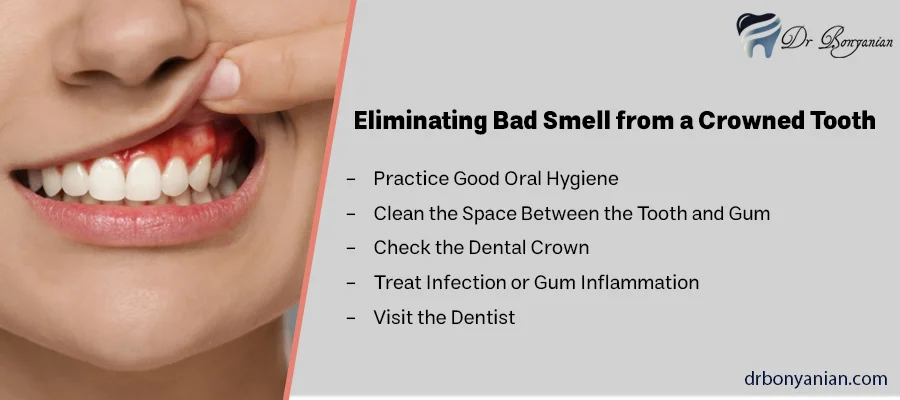
Eliminating Bad Smell from a Crowned Tooth
- Practice Good Oral Hygiene: Regular brushing, using floss specifically designed for crowned teeth, and rinsing with an antibacterial mouthwash help prevent bacterial buildup.
- Clean the Space Between the Tooth and Gum: Using a water flosser or interdental brushes can remove remaining food particles and bacteria.
- Check the Dental Crown: If the crown is leaking, cracked, or loose, it may need to be replaced.
- Treat Infection or Gum Inflammation: If the problem is due to inflammation or infection, the dentist may prescribe antibiotics or perform necessary treatments like scaling and root planing or root canal therapy.
- Visit the Dentist: If the bad smell persists, it is best to see a dentist for a thorough examination and to prevent more serious problems.
Preventing Infection in a Crowned Tooth
As they always say, prevention is better than cure! So, it’s much better to prevent an infection in a crowned tooth before it happens. For example, you can take the following steps to prevent this issue:
- Maintain regular oral hygiene. This means brushing, flossing, and using mouthwash (as directed by your dentist).
- Visit your dentist every six months for a check-up of your teeth and crowns.
- Avoid eating hard foods to prevent your crown from breaking.
- Avoid acidic and sour foods that can cause decay around your crown.
- Refrain from smoking.

How to Tell if a Crowned Tooth is Infected?
Now we know the reasons for infection under a dental crown, but how can we tell if a crowned tooth is infected? The symptoms of an infected crowned tooth include:
- Tooth pain (severe, throbbing, sharp, or inflammatory)
- Sensitivity to heat and cold
- An unpleasant taste in the mouth
- Swelling and redness of the gums
- Pus discharge from around the crown
- Bad breath
- Difficulty chewing and pain when biting
- Fever (in case of severe infection)
Read more: Price of Ceramic Dental Crowns
Can Teeth Grinding (Bruxism) Cause Infection in a Crowned Tooth?
If a person grinds their teeth (bruxism), a lot of pressure is put on their teeth. This pressure can, over time, cause the dental crown to crack or become loose. Consequently, these cracks or leaks allow bacteria to penetrate under the crown, leading to decay and infection of the underlying tooth.
Furthermore, constant pressure on crowned teeth may damage the tooth root and even lead to gum inflammation or recession, which increases the risk of infection. In such situations, the individual may experience pain, sensitivity, and bad breath. Therefore, using a night guard during sleep and regular visits to the dentist to check the condition of the teeth are essential to prevent these problems.
Diagnosing an Infected Dental Crown
If you experience any of the symptoms of an infected crowned tooth, you should see a dentist as soon as possible. Also, since a thorough examination of the tooth is not possible due to the crown, the dentist will likely prescribe an X-ray for a detailed inspection of your tooth.
To book a free dental consultation regarding an infection under your dental crown, you can submit your information through the form below, and the experts at Dr. Bonyanian’s Dental Clinic will contact you.
Treatment for an Infected Dental Crown
Usually, a dentist will proceed with treating an infected crowned tooth in several different ways.
1. Abscess Drainage
In the abscess drainage procedure, the dentist first numbs the area around the abscess using a local anesthetic. Then, by making a small incision in the gum or drilling a hole through the tooth’s crown, they access the abscess.
After that, using special instruments, they completely drain the pus from the abscess. Once the pus is fully drained, the dentist will rinse the area and may apply disinfectant.
Abscess drainage is an effective treatment method for an infected crowned tooth. However, this method is only part of the treatment. The abscess is just one of the “signs” of infection in your tooth and may recur after a few days.
For this reason, besides draining the abscess, the dentist will usually perform other procedures such as root canal therapy, crown replacement, or prescribing antibiotics (which we will explain next).
2. Root Canal Therapy
If the infection in the crowned tooth is caused by a problem like decay under the crown, an improper fit of the crown, or bacteria penetrating under the gum line, there is no other option but to perform a root canal on that tooth.
In the root canal therapy method (endodontic treatment), the dentist gains access to the root canal by creating a small hole in your tooth’s crown. Then, using special instruments, they completely clean out the nerve and infected tissues inside the canal and remove them.
After thoroughly cleaning the canal, the dentist fills it with a special material to prevent the re-entry of bacteria. Finally, the tooth is covered with a new crown to ensure its strength and aesthetics.
Root canal therapy is a complex procedure that requires the skill and experience of a dentist. This treatment is usually performed to save infected teeth so that it doesn’t lead to more invasive measures like tooth extraction.
Of course, root canal therapy may be accompanied by some pain and discomfort. For this reason, the dentist will use a local anesthetic to reduce your tooth pain.

3. Antibiotics
Another treatment method that a dentist prescribes to control and contain the infection of a crowned tooth is the use of antibiotics.
Medication use must be individualized and supervised by a qualified clinician; do not self-medicate.
Antibiotics are drugs that kill the bacteria causing the infection or stop their growth. For an infected crowned tooth, the dentist usually prescribes antibiotics that are effective against the bacteria that cause oral and dental infections. These drugs are prescribed as pills, capsules, or topically (like mouthwash).
Taking antibiotics alongside other treatments like abscess drainage or root canal therapy can help the infection heal faster and prevent it from spreading to other areas of the mouth. Also, antibiotics can help reduce the pain and swelling caused by the infection.
However, you should note that antibiotics may not be able to treat the tooth infection on their own. They primarily help control the infection and reduce the number of bacteria. Therefore, to treat the root cause of the infection, the dentist must identify and eliminate the underlying problem.
The final point is to be aware that self-medicating with antibiotics can have serious and dangerous side effects and can lead to bacterial resistance to the drug. Therefore, you should always take antibiotics as prescribed by your doctor.
4. Apicoectomy
If the infection in your crowned tooth is very severe, there may be no option left but an “apicoectomy” or “root-end surgery.”
This procedure is usually performed on teeth where the infection has spread to the end of the tooth root and conventional endodontic treatments (regular root canals) have not been able to completely resolve the infection. Also, in cases where the tooth’s root canals are complex or inaccessible, an apicoectomy can be a suitable option.
In an apicoectomy, the dentist accesses the tip of the tooth root by making a small incision in the gum. Then, they remove a portion of the root tip and the surrounding infected tissue. After thoroughly cleaning the area, the created opening is filled to prevent the re-entry of bacteria.

5. Crown Replacement
Sometimes, bacteria can enter under the crown through tiny gaps between the crown and the tooth, causing the tooth to become infected. But a question that might come to your mind is, how does replacing the crown help treat the infection?
- Eliminating the Source of Infection: One of the most important reasons for replacing a crown is to eliminate the source of infection. By removing the old crown, the dentist can fully access the infected area and clean it.
- Preventing Recurrence of Infection: The new crown is precisely fitted onto the tooth, preventing the formation of gaps between the crown and the tooth. This prevents bacteria from re-entering under the crown and causing the infection to recur.
- Root Canal Therapy (if needed): In many cases, before replacing a dental crown, the dentist needs to perform root canal therapy. This treatment involves thoroughly cleaning the root canals and filling them with special materials. This helps eliminate the bacteria inside the root canal and prevent the spread of infection.
- Restoring the Tooth’s Beauty and Function: In addition to treating the infection, a new crown also helps restore the tooth’s beauty and function. The new crown gives the tooth a more natural shape and appearance and allows you to chew and speak comfortably.
6. Tooth Extraction
This solution (which is the last resort for treating an infected crowned tooth) is for when the infection under the dental crown is so severe and widespread that there is no other option but tooth extraction. In this case, the dentist will be forced to extract the tooth in question.

Treatment for Infected Dental Crowns at Dr. Bonyanian’s Dental Clinic
A toothache can be very annoying, especially when the pain is due to an infection under a dental crown. This infection can cause significant pain, swelling, and discomfort, and if not treated promptly, can lead to more serious consequences.
At Dr. Bonyanian’s Dental Clinic, known as the best dental clinic in Arzhantin Square, we help you with the quick and effective diagnosis and treatment of infection under your dental crown. Relying on the high expertise of our specialists and using physical examinations, X-rays, and other diagnostic methods, we determine the exact cause of your crowned tooth infection. After diagnosis, we create a suitable treatment plan for you (depending on the severity of the infection).
If you are suffering from an infected crowned tooth, call 00982188539720 to schedule a free consultation with Dr. Bonyanian’s Dental Clinic, or visit us at Unit 7, No. 22, 6th St. West, Ahmad Qasir (Bokharest) St., Arzhantin Square.
Complications of Infection Under a Dental Crown
You should visit a dentist immediately after you feel pain in your crowned tooth. Otherwise, the infection in your crowned tooth may lead to other serious side effects and complications, including a tooth abscess, complete loss of the tooth, and even jawbone deterioration due to the accumulation of infection in that area.
Home Remedies for an Infected Dental Crown
This section is for symptom relief only and is not a substitute for professional diagnosis and treatment.
We usually advise our audience to avoid self-treatment at home, as there is a risk of the condition not being treated and even worsening.
However, if you are in a situation where you cannot visit a dentist, you can use the following few tips to temporarily reduce the pain from the infection until you can see a dentist at the earliest opportunity.
Gargle with Warm Salt Water
Mix one teaspoon of salt in a glass of warm (not too hot) water. Then, use the solution as a mouthwash to rinse and soothe the gums around the crowned tooth. Repeat this up to 4-5 times a day.

Apply a Cold Compress to the Infected Area
Wrap an ice pack (or a bag of ice) in a towel and place it on your cheek over the area where your infected tooth is located. Hold the cold compress for 15-20 minutes, then take a 15-minute break. Repeat this up to three or four times a day.
Take Over-the-Counter Painkillers
If your pain is severe, use over-the-counter painkillers such as ibuprofen, naproxen, or acetaminophen.
Medication use must be individualized and supervised by a qualified clinician; do not self-medicate.
However, be sure to follow the medication’s dosage instructions and do not exceed the recommended dose.
Topical Pain Relievers are Also a Good Option
You can use topical pain relievers like dental gel to numb the area and reduce pain. These products numb your tooth and eliminate the sensation of pain.
In Conclusion
If your crowned tooth becomes infected (or if you experience pain in that tooth), prioritize a visit to a specialist dentist. After a thorough examination of your tooth’s condition, the dentist will devise and implement the best solution for treating this complication.
This action will help you get rid of the tooth infection by preventing it from worsening, and of course, save your tooth before things get to the point where extraction becomes necessary.

Dr. Nazi Bonyanian
Dental Surgeon (DDS) — Medical Council Number: 138662
Graduate of Isfahan University of Medical Sciences with over 15 years of experience in implants, laminates, and oral and dental surgery.
Address: No. 22, Unit 7, West Alley 6, Bokharest Street, Argentina Sq., Tehran, Iran
Phone: +98-21-88539720 | WhatsApp: +98-912-514-2202
Email: info@drbonyanian.com
Working Hours: Sat–Wed 09:00–20:00 | Thu 09:00–14:00 | Friday Closed
⚠️ اطلاعات این صفحه صرفاً برای آگاهی است و جایگزین معاینه و تشخیص تخصصی نمیباشد.
