



What is a dental bridge? A dental bridge is a fixed restorative procedure used to replace one or more missing teeth.
Who is a dental bridge suitable for?
- Individuals who have lost one or more teeth
- Those with healthy or restorable teeth adjacent to the gap
- People looking for a more permanent alternative to dentures
- Those who cannot receive an implant for any reason (e.g., insufficient bone or medical constraints)
- Individuals who want to improve their smile’s aesthetics and chewing ability
You may have visited a dentist for a procedure (such as a Dental Implant) and encountered the term dental bridge. If this has led you to search for the term online and you’ve found this article on the Dr. Bonyanian Dental Clinic website, please stay with us until the end. We intend to provide you with all the necessary information about dental bridges and answer your questions about what a dental bridge is, its types, its pros and cons, and whether it is a good option for you.
If you lose a tooth, the adjacent teeth can drift into the empty space. In addition, the teeth in the opposing jaw can also move up or down into the gap. This can cause numerous problems, including difficulty eating, pain, and a negative impact on your facial aesthetics.
In such cases, filling this gap is crucial. A dental bridge is one of the solutions for filling this empty space and replacing an extracted tooth, which we will discuss further.
What is a Dental Bridge?
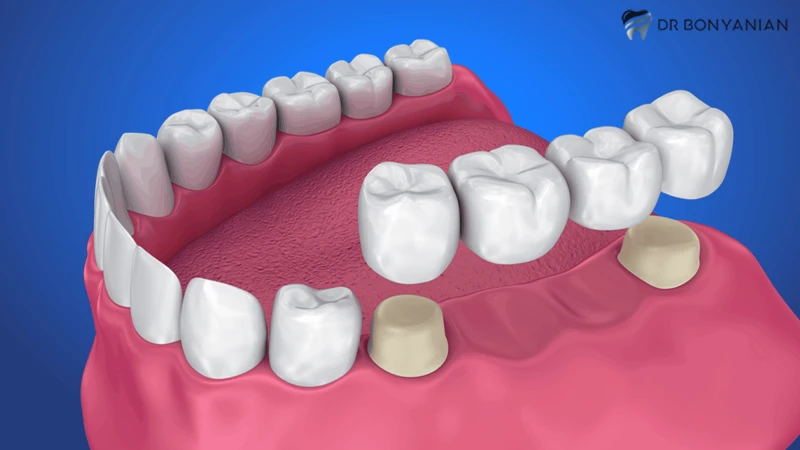
A dental bridge is one of the methods used to restore missing teeth. This method is applicable when the missing tooth is located between two other teeth. In this technique, the crowns of the teeth adjacent to the missing tooth act as pillars of a bridge, providing strong support for the empty space.
A dental bridge looks like a natural tooth crown and restores the aesthetic appearance of your face.
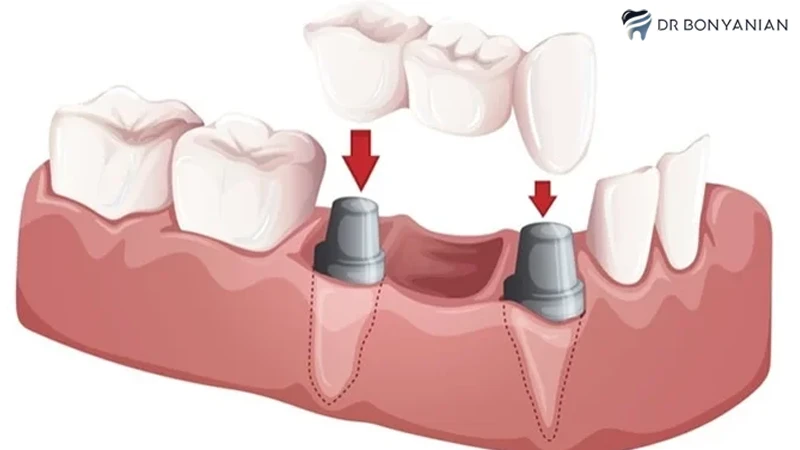
Teeth Bridging
You might have heard the term “teeth bridging.” If you want to know what it means, “teeth bridging” is another term used for a dental bridge and is no different from the method we have described above.
What is a dental bridge?
A dental bridge is a type of dental restoration used to replace one or more missing teeth. It “bridges” the gap between two healthy teeth, which are typically on either side of the missing tooth or teeth. A bridge consists of two crowns placed on the teeth adjacent to the gap, with a false tooth (pontic) in between that fills the space.

Candidates for a Dental Bridge
Determining whether a dental bridge is suitable for you depends on the professional judgment of your dentist, based on factors such as the health and strength of the teeth adjacent to your missing tooth. However, generally, if you have lost one or two teeth and the teeth next to the gap are healthy, you are a good candidate for a dental bridge.
When is a Dental Bridge Necessary?
Usually, a dentist’s first recommendation for filling the gap between your teeth is the best method for replacing a missing tooth: a dental implant. However, if for any reason you are not an eligible candidate for a dental implant, or if the cost of a dental implant is too high for you, your dentist may suggest a dental bridge.
Furthermore, other conditions might compel a dentist to opt for a dental bridge. For example, if the gap between the teeth is insufficient for placing an implant, the dentist will likely recommend a dental bridge. Therefore, whether a bridge or an implant is better for you depends on your specific situation and your dentist’s opinion. In such cases, we recommend consulting a good dentist.
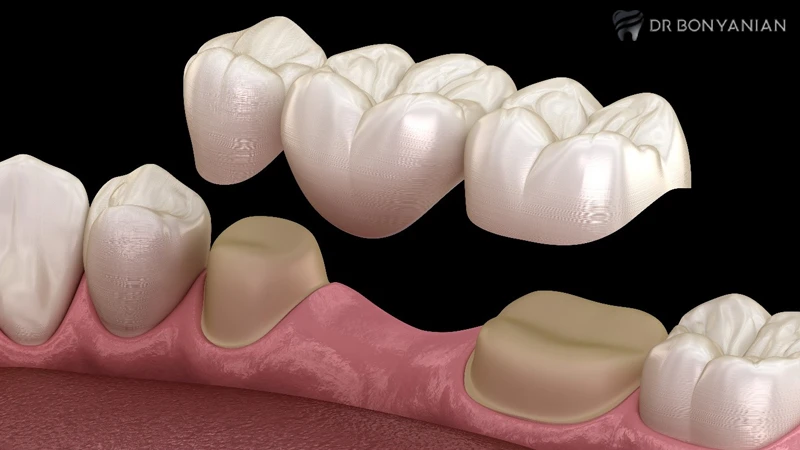
Front Tooth Bridge
A dental bridge is commonly used for the front teeth. This is because quickly achieving a natural-looking tooth is highly important when a front tooth is lost. Additionally, using a bridge for front teeth reduces the likelihood of forming a black triangle between the teeth.
Getting a Dental Bridge at Dr. Bonyanian Dental Clinic
At Dr. Bonyanian Dental Clinic, recognized as one of the best dental clinics in Tehran, our team of experienced, specialized, and committed dentists and medical staff is ready to provide you with high-quality dental bridge services.
The advantages of choosing Dr. Bonyanian Dental Clinic for your dental bridge services include:
- Professional team
- Implementation of all types of dental bridge methods
- Patient comfort and convenience
- Consultation and education
- Installment payment options
You can benefit from our dental bridge services by calling 00982188539720 or visiting our clinic, located at No. 7, Unit 22, 6th West Street, Ahmad Qasir (Bukharest) St., Arjantin Sq., Tehran. You can also request a free dental consultation through the form below.
Types of Dental Bridges
Now that you know what a dental bridge is, it’s time to explore the different types. There are four main types of dental bridges, which we will introduce below.
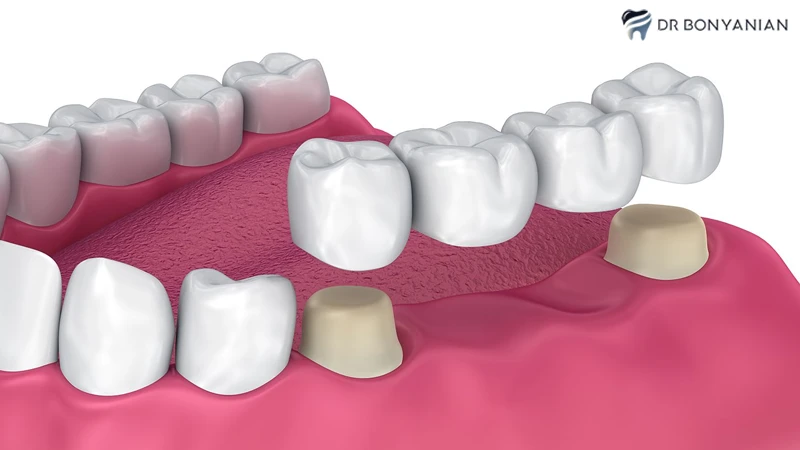
1. Traditional Fixed Bridge
This is the most common and conventional type of dental bridge. In a traditional bridge, a false tooth (pontic) is placed in the middle, and crowns are placed on the adjacent teeth. The dentist must shave down a portion of the adjacent teeth to properly fit the traditional bridge. Traditional bridges are typically made of metal, porcelain-fused-to-metal, or ceramic.
Once installed, a traditional dental bridge is fixed in place and cannot be removed. Therefore, this method is suitable for individuals who intend to use the dental bridge for a long time.
2. Maryland Bridge (Resin-bonded bridge)
If you have lost your front teeth, your dentist might suggest a Maryland bridge. This type of bridge is made of porcelain fused to metal or ceramic teeth, supported by a framework. Wings on each side of the bridge are bonded to your existing teeth.
3. Implant-Supported Bridge
Implant-supported bridges have gained more popularity in recent years. This is because they are not only used for one or two missing teeth but can also be applied in cases of complete toothlessness.
In this method, instead of relying on adjacent teeth for support, the bridge is held in place by dental implants. An implant-supported bridge offers many more advantages compared to other bridge methods. For example, this type of bridge does not damage your neighboring teeth and has much greater stability.
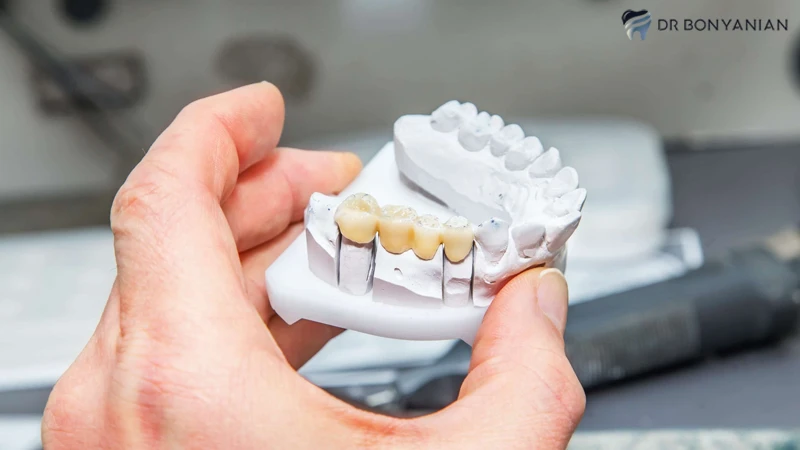
Dental Bridge Procedure by Number of Sessions Required
In this section, we discuss the dental bridge procedure. Installing a dental bridge is a multi-step process. The number of required sessions is determined by factors such as the number of missing teeth, the type of bridge, the individual’s oral health, and the dentist’s decision. Additionally, the process of fabricating the bridge in a dental laboratory takes about two weeks, which increases the number of sessions required for installation.
However, generally, installing a dental bridge requires two separate sessions. The first session is for taking impressions of the teeth, and the second is for placing the bridge.
Of course, if the teeth adjacent to the one being bridged are damaged, they must be treated first, which may require two or more additional sessions. Therefore, the dental bridge procedure can be summarized as:
- Preparing the adjacent teeth
- Taking impressions
- Placing the bridge on the teeth
What are the Advantages of a Dental Bridge?
Now that we’ve explained what a dental bridge is and its various types, it’s time to learn about its advantages. Some benefits of a dental bridge include:
- It is less expensive than a dental implant.
- It fills the gap of the missing tooth.
- It restores the natural aesthetic appearance of your teeth.
- It prevents adjacent teeth from shifting into the empty space.

What are the Disadvantages of a Dental Bridge?
Sometimes we are asked about the disadvantages of a bridge and whether getting one has any side effects. Here are some of the drawbacks of a dental bridge:
- The dentist must shave down the adjacent healthy teeth.
- The adjacent teeth must undergo root canal treatment.
- The cost of a dental bridge includes the costs of three units of dental crowns and two units of root canal therapy.
- Because the space under the bridge is empty, the jawbone and gums will eventually recede.
- The individual may need to undergo bone grafting surgery after some time.
- After bone resorption, a gap will form between the bridge and the gum. Over time, this gap becomes a place for food particles to accumulate. As a result, the person’s mouth will often have a bad odor.
Medical Disclaimer: This section is for symptom relief only and is not a substitute for professional diagnosis and treatment. We suggest reading the article on home remedies for bad breath.
Is a Dental Bridge a Good Option?
In response to the question of whether a dental bridge is a good option, we can quote Dr. Nazanin Bonyanian, a specialist in dental prosthetics:
If a dental bridge is designed and executed correctly, it can be an effective and long-lasting solution for replacing missing teeth. However, the choice must be made considering the overall condition of the mouth, the health of the abutment teeth, and the individual needs of the patient.
Furthermore, the answer to whether a dental bridge is good depends on various factors, such as the condition of your mouth and teeth, the type of bridge to be placed, and your expectations from the procedure.
This replacement method is a suitable solution for those who cannot tolerate the long recovery period after dental implant surgery and do not want to spend a lot of money to fill the gap of their missing tooth.

Dental Bridge Without Tooth Preparation
A no-prep bridge, or Maryland bridge, is a replacement tooth that is bonded to the back of the adjacent teeth using metal or ceramic wings, without the need to shave down their surfaces.
Advantages of a No-Prep Dental Bridge
- Does not damage the structure of natural teeth
- Simpler and faster process
- Relatively conservative and reversible

Disadvantages of a No-Prep Dental Bridge
- Less durable than traditional bridges
- More suitable for low-pressure areas (like front teeth)
- May debond over time or require re-cementing
Dental Bridge Without a Root Canal
One of the common questions patients ask before getting a dental bridge is whether a root canal is necessary for the abutment teeth. The answer depends on the health of the teeth adjacent to the edentulous area.
If the abutment teeth are completely healthy and only require minimal surface preparation for the bridge placement, a root canal is not necessary. However, if one of the abutment teeth has deep decay, pulp inflammation, or painful symptoms, root canal therapy may be required before placing the bridge.
Opinion of Dr. Nazanin Bonyanian, Prosthodontist:
A root canal is only performed if there is pulp damage or specific clinical symptoms. By default, it is not necessary to perform a root canal to prepare abutment teeth for a bridge.
Which is Better: A Dental Bridge or an Implant?
Generally, a dental implant is always considered a better option than other methods for replacing one or more missing teeth. This is because it replaces not only the appearance of the tooth but also its root, without damaging other teeth. However, a dental bridge may be a suitable option in specific circumstances (such as insufficient bone or budget limitations).
Comparison Table: Bridge vs. Implant
| Feature | Dental Implant | Dental Bridge |
|---|---|---|
| Durability | Very high (10–20 years or more) | Moderate (5–15 years) |
| Need to prepare adjacent teeth | ❌ No | ✅ Yes (in traditional bridges) |
| Prevents bone loss | ✅ Yes (acts like a natural root) | ❌ No |
| Treatment duration | Longer (several months) | Shorter (a few weeks) |
| Cost | Higher | Lower |
| Surgical procedure | ✅ Required | ❌ Not required |
| Suitable for | Most people with sufficient bone health | Individuals for whom implants are not suitable |
Dental Bridge in Tehran
Specialized dental bridge services are offered at Dr. Nazanin Bonyanian’s Dental Clinic, located in the heart of Tehran (Arjantin Square), using the latest technologies and high-quality materials.
The dental team at the Dr. Bonyanian clinic, relying on their extensive clinical experience, scientific precision, and warm, friendly approach, will select and implement the most suitable type of bridge (traditional, Maryland, or implant-supported) based on your oral health status and needs.
Advantages of Getting a Bridge at Dr. Bonyanian’s Clinic
- Expert consultation by a prosthodontist
- Use of premium materials and modern equipment
- Aesthetic design that harmonizes with your smile
- Adherence to principles of anesthesia and patient comfort at all stages
- Thorough post-treatment follow-up to ensure long-term performance
So, if you have lost a tooth and are looking for a reliable, beautiful, and durable solution, it’s time to consult with our expert team.
A Successful Dental Bridge Experience at Dr. Bonyanian’s Clinic
One of the memorable cases at our clinic involved a patient who had lost self-confidence not only in chewing but also in smiling due to a missing front tooth.
After a thorough examination of the oral and dental condition, considering the bone status and the health of the adjacent teeth, the team of specialists at Dr. Bonyanian’s clinic decided to place a Maryland bridge to fill the gap without significant tooth preparation, preserving the natural tooth structure.
Over a few sessions, the treatment was carried out precisely using high-quality materials and modern equipment. The result was a beautiful smile and fully natural function, which brought complete satisfaction to the patient.
This experience once again demonstrated that choosing the right treatment, combined with scientific precision and clinical skill, can have a significant impact on patients’ quality of life.
Lifespan of a Dental Bridge
With proper care, a dental bridge can last in your mouth for more than 15 years without any complications. Of course, other factors such as the material of the bridge and the quality of its installation by the dentist also affect its lifespan.
Price of a Dental Bridge
As mentioned above, the cost of a dental bridge is roughly equivalent to three crown units and two root canal units. However, determining the exact cost is not possible beforehand due to the custom fabrication of the crowns. For more information, you can refer to the pages on root canal prices and dental crown costs.
If you are considering a dental bridge for your teeth, you can contact Dr. Bonyanian Dental Clinic at 00982188539720 to get the latest information on dental bridge prices from our experts.
Post-Bridge Care
The success of a dental bridge depends on the health and strength of the remaining teeth that support it. Therefore, proper and thorough care of your teeth (especially those adjacent to the bridge) is extremely important. Use the following tips for post-bridge care:
- Brush twice a day, floss daily, and rinse your mouth with mouthwash.
- Ask your dentist to teach you the correct way to floss. This instruction should also include how to clean under the dental bridge using a bridge threader.
- Regular visits to the dentist will help diagnose and resolve potential issues with the bridge before they worsen.
- Try not to put excessive pressure on your bridge and avoid biting or breaking hard foods with it.
Eating with a Bridged Tooth
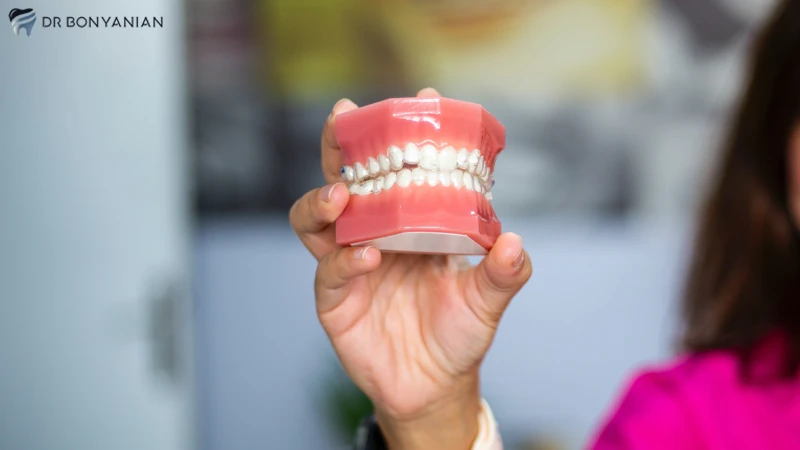
Eating with a dental bridge is a natural and problem-free process, with no restrictions, provided that the patient follows proper hygiene and care instructions.
For example, in the initial days after the bridge is placed, the patient should avoid hard, sticky, or very hot/cold foods to prevent sudden pressure on the new structure.
After this period, the patient can use the bridge like a natural tooth but should still avoid biting hard objects such as ice, hard nuts, or candy.
Ultimately, maintaining oral hygiene, using special floss for bridges (superfloss), and regular dental check-ups play a crucial role in extending the life and effective performance of the bridge.
In Conclusion
Losing teeth can affect how you eat, speak, and smile. Bridging your teeth can restore appearance and functionality to your mouth. In this article, we explained what a dental bridge is, its types, and the pros and cons of getting one. Dental bridges fill the gap caused by missing or extracted teeth and can last for many years.
If you have a dental bridge, maintain good oral hygiene and visit your dentist regularly to keep your bridged tooth healthy.

Dr. Nazi Bonyanian
Dental Surgeon (DDS) — Medical Council Number: 138662
Graduate of Isfahan University of Medical Sciences with over 15 years of experience in implants, laminates, and oral and dental surgery.
Address: No. 22, Unit 7, West Alley 6, Bokharest Street, Argentina Sq., Tehran, Iran
Phone: +98-21-88539720 | WhatsApp: +98-912-514-2202
Email: info@drbonyanian.com
Working Hours: Sat–Wed 09:00–20:00 | Thu 09:00–14:00 | Friday Closed
⚠️ اطلاعات این صفحه صرفاً برای آگاهی است و جایگزین معاینه و تشخیص تخصصی نمیباشد.
