



The Best Way to Remineralize a Decayed Tooth at Home
- A mixture of calcium and magnesium powders
- Butter oil and cod liver oil
- Bone broth
- Saltwater
- Green tea
- Clove oil
- Eggshell
- Aloe vera juice
- Neem
- Garlic
- Eucalyptus oil
- Lemon
- Vegetable oil
How to use these ingredients for the home treatment of tooth decay will be explained later in this article.
Tooth decay is one of the most important issues that can arise for various reasons. This condition will significantly increase the likelihood of problems such as fractures or tooth loss. Therefore, you should take action to treat your tooth decay at the earliest opportunity.
Since some home remedies play a significant role in resolving tooth decay, we will introduce a number of these solutions to you below.
If you want to learn more about treating tooth decay at home, be sure to read this article to the end so you can use the methods mentioned in this article to address this issue.
What is Tooth Decay?
Tooth decay is one of the most common oral and dental problems that can happen to anyone. If we want to explain tooth decay in a simple way, we can define this problem as “the erosion of the tooth or the formation of a cavity due to the loss of hard tooth structure.”
Bacteria feed on the sugar in food, especially simple sugars, and produce acid in the process. This acid attacks the tooth enamel, which is the hard outer layer of the tooth, and gradually wears it away over time.
If tooth decay is not treated, it can penetrate into the deeper layers of the tooth, including the dentin and pulp, causing pain, abscesses, and even tooth loss.
What Causes Tooth Decay?
- Frequent consumption of sugary foods and drinks: These foods are a source of nutrition for plaque-forming bacteria.
- Poor oral hygiene: Not using a toothbrush, toothpaste, and dental floss regularly will cause plaque to build up on the teeth, leading to acid production by bacteria. Over time, the acid will cause the teeth to decay.
- Dry mouth: Dry mouth can reduce saliva flow. Since saliva naturally cleans teeth and protects them from acid, dry mouth is considered a serious factor for tooth decay.
- Use of certain medications: Some medications can increase the risk of dry mouth and tooth decay.
- Genetic factors: Some people are naturally more susceptible to tooth decay because the quality of teeth is a factor that can be passed from parents to children through genetics.
We suggest you read the article “Oral and Dental Health.” This article will provide you with very complete and comprehensive explanations about all kinds of oral and dental care.
Types of Dental Caries Classes
Dentists usually use a special classification system called “Dental Caries Classification Systems” to accurately diagnose the type of tooth decay and choose the appropriate treatment method. This system is defined based on the location and depth of the decay in the tooth.
This classification system (also known as the Black system) is one of the most common systems for classifying tooth decay. In this system, tooth decay is divided into six main classes.
- Class I Caries
- Class II Caries
- Class III Caries
- Class IV Caries
- Class V Caries
- Class VI Caries

Class I Cavities
Class I caries is a type of tooth decay that occurs in the pits and fissures of the chewing surfaces of the teeth. This type of decay is asymptomatic in its early stages, but as it progresses, it causes pain and tooth sensitivity. Early diagnosis and proper treatment of this type of decay can prevent it from progressing to the tooth nerve and more serious complications.
Class II Cavities
The second type of tooth decay is called Class II caries. This is a type of decay that occurs mostly on the surfaces between the molar teeth. Because these areas have limited access for toothbrushes and floss, they are more prone to plaque and bacteria buildup. As a result, the tooth enamel in these areas is gradually destroyed and cavities are formed in the tooth.
Class II caries is usually painless in its early stages and the person may not notice it. But as the decay progresses, the cavity becomes deeper and may even reach the dentin over time. At this stage, the tooth becomes sensitive to cold, hot, and sweet foods, and gradually, severe, throbbing, and nocturnal pain is also added to it.
Just like Class I caries, early diagnosis of Class II caries is also very important. Because treatment is both easier and less expensive in the early stages, and prevention is better than cure!
Class III Cavities
Class III caries is a type of decay that occurs mostly on the surfaces between the anterior (front) teeth. This type of decay has a greater impact on the beauty of the teeth, but if left untreated, it can progress and cause pain and discomfort.
To prevent the spread of this decay, the dentist uses special tools to first diagnose the decay and then repairs it by filling the cavity. For the restoration of Class III caries, tooth-colored materials (such as composite) are usually used to preserve the appearance of the teeth.
Class IV Cavities
The location of Class IV caries is the interproximal surfaces and the incisal edge of the anterior teeth. In fact, this type of decay is considered an extended form of Class III caries. The difference is that in Class IV, the decay has actually reached the incisal edge.
Due to the position of the anterior teeth in the mouth and their role in the beauty of the smile, Class IV caries has a significant impact on the appearance of the teeth. Especially since this type of decay is more often caused by injuries from trauma, abrasion, or tooth erosion.

Class V Cavities
In this type of tooth decay, cavities appear on the front or back of the anterior or posterior teeth, near the gum line. This is a place that many dentists refer to as the “neck of the tooth,” which is where the tooth connects to the gum.
Factors such as tooth wear due to bruxism (teeth grinding) or excessive consumption of acidic substances are among the main causes of Class V tooth decay.
Class VI Cavities
Class VI caries is the last type of tooth decay that occurs on the incisal edges of the teeth. This type of decay is mainly caused by abrasion or erosion of the teeth, bruxism, chewing on hard objects, prolonged use of abrasive toothbrushes, or certain diseases.
Continuous contact of the teeth with acidic substances such as sodas, acidic juices, and some drugs are also considered other reasons for developing this type of decay.
How Does Tooth Decay Happen?
When we say a tooth is decayed, we mean that the bacteria in the mouth convert the sugars in food and drinks into acid through a series of processes.
These acids gradually dissolve the tooth enamel (which is the outer, protective layer of the tooth) and create cavities in it. The cavities are initially small and painless, but they get bigger over time and gradually penetrate the dentin, which is the layer beneath the enamel. As a result, the decay reaches the tooth’s nerve and causes severe pain.
There are also various factors that play a role in the development of this decay. But the most important of them are poor oral and dental hygiene, plaque and tartar buildup on the teeth, excessive consumption of sugar and sugary drinks, dry mouth, some diseases and medications, and genetics.
If you feel you are prone to tooth decay, it is best to fill out the form below right now so that the experts at Dr. Bonyanian’s dental team can contact you as soon as possible to book a consultation and examination appointment.
Preventing Tooth Decay
One of the famous sayings of most doctors and dentists is “prevention is better than cure.” So you too should try to prevent your teeth from getting decayed until the last moment. Rest assured that this is much easier and better than dealing with expensive dental treatments later on to fix your decayed teeth.
Dr. Nazanin Bonyanian explained the importance of preventing tooth decay to us as follows:
Tooth decay can start from childhood and, if not prevented, lead to pain, infection, and even tooth loss. But the good news is that by following a few simple principles, you can largely prevent it from happening. For example, the first and most important point is to practice good oral and dental hygiene. This means brushing correctly, using dental floss, having a healthy diet, and avoiding excessive consumption of sugars and sugary drinks.
Remember that prevention is always better than cure. Especially when it comes to the health of our teeth, which play an important role in our quality of life.
Preventing tooth decay is also a very, very simple task! It is enough to maintain good oral and dental hygiene and protect your teeth from decay by having a healthy, low-sugar diet.
Symptoms and Signs of Tooth Decay
Many people ask us how to know if our teeth are decayed. In fact, tooth decay can manifest in different ways in the teeth. Among the most important symptoms and signs of tooth decay, we can mention toothache, tooth sensitivity, bad breath, or high sensitivity of the teeth when eating and drinking various foods and drinks.
Of course, sometimes these symptoms may appear in other forms. For example, gum inflammation can also be a symptom of tooth decay.

Wisdom Tooth Decay
Wisdom teeth are the last teeth to erupt in the mouth, and due to their location at the back of the mouth, cleaning them is difficult. For this reason, the probability of wisdom tooth decay is higher than other teeth.
Wisdom tooth decay occurs when bacteria accumulate on the surface of the wisdom tooth and produce acid by consuming the sugars present in the mouth. These acids gradually destroy the tooth enamel and cause tooth decay.
The causes of wisdom tooth decay are difficult cleaning of these teeth, plaque buildup on them, their incomplete eruption, and lack of space, which causes pressure on other teeth.
You should have your wisdom teeth checked periodically to make sure they are not decayed. Regular brushing and using dental floss to clean all surfaces of the teeth also help prevent wisdom tooth decay.
Treatment of Wisdom Tooth Decay
If your wisdom tooth is decayed, the dentist will use one of 3 treatment options to solve this problem:
- Filling: If your wisdom tooth decay is in the early stages, the dentist can fill that tooth.
- Root Canal Treatment: If the decay has reached the nerve, root canal treatment is performed.
- Extraction: In many cases, the best way to treat a decayed wisdom tooth is to extract it.
If you are struggling with wisdom tooth decay and are looking for a successful way to treat this problem, you can contact Dr. Bonyanian’s dental clinic at 009821-88539720 to book the first available appointment at the clinic for you.
Front Tooth Decay
Many people think that front teeth do not get decayed. But this is a completely wrong assumption! It is true that decay is more common in the back teeth; but sometimes even the front teeth cannot escape this predicament!
Front tooth decay, due to the visibility of the front teeth and their importance in the beauty of the smile, can have a significant impact on a person’s self-confidence. For this reason, taking appropriate measures to prevent the further spread of decay or its rapid treatment is of great importance.
We advise you to maintain good oral and dental hygiene to prevent decay in your front teeth, brush regularly, and clean between your teeth with dental floss. If you also experience symptoms of decay in your front teeth, see a dentist immediately.
Diagnosing Tooth Decay
Although you can also diagnose the symptoms of tooth decay yourself, the final and correct diagnosis of tooth decay can only be determined by a dentist. For this reason, after any signs of tooth decay or your teeth appear, it is better to see a dentist and discuss your symptoms with your doctor.
Methods of Preventing Tooth Decay
You can prevent your teeth from getting decayed by observing some hygiene tips. Some of these points are mentioned below:
- Regularly brushing your teeth twice a day for two minutes with a soft-bristled toothbrush and fluoride toothpaste.
- Using dental floss after every meal.
- Rinsing your mouth with antibacterial mouthwash.
- Having a healthy, sugar-free diet, containing vegetables and increasing the consumption of foods containing calcium and phosphorus.
- Regular visits to the dentist to ensure the health of your teeth.
- Regular scaling to remove plaque and tartar from the teeth.
- Using a mouthguard in case of bruxism.
- Quitting smoking.
- Timely treatment of oral and dental problems.
Different Methods for Treating Tooth Decay
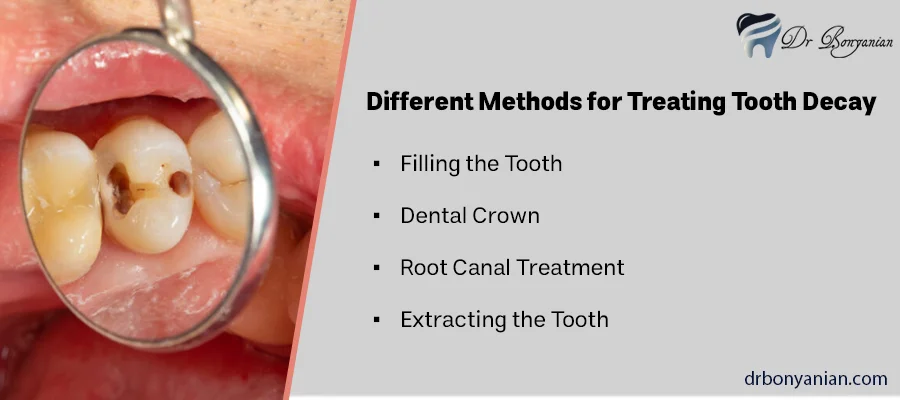
There are different methods for treating tooth decay, each of which is chosen based on the severity of the decay and the dentist’s discretion. Below we will mention some of the most common treatment methods.
Filling the Tooth
If the tooth decay is superficial and shallow, you can use the filling or restoration method to treat it. In this method, the decayed part of the tooth is removed and a restorative material such as composite, amalgam, or gold is placed in its place.
Dental Crown
If the tooth decay is more extensive, the decayed parts are trimmed and a crown is placed on the tooth. A dental crown is a hollow cap that helps prevent further damage by protecting the damaged tooth.
Root Canal Treatment
If the tooth decay is very severe and extensive, the dentist has to perform a root canal (endodontic treatment) for the person. In this procedure, the damaged parts of the tooth nerve are removed and then the tooth is filled.
Extracting the Tooth
In certain situations, the dentist determines that the tooth must be extracted and replaced with a substitute such as a dental prosthesis, dental implant, etc.
Treating Tooth Decay at Dr. Bonyanian’s Dental Clinic
If tooth decay is not treated in time, it will cause you severe pain, infection, and eventually tooth loss.
At Dr. Nazanin Bonyanian’s dental clinic, we will treat your tooth decay with the latest technologies and methods in the world. From accurate diagnosis using digital imaging equipment to professional restoration of teeth with high-quality materials, all stages are performed with care and attention by our experienced team.
In this clinic, depending on the severity of your tooth decay, various treatments such as composite restoration (white filling), root canal treatment (in more advanced cases), and even the use of crowns are offered. Because our goal is to preserve the patient’s natural tooth, prevent the progression of damage, and restore a healthy and beautiful smile.
For a consultation and to schedule an appointment, contact Dr. Bonyanian’s dental clinic today at 009821-88539720 or fill out the contact form below so our consultants can contact you as soon as possible.
When a decayed tooth is saved!
In a recent clinical case at Dr. Bonyanian’s dental clinic, a patient presented with severe pain in an upper molar tooth. After a thorough examination and digital imaging, it was determined that the tooth had deep decay and the pulp was involved.
Treatment began with a precise and painless root canal, and in the same session, the root canals were cleaned and filled with disinfectant materials. In the next step, the tooth was beautifully restored with composite and its natural shape was recreated.
The patient was very satisfied with the reduction in pain and the natural appearance of the tooth immediately after the treatment. This experience is an example of the commitment of Dr. Bonyanian’s clinic to providing precise, fast, and comfortable treatment for patients.
Treating Tooth Decay at Home
If you, like many other people, are looking for natural and home remedies to treat tooth decay or your teeth, it is better to consider this before taking any action: are these methods really effective?
Tooth decay is a very severe condition that has been able to destroy your tooth enamel over time! So the probability that home remedies can treat it is really low!
The only plausible option regarding home remedies for tooth decay is that these methods can prevent further progression of the decay. Of course, this is also a great help! But we must not forget that severe and extensive decay can only be treated with dental intervention.
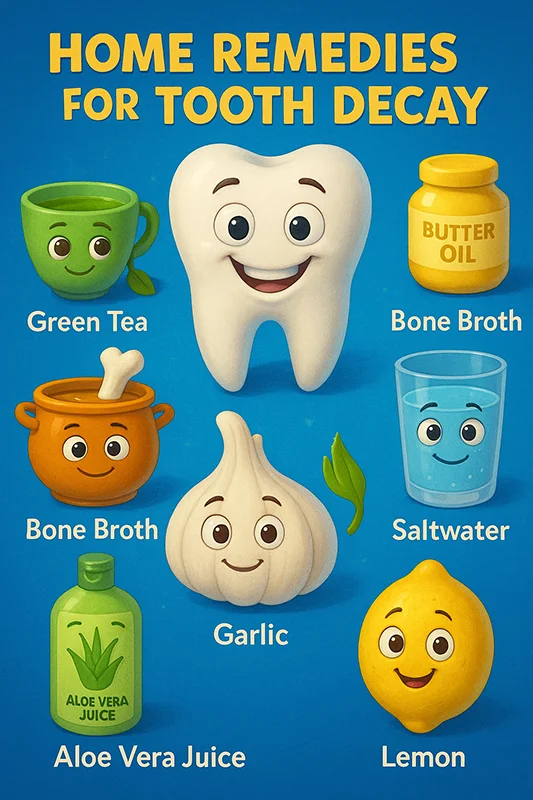
The home remedies that are often suggested for treating tooth decay include using salt water, coconut oil, baking soda, garlic, and so on. In the following, we will introduce you to 13 of the most common ones.
13 Home Remedies for Tooth Decay
In addition to the specialized dental solutions we introduced to you for treating tooth decay, some home remedies are also used to prevent the spread of tooth decay and treat this problem.
In the continuation of this article, we will review 13 of these home remedies together.
1. Mixture of Calcium and Magnesium Powders
One of the best things you can do to prevent the spread of tooth decay is to use powders and supplements containing calcium and magnesium. This combination, by increasing the amount of necessary minerals for the teeth, helps to strengthen the teeth and remineralize the enamel (the outer protective layer of the tooth).
There are two main ways to use this combination:
- Buying a supplement containing calcium and magnesium.
- Crushing calcium and magnesium tablets, turning them into powder, and using this combination for brushing.
How to Brush with Calcium and Magnesium Powder
To brush with calcium and magnesium powder, you first need to slightly moisten your toothbrush. Then, apply a small amount of powder (about half a teaspoon) to the toothbrush or pour it into the palm of your hand and dip the toothbrush in it. Finally, you should brush your teeth gently and with circular motions from the gums downwards (or upwards for the lower teeth).
Continue this for about 2 to 3 minutes. After you are done, rinse your mouth with water and use dental floss if necessary. Using it once or twice a day is sufficient.
2. Butter Oil and Cod Liver Oil
These two oils are very beneficial for oral and dental health due to their vitamins A, D, and K. You can use these oils in the amount of one capsule (daily) in each meal. Continuous and long-term use of these oils will ensure that your mouth and teeth are always healthy.
3. Bone Broth
Bone broth is a great option for health and strengthening the immune system due to its minerals, vitamins, and healthy fats. You can use this food to strengthen your hair, nails, skin, and teeth.
In addition, since this broth is made up of a large amount of calcium, it can eliminate tooth decay with repeated consumption.
To prepare this broth, it is better to use lamb or beef (which contain more calcium). Consuming this meal once or twice a week will help you treat your tooth decay at home.
4. Saltwater
You got it right! Saltwater is a simple and accessible solution that can help prevent and even treat tooth decay! But how does this happen?
- Saltwater is a natural antiseptic: Salt has high antiseptic properties and can help eliminate harmful bacteria that lead to tooth decay, gum disease, and bad breath.
- Reduces gum inflammation and, consequently, prevents tooth decay at home: Gum inflammation is one of the early stages of gum disease, which, if left untreated, can lead to more serious problems such as tooth decay and even periodontitis. The anti-inflammatory properties of salt can help reduce this inflammation.
- Neutralizes acid: One of the main causes of tooth decay is the acidic environment of the mouth. This is because the bacteria in the mouth can produce acid that can attack tooth enamel and lead to tooth decay. Salt can help neutralize the acid in the mouth and help protect tooth enamel.
To use this solution, you should add about one teaspoon of salt to a glass of warm water. After mixing these two ingredients, gargle the saltwater in your mouth. This will cause the bacteria to detach from the surface of your teeth, and by expelling the saltwater from your mouth, the bacteria will also be removed from your mouth.
Our suggestion to you is to do this once or twice a day.
5. Green Tea
Green tea is another home remedy for tooth decay that, in addition to preventing the growth of bacteria, can also remove microbes from the mouth. Of course, this drink has another benefit that may help treat tooth decay in a more indirect way.
This feature is helping to increase saliva in the mouth. Saliva plays an important role in oral and dental health and helps to keep the mouth moist, neutralize acid, and wash away bacteria. Green tea, by increasing the amount of saliva secretion, in turn, helps to protect the teeth against decay.
To use the properties of this tea for your teeth, you should first brew green tea and add honey and lemon juice to it. Drink green tea, like black tea, once a day warm or lukewarm and enjoy its miraculous effect on your teeth.
6. Clove Oil
Clove itself and all its derivatives (including clove oil) are very useful as one of the ways to stop tooth decay at home and also to control tooth pain. This property is due to the presence of an element called eugenol. This element prevents the growth of various types of viruses, bacteria, and fungi in different parts of the body, especially the teeth.
In addition, clove oil also has a property similar to a natural painkiller. For this reason, in situations where you have a toothache at night (and do not have the opportunity to go to the dentist), you can put some clove oil on your tooth or teeth.
To use this clove oil for treating tooth decay at home, it is better to put some clove oil on your finger and then rub your finger on the decayed tooth or the tooth cavity. You can also use a clean cotton swab for this purpose. You are allowed to do this up to three times a day.
7. Eggshell
Since eggshells are made of calcium carbonate, this shell can be very useful for treating tooth decay at home.
To use this shell, it is better to finely chop about a quarter of a cup of eggshell. Then boil the shells with water and dry them in the open air. After drying, it is better to grind them completely until they become a powder, and then add some baking soda and coconut oil to it to make a paste.
You can use this paste instead of toothpaste or put it on your teeth once a day.
8. Aloe Vera Juice for Home Treatment of Tooth Decay
Aloe vera has strong antimicrobial properties and can help eliminate harmful bacteria in the mouth (which can lead to tooth decay, gum disease, and bad breath).
One of the compounds present in this plant is a substance called “anthraquinone.” This element eliminates the bacteria related to tooth decay and, with its anti-inflammatory properties, greatly reduces inflammation and pain if your gums or teeth are inflamed.
To use aloe vera, it is best to gargle with aloe vera juice in your mouth like saltwater after brushing your teeth. If the taste of this plant is not pleasant for you, it is enough to rinse your mouth with a little water after this step.
The specialists at Dr. Bonyanian’s dental clinic suggest that you repeat this twice a day. You can also use aloe vera gels instead of toothpaste. Of course, do not forget that you should not overdo it.

9. Neem
The neem plant is one of the native plants of India and Myanmar, which in the Swahili language (in East Africa) also means Mwarobaini or (the 40 tree). This is because it is believed by the common people that this tree cures 40 different diseases.
Many traditional medicine specialists in India also recommend using this plant and chewing it to strengthen the teeth and gums of individuals.
To use the properties of the neem plant, you should either chew it in your mouth and then rinse your mouth. Or use neem oil (just like clove oil or fish oil) to massage your gums and teeth.
10. Garlic
Garlic is also a very useful and beneficial plant that is used to treat various types of dental problems. This plant has antibacterial and antifungal properties and is also a pain reliever for various pains in many cases. To use the properties of garlic for treating the decay of your teeth, you should chew a clove of raw garlic with the aching tooth or place some crushed garlic on the affected tooth.
11. Eucalyptus Oil for Treating Tooth Decay at Home
Eucalyptus oil is one of the very famous oils whose antibacterial properties have made it famous for preventing and treating tooth decay. To use this oil, you should add it to your toothpaste.
Continue using this toothpaste combined with the oil until your tooth decay is treated.
12. Lemon
Lemon, due to its vitamin C and citric acid, eliminates microbes in the mouth and teeth. This fruit reduces toothache to a great extent like a painkiller. To use lemon, it is better to put some lemon in your mouth, chew it, and after 5 to 8 minutes, rinse your mouth with water.
Of course, be careful that excessive consumption of lemon is harmful to the teeth due to the acidity of this fruit. So, as much as possible, avoid excessive consumption of lemon or any other acidic substance.
13. Vegetable Oil
Vegetable oil can also be effective in eliminating tooth infection and reducing its pain. Also, vegetable oil reduces gum and tooth swelling to a great extent. For its consumption, it is better to gargle a cup of vegetable oil in your mouth. Gargling with oil causes bacteria to get trapped in the oil and be expelled from the mouth.
It is better to do this once or twice a day. But be careful not to swallow the oil because consuming a large amount of oil will be dangerous for your digestive system and blood fat.
Strengthening a Decayed Tooth
Strengthening a decayed tooth means restoring strength and health to a tooth that has been damaged by decay. Unfortunately, a decayed tooth cannot be fully strengthened, and its damaged part cannot be returned to its original state. However, there are various treatment methods that can prevent the progression of decay and restore the tooth to improve its function and appearance.
The most important of these methods are using dental solutions such as tooth restoration, using a tooth crown, and root canal treatment. But in addition to these, solutions such as maintaining oral and dental hygiene, fluoride therapy, and having a healthy diet also help to strengthen a decayed tooth.

Preventing Tooth Decay at Home
Preventing tooth decay at home is not possible except by maintaining oral and dental hygiene (and that too on a regular basis). Brushing twice a day with a fluoride toothpaste, using dental floss regularly, limiting the consumption of sugars and sugary drinks, and regular visits to the dentist for check-ups and professional cleanings are among the most important measures you should take to prevent your teeth from getting decayed at home.
Also, consuming foods rich in calcium and phosphorus, such as dairy products and dark green leafy vegetables (like spinach), also helps to strengthen tooth enamel and its resistance to decay.
So by following these simple tips, you can prevent the occurrence of tooth decay and maintain the health of your mouth and teeth for many years to come.
How to Stop Tooth Decay at Home
Rinsing the mouth with salt water, gargling with coconut oil at night, consuming less sugar, and drinking plenty of water are all among the ways to stop tooth decay at home.
Treating a Child’s Tooth Decay at Home
Unfortunately, many parents imagine that their child’s baby teeth are not very important. Because eventually these teeth will fall out. While baby teeth play a very important role in the growth and health of the child in adulthood.
Regarding the treatment of a child’s tooth decay, although some home remedies may help to relieve the symptoms of your child’s tooth decay, none of them are a substitute for professional dental care.
If you are worried about your beloved child’s tooth decay, you should take them to the dentist as soon as possible. The dentist can properly assess the decay and recommend the best treatment method for your child.
However, several common home remedies that help reduce the symptoms of your child’s tooth decay include rinsing the child’s mouth with salt water, aloe vera, and garlic. It is also better to convince your child that the various sweets that they like are harmful to their dental health and they should avoid consuming them as much as possible.
Home Treatment for a Cavity in a Tooth
It is better to explain to you from the very beginning that none of the home remedies can replace dental treatment for a cavity in a tooth.
So if your tooth has a cavity, the only effective solution to repair it is to go to the dentist and use treatment methods such as filling the tooth or using a dental crown.
Note that home remedies may temporarily relieve your pain, but they cannot prevent the progression of decay and its more serious complications. So instead of relying on home remedies, be sure to see a dentist to maintain the health of your mouth and teeth.
Complications of Tooth Decay
If tooth decay is not treated in time, it can cause serious and widespread complications for the health of the mouth and even the whole body. Initially, decay may only be accompanied by sensitivity to cold or hot foods and mild pain. But as the decay progresses, the following complications also occur:
- Severe infection and inflammation of the dental pulp and its spread to other parts of the tooth and jaw.
- Dental abscess along with swelling of the face, fever, chills, and severe pain.
- Tooth loss.
- Problems with chewing food and decreased quality of life.
- Developing gum diseases such as gingivitis and periodontitis.
- Widespread infections in other parts of the body such as the sinuses, brain, and heart.
- Digestive problems.
- Heart problems.
- Respiratory problems.
- Decreased self-confidence and beauty of the face.
Final Summary
Tooth decay is a condition caused by the acidic activity of bacteria and poor oral and dental hygiene. This problem should be resolved by a dentist at the earliest opportunity and at the time of diagnosis. But if the decay was superficial or the conditions for going to the dentist were not available to you, you can get help from home remedies to relieve tooth decay.
Using various oils such as vegetable oil, clove oil, and eucalyptus oil, or using natural materials such as lemon, aloe vera, garlic, and salt water are considered the best ways to treat tooth decay at home.

Dr. Nazi Bonyanian
Dental Surgeon (DDS) — Medical Council Number: 138662
Graduate of Isfahan University of Medical Sciences with over 15 years of experience in implants, laminates, and oral and dental surgery.
Address: No. 22, Unit 7, West Alley 6, Bokharest Street, Argentina Sq., Tehran, Iran
Phone: +98-21-88539720 | WhatsApp: +98-912-514-2202
Email: info@drbonyanian.com
Working Hours: Sat–Wed 09:00–20:00 | Thu 09:00–14:00 | Friday Closed
⚠️ اطلاعات این صفحه صرفاً برای آگاهی است و جایگزین معاینه و تشخیص تخصصی نمیباشد.

boat rental
Thank you for every other fantastic post. Where else may just anybody get that kind of info in such an ideal way of writing?
I have a presentation next week, and I am on the search for such information.
Dr. bonyanian
You can use all the content of our website by citing the source in your article.