



A sealant is a thin protective coating applied to the grooves of molar teeth to prevent > What is Sealant? decay.
Benefits of Sealant
- Effective prevention of tooth decay
- Painless and non-invasive
- Suitable for children and adolescents
- Quick and easy application
- Can be used for newly erupted permanent teeth
- Reduces the need for costly future treatments
- Increases the useful life of teeth
When parents worriedly ask the dentist, “How can we prevent our child’s teeth from decaying?”, there is an answer that is not painful, not expensive, and not time-consuming. An effective and preventive solution called fissure sealant.
Although this term may be unfamiliar to some, it plays a key role in maintaining dental health, especially during growing years.
In this article from Dr. Bonyanian’s dental website, we will both thoroughly review this method and get acquainted with its applications and benefits in preventing tooth decay.
What is Sealant?
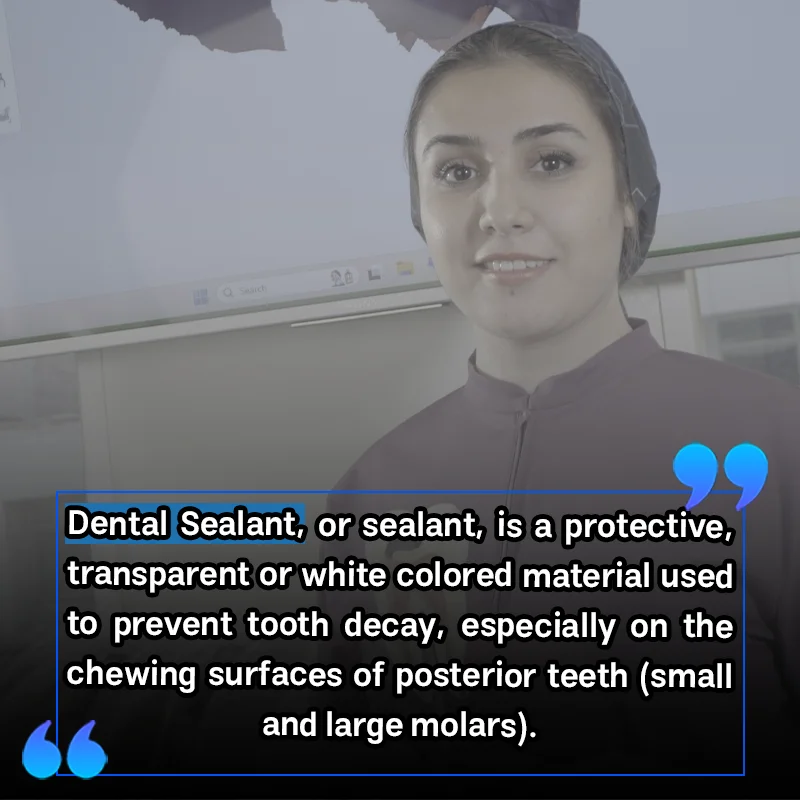
Dental Sealant, or sealant, is a protective, transparent or white-colored material used to prevent tooth decay, especially on the chewing surfaces of posterior teeth (small and large molars).
This material is applied as a thin layer on the grooves and pits of the tooth surface and acts like a protective barrier to prevent the penetration of bacterial plaque and food particles into the depth of the grooves. The same grooves that are ideal places for bacteria and food particles to accumulate and, if not properly cared for, can lead to tooth decay.
So, sealants, by filling these grooves and creating a smooth and polished surface, prevent the accumulation of bacteria and food substances.
These coatings are usually made of composite resins that adhere to the tooth and create a protective barrier against bacteria and external factors for the intended tooth.
These sealants are available in various colors to match the natural color of the teeth.
What is Fissure Sealant?
Fissure sealant is a preventive dental procedure in which a thin layer of sealant material is applied to the grooves and pits of the chewing surfaces of molar teeth (usually in children and adolescents).
This coating acts as a protective barrier and prevents the penetration of bacteria and food particles into the depth of the grooves, thereby significantly reducing the probability of tooth decay.
Literal Meaning of Fissure Sealant
Sealant means caulk or putty. Fissure sealant, or sealant fissure, is the Persian equivalent for the English words groove, crack, and fissure. Therefore, the best Persian equivalent for this English term is “groove filler.”
How Do Sealants Work?
Sealants prevent tooth decay by creating a thin, tooth-colored protective layer on the deep grooves and pits of teeth. These grooves, especially on molar teeth, are suitable places for bacteria and food particles to accumulate, which, if not properly cared for, can lead to tooth decay.
If we want to explain how sealants work in a simple way for you, we should say that sealants are like a rain that falls on your teeth and fills the holes (or the potholes in the street).
So, when oral bacteria try to attack the tooth, they encounter a large barrier called a sealant, and their sinister plan fails.

Who is Sealant Suitable For?
Both children and adults can use sealants. However, the sooner you use sealants, the better. Because the first permanent teeth erupt around the age of 6, and the second permanent teeth erupt around the age of 12. So, sealant can prevent the formation of dental cavities from the very beginning of the eruption of permanent teeth and, in the long run, save you time and money.
What is the Difference Between Fissure Sealant and Tooth Filling?
Dr. Bonyanian explained to us:
Filling a tooth means that the decayed parts of the tooth are drilled, and then the resulting dental cavity is filled with filling material. However, in fissure sealant, the sealant material is placed on a tooth that has no decay, and no drilling is done. In fact, filling a tooth is a therapeutic and restorative dental procedure. Whereas, when we apply fissure sealant to a completely healthy tooth, we are performing a preventive measure.
Benefits of Using Sealant
Sealants have many benefits, some of the most important of which we will try to mention below:
- Effective prevention of decay
- Protection of tooth enamel
- Long lifespan
- Simple and painless method
- Affordable cost
- Suitable for people of all ages
- Reduced need for tooth restoration
- Improved oral and dental hygiene
- Increased self-confidence

Effective Prevention of Decay
Sealants prevent tooth decay by creating a protective barrier on the deep grooves and pits of teeth. Because these grooves, especially on molar teeth, are an ideal place for bacteria and food particles to accumulate.
So, by filling these grooves with sealant, the tooth surface becomes smooth and polished, and no type of food material gets stuck in it.
Protection of Tooth Enamel
Another benefit of using sealants is the creation of a transparent protective layer on the teeth, especially in deep grooves. A benefit that plays a very important role in maintaining the health of tooth enamel.
Given that tooth enamel, as the hardest tissue in the body, plays an important role in protecting teeth, sealants, by filling the tooth grooves and creating a smooth and polished surface, prevent the penetration of bacteria and acids produced by them into the tooth enamel.
This protective layer prevents direct contact of acids with tooth enamel and prevents further destruction of that tooth enamel. As a result, by using sealant, tooth enamel remains healthy and strong for a longer period.
Long Lifespan
Sealants have a long lifespan. Because they are usually made of durable materials that adhere well to the tooth surface and are resistant to wear and corrosion. For this reason, they can protect your teeth for several years without needing replacement.
Of course, the exact lifespan of sealants depends on various factors such as the type of sealant, the individual’s oral and dental hygiene, dietary habits, and post-treatment care.
However, in general, sealants can maintain their effectiveness for several years, even up to 10 years or more. A feature that makes sealants known as an affordable and long-term treatment method for preventing tooth decay.

A Simple and Painless Method Suitable for People of All Ages
Another reason for the popularity of sealants is their simple application and painless procedure.
Unlike many dental treatments that require anesthesia injection, sealant placement does not require this. In fact, the entire process is very quick and is performed without causing any discomfort to the patient.
This process is so quick that the patient does not feel any pain during it. For this reason, sealants are a very suitable option, especially for children and individuals who are afraid of dentistry.
The simplicity and painlessness of this method make patients easily visit the dentist and benefit from the advantages of this treatment.
Affordable Cost
Compared to methods such as tooth restoration that are used to fill cavities on the tooth surface, the cost of sealants is much lower. Because sealants are used to prevent decay and are actually a preventive method, not a therapeutic one.
In addition, as we said, the sealant placement process is very simple and quick and does not require special equipment and materials. For this reason, the incidental costs of this method are also relatively low.
Improved Oral and Dental Hygiene
Sealants, by creating a smooth and polished surface on the teeth, especially in deep grooves, significantly contribute to improving oral and dental hygiene. Grooves, due to their complex and deep shape, are difficult to clean with regular brushing.
So, sealants, by filling these grooves, create a smooth and polished surface on the tooth, making brushing and flossing easier and allowing individuals to clean their teeth more easily.
How are Sealants Placed?
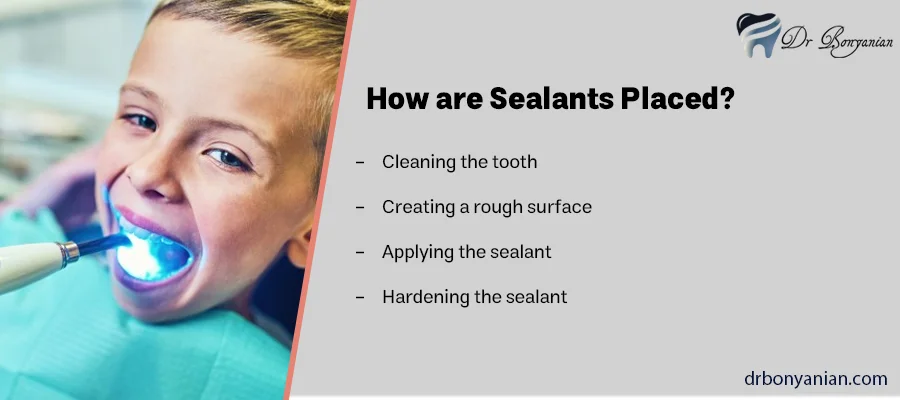
The sealant placement steps are generally as follows:
-
- Cleaning the tooth: First, the tooth is thoroughly cleaned and dried by the dentist so that no contamination or plaque remains on the tooth surface.
- Creating a rough surface: To increase the adhesion of the sealant to the tooth, the tooth surface is roughened using an acidic gel. This causes the sealant to adhere well to the tooth and prevents it from detaching.
- Applying the sealant: After rinsing and drying the tooth, the sealant is applied as a liquid on the deep grooves of the tooth. Sealants are usually available in various colors that match the natural color of the teeth.
- Hardening the sealant: To harden the sealant, a special light called a polymerizing lamp is used. This light causes the sealant to harden quickly and create a protective layer on the tooth.
Best Time to Apply Fissure Sealant
Since the first permanent molars, which are tooth number 6, erupt around the age of 6, and the second permanent molars, or tooth number 7, erupt around the age of 12, the best time to apply fissure sealant to these teeth is within these periods.
For fissure sealing deciduous (baby) molars, the best time is between 3 to 4 years of age. Although sealing permanent teeth in children is more effective than doing it for deciduous teeth, deciduous teeth are also as effective as permanent teeth in the current and future health of the child.
How Long Do Sealants Last?
Fissure sealants can last between 3 to 10 years on your teeth. However, the exact durability of the sealant depends on the techniques used by the dentist.
Of course, the amount of care you take for your oral and dental hygiene also has a great impact on the durability of sealants. Because, as we know, not observing proper oral and dental hygiene and some other factors (such as bruxism, consuming very acidic foods, and also stomach reflux) can also shorten the life of the sealant.
Can Sealant Coating Be Removed?
Fissure sealing is a reversible and replaceable procedure. This means that if you want to remove the sealant material from your teeth, the dentist can do this quickly for you using a dental drill or laser, without damaging your tooth tissue.
Of course, sealants are usually not removed after being placed on the tooth unless there is a specific problem! For example, if there is decay under the sealant, or if the sealant itself is broken or cracked.
Risks of Using Dental Sealant
Failure to check the tooth for decay before applying fissure sealant can cause problems in the future. Also, incorrect placement of this dental protector can create new space between the coating and the tooth, for microbes and bacteria to nest.
However, if the sealant is correctly placed on your teeth, it will not have any complications.
Can Sealant Be Used on a Decayed Tooth?
Many people imagine that it is not possible to use fissure sealant on decayed teeth. But from a scientific point of view, there is no obstacle to doing this.
This means you can use transparent sealant material to prevent the progression of decay in your teeth. Although it is better to do this with the aim of preventing the occurrence of decay, not as a therapeutic solution.
How to Care for Sealant?
Sealant materials, just like the tooth itself, are exposed to decay and destruction. Therefore, these materials also need our care, just like natural tooth tissue. This means that although sealants are applied as a protective layer on the teeth, they are not completely resistant to all destructive factors.
So, just like tooth enamel, sealants can also be exposed to wear, fracture, or destruction, and factors such as chewing hard materials, trauma to the tooth, and some dietary habits can gradually cause them to be damaged.

How to Care for Sealants?
-
-
- Brushing twice a day with fluoride toothpaste helps maintain oral and dental health as well as sealants.
- Daily flossing helps clean the areas around the sealant and prevent plaque buildup.
- By visiting the dentist regularly, you can ensure that the sealants are healthy and, if necessary, have them repaired or replaced.
- Avoid chewing hard materials such as ice, hard candy, or pencils.
- When engaging in contact sports, use a mouthguard.
-
It is worth mentioning that using sticky materials such as gum can also cause the sealant to come off. Also, excessive consumption of colored foods or tea and coffee may also cause its color to change.
Price and Cost of Fissure Sealant Treatment
Economically, prevention using fissure sealant is much more cost-effective than treating tooth decay. So, by performing fissure sealant, you can prevent the high costs of tooth restoration and, in the long run, reduce dental expenses.
In other words, it is better to prevent the occurrence of decay by using fissure sealant instead of waiting for decay to occur and then paying a lot of money to restore the tooth. This not only helps maintain dental health but also saves on dental expenses.
Fissure Sealant Services at Dr. Bonyanian’s Dental Practice
At Dr. Bonyanian’s dental practice, fissure sealant services are provided using the latest materials and equipment in the world, professionally and under the supervision of experienced dentists.
This simple, painless, and completely non-invasive method is especially designed for children and adolescents whose permanent teeth have recently erupted, to prevent future decay.
Our professional team, by carefully examining the condition of the teeth, determines the best time to perform fissure sealant and performs it with high precision to achieve maximum effectiveness and durability. Our goal is to create a safe and pleasant experience for children and parents in the path of maintaining oral and dental health.
The mother of one of our child patients, after performing fissure sealant for her child’s molar teeth, said with complete satisfaction with the treatment process:
“My son was always afraid of going to the dentist, but the friendly and calm demeanor of Dr. Bonyanian’s team made him not only not stressed, but after finishing the work, he said he didn’t even realize anything was done on his tooth. I’m glad that now I’m relieved about the health of his permanent teeth.”
Final Conclusion
In conclusion, it can be concluded that fissure sealants, as an effective preventive method in dentistry, play an important role in maintaining oral and dental health.
These materials, by filling the deep grooves of molar teeth, prevent the accumulation of bacteria and food substances in these areas and consequently significantly reduce the risk of tooth decay.
Simplicity of application, affordable cost, and high durability are among the benefits of using fissure sealants. Given the importance of preventing oral and dental diseases, the use of fissure sealant, especially for children and adolescents whose permanent teeth are erupting, is recommended.

Dr. Nazi Bonyanian
Dental Surgeon (DDS) — Medical Council Number: 138662
Graduate of Isfahan University of Medical Sciences with over 15 years of experience in implants, laminates, and oral and dental surgery.
Address: No. 22, Unit 7, West Alley 6, Bokharest Street, Argentina Sq., Tehran, Iran
Phone: +98-21-88539720 | WhatsApp: +98-912-514-2202
Email: info@drbonyanian.com
Working Hours: Sat–Wed 09:00–20:00 | Thu 09:00–14:00 | Friday Closed
⚠️ اطلاعات این صفحه صرفاً برای آگاهی است و جایگزین معاینه و تشخیص تخصصی نمیباشد.
