


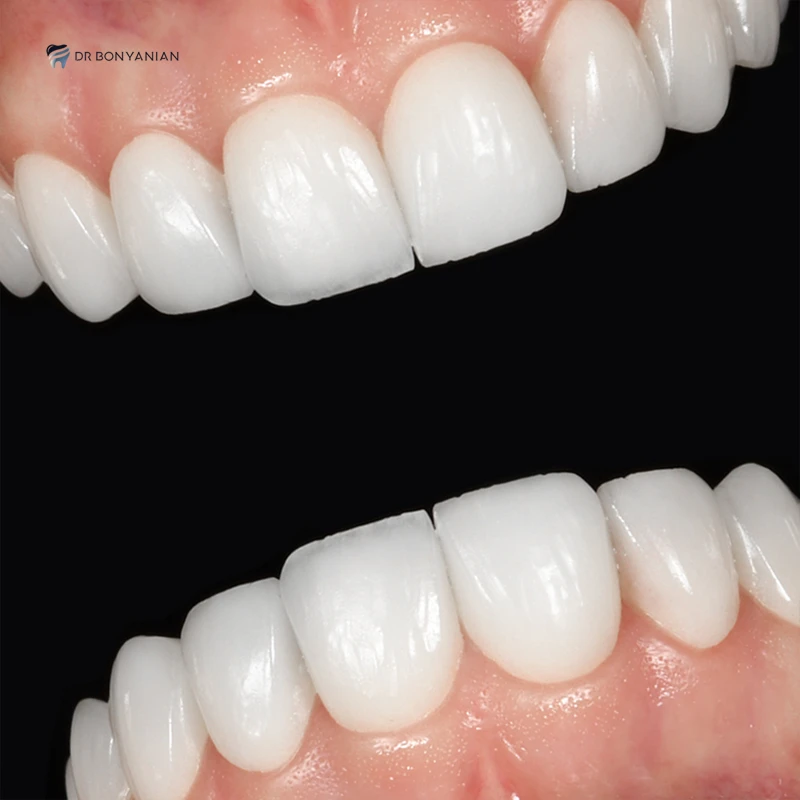
A thin, custom-made layer that is placed on the front surface of teeth to give them a beautiful and natural appearance.
Advantages of Using Dental Veneers
- Improved appearance of teeth
- Natural appearance
- High strength and durability
- No need for major surgery
- Simple care
- Coverage of minor dental problems
- Quick and non-invasive treatment
- Predictable results
- Increased self-confidence
- Repairability
Using dental veneers is an excellent solution for achieving your desired appearance. Veneers are a popular choice for individuals with broken, gapped, or misaligned teeth. In this article, we intend to discuss what a dental veneer is, its types, and also mention information regarding the uses and features of dental veneers.
What is a Dental Veneer?
A dental veneer is a thin layer made of ceramic (porcelain) or composite material that is placed on the front surface of the tooth to beautify its appearance.
These layers are custom-made for each individual and are usually used to improve cosmetic problems.

What is a dental veneer?
A dental veneer is a thin, custom-made shell designed to cover the front surface of a tooth to improve its appearance. Made from either porcelain or composite resin, veneers are used to fix a variety of cosmetic issues such as discoloration, chipped or broken teeth, gaps, or slight misalignments.
They are bonded permanently to the teeth and are crafted to match the natural color, shape, and size of the patient’s existing teeth, offering a more uniform and attractive smile.
What are the Uses of Dental Veneers?
Dentists use dental veneers to improve various dental problems, including:
- Tooth Color: Veneers can be used to cover stains, yellowness, and tooth discoloration or improper tooth color.
- Tooth Shape: Veneers can be used to straighten crooked, broken, or irregular teeth. Of course, only for teeth with minor irregularities.
- Gaps Between Teeth: Veneers can also be used to close small spaces between teeth (diastema).
The use of dental veneers, due to their cosmetic application, is considered a part of cosmetic dentistry services. In addition to covering the unsightly appearance of a restored tooth, they also protect the tooth surface. Therefore, the tooth will not require further treatments such as crowns.
If you intend to use dental veneers, we recommend consulting with the best cosmetic dentist you know for the best possible choice.

Which Dental Problems are Corrected with Veneers?
Dental veneers can correct many cosmetic dental problems. For example, one of the most common uses of veneers is correcting discolored teeth. Especially when teeth whitening has no effect (meaning the tooth has discolored from the inside).
Veneers are also an excellent option for chipped or cracked teeth, as they restore the appearance of the tooth without the need for complex treatments like orthodontics.
If teeth are slightly misaligned or there are small gaps between them, veneers can also cover these imperfections and create a more uniform appearance in the individual’s teeth.
Finally, individuals whose teeth are shorter than usual can also improve the length of their teeth with veneers and have a more harmonious smile.
Types of Dental Veneers
Most dental veneers are made of ceramic or composite resin. In fact, ceramic veneers are the same as dental laminate, and composite veneers are the same as dental composite.
Each of these veneers has different advantages and disadvantages and is considered a more suitable option for individuals with different conditions. For example, if someone is looking for higher quality, more striking beauty, and greater strength in a veneer, they should use ceramic veneers.
However, if cost is an important factor in a person’s decision-making, or if the person intends to preserve their tooth enamel (avoiding tooth grinding for ceramic veneers), it is better to use composite veneers for their teeth.

Ceramic Veneers
Ceramic dental veneers or dental laminates are thin shells that are custom-made for you and placed on your teeth. These veneers are strong and durable and give you a very natural appearance.
In addition, ceramic veneers have high resistance to color change. For this reason, with proper and principled care, you can use the beauty of your laminates for more than 15 years.
Types of Ceramic Laminate: Read More
Composite Veneers
Composite veneers are made of tooth-colored filling material and are bonded to the tooth layer by layer. Finally, the dentist will deliver a polished, smooth, and uniform tooth to you by polishing the composite.
The price of composite veneers is usually cheaper than ceramic veneers. They do not require tooth grinding, and their repair, when damaged, is easier than dental laminate. However, they do not have the strength of ceramic veneers.
Reading the article “Difference Between Composite and Laminate” will provide you with more complete information about these two cosmetic dental procedures.
Types of Composite Veneers
We can categorize composite veneers based on their placement location, application method, use, body structure, and installation method. Each type of these veneers has its own specific features, advantages, and disadvantages. However, the dentist, based on gum condition, jawbone density, and patient needs, chooses the most suitable type.
Types of Composite Veneers by Application Method:
- Partial Veneer: Partial veneer is used to restore the damaged part of the tooth, especially broken teeth, and its appearance is very similar to a natural tooth.
- Full Veneer: Full veneer is an option for complete tooth coverage. If installed correctly and cared for properly, it will have high durability.
Types of Composite Based on Place of Use:
- Anterior Dental Composite: Mostly used for cosmetic purposes, such as closing gaps between teeth and whitening them.
- Posterior Dental Composite: Used to restore posterior teeth and prevent decay and damage.
- Universal: A multi-purpose composite type that can be used in both anterior and posterior areas of the teeth.
- Self-cure: Cures without the need for light and is often suitable for filling posterior teeth.
Types of Composite Based on Application:
- Universal Composite: Used for surface and cosmetic treatments but is not suitable for deep cavities.
- Flowable Composite: With high resistance to pressure and wear, it is an excellent option for restoring small tooth cavities.
- Packable Composite: With high adhesion strength, it performs well for restoring posterior teeth.
Types of Composite by Strength:
- Flowable Composite: Has a thin consistency and is suitable for restoring surface cavities in posterior teeth.
- IPS Composite: Made of ceramic material and is highly resistant to color change.
- Bulk-fill Composite: Allows more resin to be used on the tooth and has high durability.
Types of Composite Based on Installation Method:
- Direct Composite: Placed directly on the tooth and can be done in one session. This method is faster and less expensive.
- Indirect Composite: First made in a laboratory and then bonded to the tooth. This method has higher precision and quality.
For Whom is Composite Veneer Forbidden?
Composite veneer, despite its many advantages, is not a suitable option for everyone. In the following cases, the use of this method is either forbidden or must be done with great caution and definitely under the supervision of a specialized dentist:
- Individuals with bruxism (teeth grinding)
- Those who do not maintain oral hygiene
- Individuals with active decay or gum disease
- Those looking for a permanent solution to correct their dental problems
- Adolescents and individuals with incomplete jaw growth
How Many Years is the Lifespan of Composite Veneer?
The lifespan of composite dental veneer is usually between 5 to 7 years, but this number can be less or more depending on several important factors. In ideal conditions and with good care, it can sometimes last up to 10 years.
Best Brands of Composite Dental Veneers
- 3M ESPE Filtek Supreme Ultra (USA)
- GC Gradia Direct (Japan)
- Kulzer Charisma (Germany)
- Tokuyama Estelite Sigma Quick (Japan)
- Ivoclar Vivadent Tetric EvoCeram (Liechtenstein)
- VOCO Amaris (Germany)
- Shofu Beautifil II (Japan)
- Dentsply Ceram.X (USA)
- Enamel Plus HRi (Italy)
- A3 Composite (UK)

Which Veneer is More Suitable for Me?
Which type of dental veneer is more suitable for you is a question that depends on your expectations, budget, and the dentist’s opinion. Your dentist, by evaluating your needs and desires, and also after carefully examining the condition of your teeth, will recommend the best type of veneer for you.
Advantages of Using Dental Veneers
- Results in a beautiful and natural appearance.
- Gum tissue tolerates ceramic veneers well.
- Ceramic veneers are stain-resistant.
- The color of ceramic veneers can be chosen to make dark teeth appear whiter.
- Dental veneers are a non-invasive way to change the color and shape of teeth. Because overall, placing dental veneers does not require much shaping and provides greater strength and beauty to the teeth.
Best Dental Laminate: Read More
Advantages of Ceramic Dental Veneers
Ceramic dental veneers, as one of the most popular types of veneers, have many advantages. One of the most important of these advantages is their natural and radiant appearance, similar to tooth enamel, which makes the smile look very beautiful and natural.
This type of veneer has high resistance to stains and discoloration. This means that compared to composite veneers, they retain their color for a longer period. The durability and longevity of ceramic veneers are also other advantages. Meaning, with proper care, they can last for more than 10 to 15 years.
Finally, despite their high strength, they are thin, and for their installation, only a small amount of tooth enamel is ground. Ceramic veneers have good compatibility with gum tissue and do not lead to gum irritation or inflammation.

Advantages of Composite Dental Veneers
Composite dental veneers cost less than ceramic veneers. This very advantage allows more people to use this method.
This type of veneer can be done in one session, as it does not require molding and sending to the laboratory, and the dentist can correct the shape, color, and form of the tooth on the same day.
Compared to ceramic veneers, less tooth grinding is required in this method, or it may even be done without any grinding. So, this issue helps preserve the natural structure of the tooth and makes composite veneers more suitable in some aspects than ceramic veneers.
Repairability is also another advantage of composite dental veneers. Meaning, if your composite chips or breaks, the dentist can easily repair it. Whereas, in ceramic veneers and in case of such conditions, the veneer must be completely replaced.
| Feature | Composite Veneer | Ceramic Veneer |
|---|---|---|
| Cost | Lower | Higher |
| Treatment Duration | Single session | At least two sessions |
| Lifespan | 5 years | 10 to 15 years or more |
| Resistance to Stains and Discoloration | Moderate | Very high |
| Tooth Grinding | Minimal or none | Required |
| Appearance and Transparency | Good | Very natural and similar to enamel |
| Strength and Resistance | Moderate | More resistant to chipping and breakage |
| Repairability | Easily repairable | Requires complete replacement in case of damage |
| Gum Compatibility | Good | Very compatible |
Disadvantages of Dental Veneers
- It is an irreversible procedure.
- They are not repairable and must be replaced if broken.
- Due to enamel grinding, teeth may become sensitive to hot and cold food.
- They change color over time.
- If the tooth underneath the veneer decays, the veneer must be completely removed for treatment.
You can fill out the form below to receive a free cosmetic dentistry consultation.
Is Laminate Better or Composite Veneer?
Dr. Nazanin Bonyanian, in response to the question “Is composite veneer better or laminate?”, told us:
Ceramic laminate is superior to composite in terms of durability, stain resistance, and natural beauty, and usually lasts between 10 to 15 years (or more). However, in contrast, composite veneer is cheaper, can be done in one session, and is repairable.
But it has a shorter lifespan and changes color faster. So, generally, if quality and longevity are your priority, laminate is a better option for you. But if you are looking for a faster and more economical solution, composite is more suitable for you.
Price of Dental Veneer
The price of dental veneer will vary depending on the type of veneer you choose. However, generally, the price of ceramic dental veneer is significantly higher than the price of composite veneer.
However, you should note that ceramic veneer has greater longevity. For accurate information on the price of veneer and for information on the price of composite veneer, refer to the article price of dental composite, and for ceramic, refer to the article price of dental laminate.

How to Attach Veneer to Teeth
The installation of dental veneers, whether ceramic or composite, is done in several stages. In the following, I will explain the stages of attaching veneer to teeth:
- Examination and Consultation: First, the dentist examines the patient’s dental condition to ensure that dental veneer is a suitable option. X-rays or initial impressions may be taken for a more accurate assessment.
- Tooth Preparation: For ceramic veneers, usually a thin layer of enamel (about 0.3 to 0.7 mm) is ground to allow the veneer to fit properly on the tooth. In some cases, for composite veneers, no tooth grinding is needed, or the amount of grinding is very small.Is tooth grinding necessary for laminate?: Read More
- Impression Taking (for ceramic veneers): After preparation, an impression of the teeth is taken, and this impression is sent to the laboratory to make custom veneers. During this time, the dentist may use temporary veneers to protect the teeth.
- Color Selection: For both types of veneers, the desired color is selected in coordination with the patient’s teeth to achieve complete harmony with the smile.Laminate tooth color change: Read More
- Bonding the Veneer to the Tooth (for ceramic veneers): After the veneers are ready, they are first tried on the teeth to ensure the correct size and color. Then, the teeth are cleaned and prepared. The dentist uses a special acid for etching to roughen the tooth surface and increase adhesion. Then, a special resin cement is placed on the tooth, and the veneer is bonded to it. Finally, using a special light (light cure), the cement is hardened and secured.
- Composite Veneer Placement: In the composite method, resin materials are placed directly on the teeth and gradually shaped. After achieving the desired form, it is hardened with a special light and then polished to have a smooth and natural surface.Tooth decay after laminate: Read More
- Final Adjustments and Bite Check: The dentist ensures that the veneers are correctly placed on the teeth and do not cause any problems when biting. If necessary, minor adjustments are made.
- Post-Installation Care: The patient receives recommendations regarding oral hygiene, avoiding hard or staining foods (for composite veneers), and regular check-ups. With proper care, dental veneers can create a beautiful and lasting smile.
How Long is the Durability and Lifespan of Dental Veneer?
It is between 5 to 10 years, after which the composite veneer must be replaced. Also, the longevity of composite veneer or ceramic veneers, provided they are properly maintained, is lifelong and in the worst case, 15 years. Laminate longevity.
What Factors Affect the Lifespan and Durability of Dental Veneer?
Usually, the lifespan and durability of dental veneer depend on various factors. Some of these factors are related to the type of veneer, and others are related to its care. For example:
- Type of Veneer: Ceramic veneers have higher strength and resistance and last between 10 to 15 years or more. While composite veneers typically last about 5 to 7 years.
- Dentist’s Skill: The dentist’s skill in preparing the tooth, using quality bonding materials, and the correct execution of the installation and bonding stages of the veneer have a direct impact on the durability of the veneer. Strong and proper adhesion prevents detachment or damage to the veneer.
- Oral Hygiene: Regular brushing, flossing, and regular visits to the dentist for check-ups and scaling greatly affect the increased lifespan of the veneer.
- Avoiding Excessive Pressure on Teeth: Habits such as bruxism and nail-biting can cause veneers to crack or break. Therefore, if you have bruxism, it is better to use a night guard while sleeping.
- Diet and Drinks: Especially the type of diet and drinks for those who use composite veneers is forbidden. Because these drinks cause discoloration of the veneer.
- Quality of Materials Used: The higher the quality of the ceramic or composite used by the dentist, the longer the veneer will last. High-quality materials have greater resistance to wear, discoloration, and chipping.

Cleaning and Caring for Dental Veneers
Cleaning dental veneers is the same routine as caring for teeth. Brushing, flossing, and using a suitable toothpaste are essential for oral and dental health. Never forget that the dentist is your friend and helps you maintain your oral and dental health. So, visit the dentist periodically (e.g., every 6 months).
Keep your teeth clean regularly in your daily routine and consult your dentist about various products that are useful for protecting veneers. The dentist should answer your questions, including what a dental veneer is and whether veneer is suitable for you.
In this regard, you can fill out the form below to receive a free dental consultation:
Pre-Veneer Care
- Before getting veneers, your teeth and gums should be healthy. It is better for the dentist to treat any disease or decay before placing veneers.
- Veneers are usually not suitable for people who suck their fingers or clench their teeth, as veneers may become thin or break. If you suck your finger or clench your teeth, the dentist will probably suggest using a plastic mouthguard while sleeping.
- Although the dentist removes a small amount of tooth enamel, this process is not reversible after enamel grinding.
- Veneers may loosen over time. In this case, new veneers may be needed.
- Like all dental care, discuss all your expectations and treatment methods with your dentist. Regular visits to the dentist are important for healthy teeth and gums.
Post-Veneer Care
- Veneers can crack or break under pressure. Therefore, avoid biting your nails and chewing hard objects like pencils or ice.
- It takes a few days to get used to your veneers. However, if the veneers bother you after this period, inform your dentist. They will repair them immediately.
- Keep your teeth and gums clean by brushing and flossing daily. You may still get cavities under or around the veneers. Use dental care products that have the American Dental Association (ADA) seal of acceptance. This seal indicates that a product is safe and effective according to ADA standards.
Placing Dental Veneers at Dr. Bonyanian’s Dental Clinic
Dr. Bonyanian’s dental clinic, with the presence of the best dentists and cosmetic and restorative specialists, recognized as one of the best dental clinics in Tehran, is ready to provide cosmetic dental services to you dear ones.
The popularity of veneers, due to their stunning beauty, is increasing day by day around the world. So, if you also intend to use various types of dental veneers, after reading this article completely, to book your appointment with the clinic, contact Dr. Bonyanian’s dental clinic at 00982188539720 or visit us at our address: Tehran, Arjantin Square, Ahmad Qasir (Bokharest) Street, Sixth West Street, No. 22, Unit 7.
The Right Choice for a Beautiful Smile: A Clinical Consultation Experience Between Composite Veneer and Ceramic Laminate
A few months ago, a roughly 28-year-old girl named Negin came to our clinic. From the moment she entered, it was clear that she was not happy with the appearance of her smile. Her front teeth had some gaps, and their color had also changed over time. Negin had done her research before the consultation and was hesitant between two options: composite veneer and ceramic laminate; both in terms of cost and in terms of durability and final result.
Dr. Nazi Bonyanian, after a thorough examination of the teeth and listening to Negin’s concerns, scheduled a specialized consultation time for her. The doctor explained to her that considering the shape of her jaw, the way her teeth occluded, and the high importance of beauty in Negin’s smile, ceramic laminate could be a more stable choice. However, since Negin was worried about the cost, Dr. Bonyanian, without any pressure or insistence, explained the advantages and disadvantages of both methods to her in simple language.
In the end, Negin decided with complete confidence to use laminate. Now that a few months have passed since the laminate installation, she has left us a comment saying, “Every time I smile, I feel like I’m seeing a new version of myself!” and this is the best reward for us.
Final Conclusion
Dental veneer is one of the suitable options for individuals looking for a solution to improve the appearance of their smile. Veneers are thin, custom-made shells that are placed on your teeth and cover the imperfections of your teeth.

Dr. Nazi Bonyanian
Dental Surgeon (DDS) — Medical Council Number: 138662
Graduate of Isfahan University of Medical Sciences with over 15 years of experience in implants, laminates, and oral and dental surgery.
Address: No. 22, Unit 7, West Alley 6, Bokharest Street, Argentina Sq., Tehran, Iran
Phone: +98-21-88539720 | WhatsApp: +98-912-514-2202
Email: info@drbonyanian.com
Working Hours: Sat–Wed 09:00–20:00 | Thu 09:00–14:00 | Friday Closed
⚠️ اطلاعات این صفحه صرفاً برای آگاهی است و جایگزین معاینه و تشخیص تخصصی نمیباشد.
