



What is a dental cyst? → Swollen, closed sacs filled with infectious and non-infectious material.
Symptoms of a dental cyst:
- Swelling in the jaw or gum area
- Painless in the early stages
- May grow larger over time
- A feeling of pressure or fullness in the jaw
- Dull or intermittent pain at the site of the affected tooth
- Sensitivity when chewing or applying pressure to the tooth
- Loosening of surrounding teeth
- Protrusion or deformation of the gum (abnormal bump)
- Bad breath or pus discharge from the infected area
Have you ever heard of a dental cyst? These small, fluid-filled sacs that form around the roots of teeth may be unfamiliar to some. But do you know how these cysts develop and what dangers they can pose?
In this article from the Dr. Bonyanian dental website, we will comprehensively review dental cysts, their symptoms, causes, and treatment methods in simple and clear language. So, stay with us to become fully acquainted with these cysts.
What is a Dental Cyst?
A dental cyst is a small, closed sac that forms within the tissues surrounding a tooth, usually at the root. This sac contains fluid and gradually grows larger.
Cysts are typically painless and may not be detected until they become large enough.

Types of Dental Cysts
In total, there may be more than 10 different types of dental cysts, each with its own specific signs. However, the most famous and common types of cysts include:
Gingival Cyst (Peripheral)
A gingival cyst, or peripheral cyst, is a type of cyst that develops on the gums, often near the gumline. Unlike dental cysts that usually form at the root of teeth or in the jawbone, this type of cyst is located entirely in the soft tissue of the gum.
Peripheral cysts are usually small and have slow growth. In many cases, they are completely asymptomatic and are discovered incidentally during a dental examination. However, in some instances, they may appear as a small, white or pinkish bump on the gum, which is sometimes mistaken for a pimple or a wart.

The exact cause of peripheral cysts is not yet fully understood, but some factors such as chronic gum irritation, mild infections, and certain changes in the gum tissue may play a role in their development. These cysts are usually benign and do not invade surrounding tissues.
Ultimately, it’s good to know that peripheral cysts are one of the common oral cysts and usually do not require serious concern. However, for an accurate diagnosis and appropriate treatment, it is recommended to visit a dentist if you notice any unusual bumps or lesions on your gums.
Radicular Cyst
A radicular cyst, or periapical cyst, is also one of the most common types of dental cysts. These cysts are located around the tip of the tooth root and often result from an infection or inflammation in the dental pulp.
The pulp is the soft part containing nerves and blood vessels located in the center of the tooth. Therefore, when the pulp becomes infected due to decay, trauma, or improper root canal treatment, the body forms a cyst around the root tip to combat the infection.

Treatment for a radicular cyst usually involves surgery. This surgery involves removing the cyst along with a portion of the surrounding bone. In some cases, a standard root canal treatment may help eliminate the cyst. However, the choice of treatment method depends on the size and location of the cyst, the condition of the tooth, and the dentist’s opinion.
| halitosis home remedies | mouth smell solution | bad breath home remedies |
| remedy for bad breath | mouth smell remedies | remedies for bad breath |
| eliminate bad breath | mouth smell home remedies | bad breath remedy |
Periodontal Cyst
Another type of dental cyst is the periodontal cyst. This is a benign cyst that develops in the tissues surrounding the tooth root and is usually caused by gum disease (periodontitis).
Unlike radicular cysts, which typically form at the tip of the tooth root, periodontal cysts develop on the lateral aspects of the root, where the root connects to the jawbone.

Diagnosis of a periodontal cyst is possible through both clinical examination and radiographic imaging. In a radiograph, this cyst appears as a clear, round area around the tooth root. For its treatment, there is no option other than surgery to remove the cyst and the surrounding infected tissues.
Periapical Cyst
Periapical cyst is a dental term often used as a synonym for radicular or periapical cysts. This type of cyst forms around the tip of the tooth root and is usually the result of infection or inflammation in the dental pulp (the inner part of the tooth containing nerves and blood vessels).
In its early stages, a periapical cyst is usually asymptomatic. But as it grows larger, the following symptoms may appear one by one:
- Pain in the tooth area
- Gum swelling
- Abscess (What is an abscess)
- Sensitivity to pressure
- Tooth mobility

Dentigerous Cyst
This type of cyst is also called a follicular cyst. These cysts mainly occur near the crown of a wisdom tooth. The best preventive treatment for this type of cyst is wisdom tooth extraction, and we have discussed the costs of this procedure (such as the cost of impacted wisdom tooth surgery) in detail in another article.
Mucocele Cyst
Mucocele or mucous cysts often occur in the oral mucosa, affecting the inner surface of the cheeks, lips, or tongue. The main reason for the occurrence of this cyst can be pressure, irritation, or trauma to this part of the oral tissues.
Mucocele cysts are divided into two categories:
- Extravasation Mucocele: In this type, due to trauma or injury to the ducts of minor salivary glands, these ducts rupture, and saliva leaks into the underlying tissues, causing a cyst to form.
- Retention Mucocele: In this type, a blockage in the salivary gland ducts leads to the accumulation of saliva and the formation of a cyst.

Odontogenic Cyst
The last common type of oral and dental cyst is the odontogenic cyst. These are cysts that occur in the jawbone, and although they are very rare, they grow rapidly and are considered one of the most troublesome types of cysts.
Also, identifying these cysts is slightly more difficult compared to other types of cysts.
Radicular Cyst
A radicular cyst (Radicular cyst) is one of the most common types of dental cysts that usually arises from a long-standing infection of a dead or untreated tooth root. This type of cyst typically forms around the root tip of teeth whose pulp (nerve) has been damaged or has become necrotic.
A radicular cyst often grows gradually and painlessly and may remain asymptomatic for a long time. However, in some cases, it can cause swelling, a feeling of pressure, displacement of teeth, or even jawbone resorption.

How is a Radicular Cyst Treated?
Treatment depends on the size of the cyst, its location, and the condition of the involved tooth, but the treatment of this cyst generally includes the following steps:
- Root Canal Treatment: If the tooth is still salvageable, root canal treatment can lead to a reduction in inflammation and shrinkage of the cyst. Sometimes, this step alone is sufficient for treatment.
- Surgery (Apicoectomy or Cystectomy): In cases where the cyst is large or root canal treatment is not sufficient, surgery may be necessary. In this procedure, the entire cyst is removed from the bone, and the tip of the tooth’s root is also removed.
- Tooth Extraction: If the involved tooth cannot be saved, the tooth must be extracted along with the cyst, and then the site is thoroughly cleaned.
What are the Signs and Symptoms of Oral Cysts?
Before an oral cyst worsens, it exhibits signs and symptoms that make it easier to identify. The more these symptoms intensify, the more advanced the disease becomes.
Among the most important symptoms that can help you detect the presence of a cyst in your mouth, we can mention the following:
- Toothache
- Pressure in the cyst area
- Inflammation and redness of the tissue involved with the cyst
- Blisters or sores

How are Cysts Diagnosed?
The diagnosis of cysts may be visual, based on their type and symptoms. Otherwise, as prescribed by the dentist, these cysts can be identified with X-ray imaging.
In cases where the cyst has grown larger than 2 centimeters and shows signs of cancer, the specialist will try to diagnose the type of cyst by taking a biopsy. Also, if the cysts have grown in the jawbone area, necessary imaging with a CT scan or MRI will be performed.
What Complications Do Dental Cysts Cause?
A dental cyst is associated with complications for the patient, and if left untreated, it can lead to the destruction of parts of the jawbone and teeth. In more advanced cases, these cysts can even endanger the patient’s health.
In any case, dentists regularly advise patients who come to them with symptoms of a dental cyst to take action to treat their dental cyst as soon as possible.
Among the most important complications that dental cysts can cause for individuals, we can mention the following:
- Infection in the tooth area
- Tooth loss and the necessity of tooth extraction
- Occurrence of benign tumors in the jaw
- Jaw fracture

What are the Treatment Methods for Oral and Dental Cysts?
One of the main concerns for patients with oral and dental tissue cysts is learning about the treatment methods for these cysts. In response to this, we can state that the most important factor in choosing a treatment method is the extent of progression and the type of cyst.
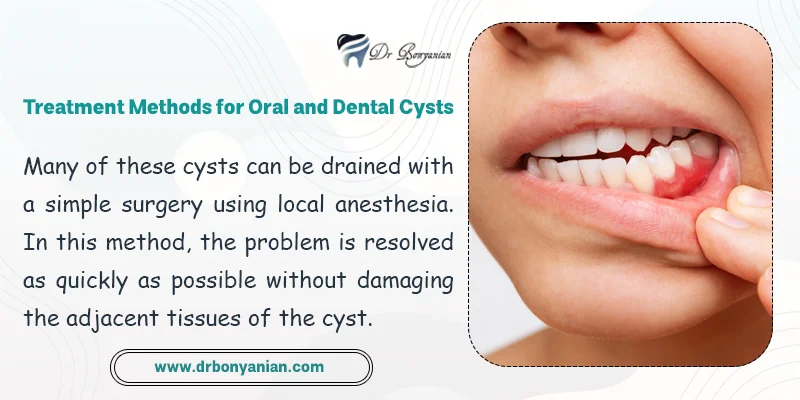
Many of these cysts can be drained with a simple surgery using local anesthesia. In this method, the problem is resolved as quickly as possible without damaging the adjacent tissues of the cyst.
However, another method that specialist surgeons usually choose in cases of high cyst prevalence is the Marsupialization surgery. In this method, the dentist opens the cyst and drains its infectious and waste materials. Afterwards, by suturing parts of the cyst, they prevent it from growing larger in the future.
Keep in mind that if the cyst in the tooth area has destroyed the root nerve, performing a root canal treatment is essential and undeniable. Nevertheless, before any action, the dentist will ascertain the size and location of the cyst with X-rays and CT scans and ultimately choose the best method to proceed with treatment.
What is the Difference Between a Dental Cyst and an Abscess?
To better understand the difference between a cyst and a dental abscess, you can refer to the table below:
| Characteristic | Dental Cyst | Dental Abscess |
|---|---|---|
| Definition | A closed, fluid-filled sac that forms in the tissues surrounding a tooth. | An acute infection accompanied by the accumulation of pus in the tooth or gum tissues. |
| Cause | Usually results from a chronic infection in the dental pulp or its surrounding tissues. | Usually caused by an acute bacterial infection. |
| Growth | Usually has slow growth and may be asymptomatic for years. | Usually has faster growth and can quickly cause symptoms. |
| Pain | Usually painless unless it becomes infected or puts pressure on a nerve. | Usually painful and can be throbbing or constant. |
| Swelling | May cause mild, painless swelling. | Usually causes severe swelling and redness in the infected area. |
| Pus | Contains clear or slightly cloudy fluid. | Contains pus. |
| Treatment | Usually requires surgery to remove the cyst. | May be treated with antibiotics and surgery to drain the pus. |
What Factors Lead to the Formation of Dental Cysts?
It is clear that the formation of a cyst in the mouth or tooth must have a reason. Right?
There are many reasons that can lead to the formation of cysts in the mouth. The most prominent of these factors include the following:
- Growth of permanent teeth in the wrong position
- Abnormal tooth development
- Complications from root canal treatment
- Presence of hereditary disorders or Gorlin syndrome
- Growth of a wisdom tooth
- Cellular mutations during tooth development
Wisdom Tooth Cyst
A wisdom tooth cyst is a type of dentigerous cyst (Dentigerous cyst) that forms around the crown of an impacted or partially erupted wisdom tooth. This cyst develops when fluid accumulates between the wisdom tooth and the surrounding tissue. If the wisdom tooth does not erupt properly and remains impacted in the jaw, the likelihood of this cyst forming increases.
In most cases, a wisdom tooth cyst is asymptomatic and is only discovered on radiographic or panoramic (OPG) X-rays. But if left untreated, it can cause jawbone destruction, displacement of adjacent teeth, infection, or pain.
Common Symptoms of a Wisdom Tooth Cyst
- Swelling in the back of the jaw
- Feeling of pain or pressure
- Bad breath or pus discharge in cases of infection
- Observation of a lump or protrusion in the jaw
Treatment of a Wisdom Tooth Cyst
Treatment is performed based on the size of the cyst and the condition of the wisdom tooth:
- Surgical removal of the cyst and wisdom tooth: In most cases, extracting the impacted wisdom tooth along with the cyst via surgery will be necessary.
- In advanced cases: If the cyst is large and has caused bone resorption, reconstruction of the area using a bone graft may be required.
- Regular follow-up: Even if the cyst is small and asymptomatic, it should be monitored to prevent its progression.
💬 Dr. Bonyanian:
In many patients, wisdom tooth cysts are completely asymptomatic and are only detectable with a simple X-ray. This is why we always emphasize regular radiological examinations, especially for impacted wisdom teeth, as early treatment prevents serious complications in the future.
How Can We Prevent the Formation of Oral Cysts?
The good news about oral and dental cysts is that you can prevent their occurrence by following some hygiene tips. Simple tips that should, over time, become part of your routine for maintaining the health of your mouth and teeth.
Regular and thorough brushing at least twice a day and daily flossing help to completely clean the mouth and remove plaque and food debris. As a result, the chance of bacteria remaining that could lead to a tooth infection will be reduced.

Regular visits to the dentist for early detection and treatment of dental problems is another simple strategy that can prevent the formation of these annoying cysts.
A healthy and balanced diet also plays an important role in maintaining oral and dental health. Consuming foods rich in vitamins and minerals helps strengthen the body’s immune system and reduces the risk of oral infections. On the other hand, quitting harmful habits like smoking and excessive alcohol consumption, which can damage gums and teeth, is very important.
However, you should know that maintaining oral and dental hygiene is not a guarantee for preventing the occurrence of oral cysts. Because, as we wrote above, sometimes the reasons for the formation of these cysts are not related to the person themselves (it’s practically out of your hands!)
For example, when a wisdom tooth grows in the wrong direction, or a person has a genetic disorder.
Treatment of Tooth and Gum Cysts
Usually, the most appropriate treatment for removing a cyst from your gum or tooth is chosen by the dentist, based on the type of cyst you have and, of course, the cause of its formation.
For example, some cysts are merely abscesses resulting from an infection that the dentist drains during your root canal treatment. But there are also cases where the origin of the cysts is gum disease. In such situations, the person must first seek treatment for the underlying disease so that the cyst can be treated with medication or surgery becomes possible.

Another important point in the treatment of tooth and gum cysts is that you must see an experienced and skilled specialist and gum surgeon for the treatment and surgery of these cysts. Because the surgeon’s experience and expertise can greatly help in accurately diagnosing the cause of the cyst formation and accelerating your treatment process.
Dr. Bonyanian Dental Clinic is one of the specialized clinics in the field of oral and dental services that, with the presence of expert specialists and the use of advanced equipment, undertakes the treatment of various oral and dental problems, including the treatment of cysts.
If you need an examination and treatment for any type of cyst in the oral and dental area, you can contact our clinic’s experts at 00982188539720 or enter your information in the form below to schedule an appointment.
Types of Cyst Removal Surgery
If a specialist dentist in the field of oral and dental surgery deems that your cyst requires surgery, you should proceed with the cyst removal surgery immediately. This is because the dentist has certainly taken seriously the possibilities of the cyst growing larger, becoming infected, and the infection spreading to other teeth.
If the individual is unwilling to undergo this surgery, they will likely have to have the tooth affected by the cyst completely extracted.
Dental Cyst Removal
Cyst removal is one of the most common and standard methods for treating oral and dental cysts. However, the removal of that cyst depends on its size and the extent of its progression. Sometimes it is necessary to first drain the contents of the cyst. At other times, the dentist may decide to immediately remove the cyst and the surrounding tissues.

If the goal is to remove the entire cyst, the surrounding tissue will also heal quickly. However, if the cyst is in the jawbone area, after the cyst is removed, the person will need a bone graft in that area.
Cyst Removal with Laser
The laser tool is simply intended to perform the incision of the cyst and its surrounding area with high precision for your dentist. This means that using a laser is not considered a separate treatment method; rather, it is a tool that, alongside other surgical methods, increases the surgeon’s precision and speed, resulting in a shorter recovery period for the patient.
However, note that in some cases, using a laser may not be very suitable! This means the dentist might be able to perform your treatment with greater precision and speed using traditional methods! Therefore, it is best to leave the decision about using a laser to your dentist.

Cryotherapy
In this method, your cyst is dried to a great extent by freezing and is ultimately removed along with the surrounding infected tissue.
Cryotherapy is performed with the help of liquid nitrogen or other very cold gases. This means these substances cause ice crystals to form inside the cells, destroying them.
However, cryotherapy is not suitable for all types of cysts and is not recommended for large or deep cysts. Also, side effects such as blistering at the treatment site, the possibility of infection, and skin discoloration are considered complications of this treatment method.
Injecting Medication into the Cyst
The last common method for treating a cyst is injecting medication into it. The medication used is usually a type of corticosteroid that helps reduce inflammation and swelling around the cyst. Although this drug does not directly eliminate the infection, by reducing inflammation, it helps improve the patient’s symptoms and shrink the cyst.

After the cyst has shrunk sufficiently, the dentist can proceed with its surgical removal.
How Long Does Dental Cyst Surgery Take?
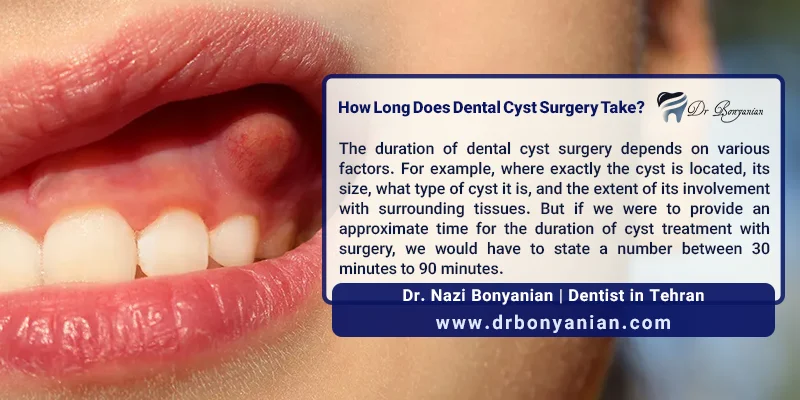
The duration of dental cyst surgery depends on various factors. For example, where exactly the cyst is located, its size, what type of cyst it is, and the extent of its involvement with surrounding tissues.
But if we were to provide an approximate time for the duration of cyst treatment with surgery, we would have to state a number between 30 minutes to 90 minutes.
In simple cases, the surgeon drains or completely removes the cyst from your tooth/mouth with a small incision. But in more complex cases, it may be necessary to remove a part of the jawbone or even the adjacent tooth, which naturally requires more time.
In general, this surgery is often performed on an outpatient basis with local anesthesia, and after the operation, the patient can go through a short recovery period by following post-surgical recommendations.
Dr. Bonyanian’s treatment team will be with you at all stages, from the initial evaluation to post-surgery follow-up, to ensure the treatment process is carried out in the best possible way.
Home Remedies for Dental and Oral Cysts
One of the frequently asked questions that many patients ask the specialists at Dr. Bonyanian Dental Clinic is, “What home remedies are there for treating oral and dental cysts?”
The truth is that this largely depends on the type of cyst. For example, there may be home remedies for abscesses caused by tooth infections, but for cysts caused by gum diseases, home remedies will not be effective.
The remedies we mention below are only used to reduce the pain and inflammation of your oral cyst. So, remember not to use these remedies as a definitive treatment for your oral cyst and be sure to visit a specialist dentist at the earliest opportunity.
Using Turmeric
Spices have antibacterial and anti-inflammatory properties, and for this reason, we can use turmeric to treat cysts. To do this, simply mix some milk with a spoonful of turmeric and place the resulting mixture on the cyst. After a while, you will notice a reduction in pain and swelling.

Using Tea Tree Oil
The antibacterial property of this oil is very beneficial for eliminating infection, especially for cysts in the tooth area. To benefit from the properties of tea tree oil for treating your oral and dental cysts, you should mix some water with tea tree oil to dilute it. Then, you should apply this mixture with a cotton ball to the cyst area several times throughout the day.
Clove Oil
Clove oil is used to relieve toothache and other oral problems like oral and dental cysts due to its antibacterial and anti-inflammatory properties. To use it, simply soak a cotton ball in this oil and place it on your tooth or cyst.

Salt Water
The best and most effective remedy that has been recommended and used for oral and dental diseases and even for preventing dental problems since ancient times is salt water. You can use salt water as a mouthwash several times a day. By doing this, your sores, inflammations, and cysts will gradually subside.
What is the Best Medication for a Dental Cyst?
We must first emphasize that no single medication can completely cure your dental cyst. Although drugs can only help control inflammation, infection, and reduce the symptoms of your dental cyst, the primary treatment is often surgery or root canal therapy.
However, the medications that a dentist might prescribe for temporary control of the condition include:
Antibiotics: Used to reduce the infection around the cyst, especially if the patient has swelling, fever, or pus discharge.
-
- Amoxicillin (or Amoxicillin + Clavulanate)
- Metronidazole (sometimes in combination with Amoxicillin)
- In case of allergy: Clindamycin or Azithromycin
Pain Relievers and Anti-inflammatories:
-
- These are useful for controlling pain and inflammation around the cyst.
Ibuprofen, Gelofen, or Acetaminophen (in cases where the patient has gastrointestinal issues or sensitivity to NSAIDs)
Antiseptic Mouthwashes
-
- To reduce the microbial load in the area and prevent secondary infections:
- Chlorhexidine 0.2% (limited use for up to 2 weeks)
⚠️ Important Note: Medications can temporarily stabilize the condition. But for a definitive cure of the cyst, depending on its type, procedures such as root canal treatment, surgical removal of the cyst, or extraction of the involved tooth (in non-salvageable cases) must be performed.
Extracting a Tooth with a Cyst
Extracting a tooth with a cyst is a common treatment method in cases where the involved tooth is so damaged that it can no longer be saved, or when the cyst has caused severe destruction of the surrounding tissues.
When is it necessary to extract a cystic tooth?
A dentist may decide to extract the tooth under conditions such as:
- A tooth whose root is severely resorbed or fractured
- The presence of a large cyst or severe infection that cannot be controlled with root canal treatment
- Simultaneous involvement of the cyst with the jawbone or adjacent teeth
- Cysts like dentigerous cysts that involve an impacted wisdom tooth.
Final Summary
Although an oral or dental cyst is an annoying and uncomfortable condition, it is a treatable problem. By visiting a dentist in a timely manner and undergoing appropriate treatments, you can prevent its aggravation and the occurrence of more severe potential complications.

Dr. Nazi Bonyanian
Dental Surgeon (DDS) — Medical Council Number: 138662
Graduate of Isfahan University of Medical Sciences with over 15 years of experience in implants, laminates, and oral and dental surgery.
Address: No. 22, Unit 7, West Alley 6, Bokharest Street, Argentina Sq., Tehran, Iran
Phone: +98-21-88539720 | WhatsApp: +98-912-514-2202
Email: info@drbonyanian.com
Working Hours: Sat–Wed 09:00–20:00 | Thu 09:00–14:00 | Friday Closed
⚠️ اطلاعات این صفحه صرفاً برای آگاهی است و جایگزین معاینه و تشخیص تخصصی نمیباشد.
