



What is a Ceramic Dental Crown? → A ceramic dental crown is a tooth-shaped cap made of ceramic material used to restore damaged teeth or for cosmetic enhancement.
Benefits of Ceramic Dental Crowns
- Natural appearance and high translucency
- Color matching with natural teeth
- Metal-free and suitable for individuals with metal allergies
- Resistant to staining
- Creates a natural gum line without a dark margin
- Does not harm the gums
- Improves the aesthetics of front teeth
- Suitable for teeth restored due to decay
A dental crown is one of the most popular methods for tooth restoration and cosmetic enhancement. It’s a solution that can provide a long-term way to extend the life of a decayed or damaged tooth. However, its longevity largely depends on the material. A ceramic dental crown is a type of dental crown that offers a combination of beauty and high quality.
This crown has various advantages, disadvantages, and applications. Being aware of them will help you make the best choice when deciding on a crown for your teeth. If you want to learn what a ceramic dental crown is and explore the different types of this durable and beautiful restoration, continue reading this article.
What is a Ceramic Dental Crown?
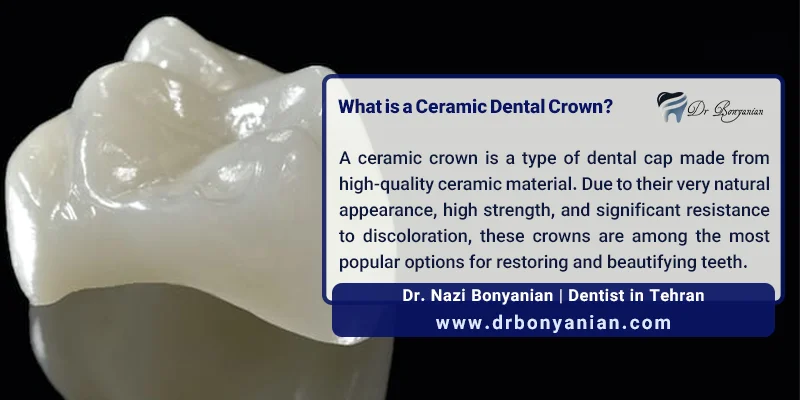
A ceramic crown is a type of dental cap made from high-quality ceramic material. Due to their very natural appearance, high strength, and significant resistance to discoloration, these crowns are among the most popular options for restoring and beautifying teeth.
Applications of Ceramic Dental Crowns
Generally, a dental crown is typically used to prevent further damage and protect a tooth that has previously undergone a root canal. We suggest reading the article on the reasons for needing a crown on a root-canaled tooth. However, this is not the only application for a ceramic dental crown.
A ceramic crown can also be used to stabilize a tooth. This means it can protect broken or cracked teeth and prevent them from fracturing further. It can even be placed over them to conceal the unappealing appearance caused by the fracture.
A dentist might also recommend a ceramic crown for individuals whose teeth are discolored. Because of its very natural appearance, the ceramic crown hides the imperfections of the tooth, giving the teeth a uniform and beautiful look.

In some cases, a dental crown is prescribed to correct malformations and create symmetry among the teeth, as some people naturally have irregularly shaped teeth.
We emphasize that by “irregular,” we do not mean crowded or crooked teeth, as those issues require orthodontic treatment. We are referring to irregularities such as one tooth being excessively short or even longer than the others.
Finally, a ceramic dental crown is an excellent option for use on a dental implant. It is a beautiful crown that completes your dental implant process and gives you a completely natural-looking tooth.
Read more: Dental Crown Falling Off
Contraindications for Ceramic Crowns
- Individuals who grind their teeth (bruxism): Because ceramic crowns are sensitive to high pressure and abrasion and may crack or fracture.
- Those who chew hard substances (like ice or nuts): This behavior can damage ceramic crowns.
- Individuals needing restoration for posterior (back) teeth: Ceramic crowns are generally more suitable for front teeth, as they may not have sufficient strength for back teeth, which endure more pressure.
- Individuals with insufficient tooth enamel: Placing an all-ceramic crown requires shaving down the tooth enamel, and if there isn’t enough volume, these crowns may not be suitable.
- Those with gum problems: Gum issues can lead to inadequate crown stability and a higher risk of damage.
- Individuals with metal allergies who exert significant pressure on their teeth: In these cases, zirconia crowns might be a better option due to their higher strength.
- Individuals with a limited budget: All-ceramic crowns are more expensive compared to other types of crowns (such as porcelain-fused-to-metal or zirconia). (See our article on ceramic dental crown prices)
Types of Ceramic Dental Crowns
After learning about ceramic crowns, you might wonder what types are available. It’s important to note that ceramic crowns are divided into different types based on the kind of ceramic used and their manufacturing method. Each type of ceramic crown has its own specific features and applications.
For example, one type of ceramic crown is the full crown, which comes in two varieties: all-ceramic crowns and ceramic crowns with a metal base. Another type is ceramic veneers, which include various kinds like Emax, Empress, and Lumineers.

1. All-Ceramic Crown
An all-ceramic crown is a restoration made entirely of ceramic materials. This means no metals or other materials are used in its construction. All-ceramic crowns are very popular due to their natural appearance, high translucency, and compatibility with gum tissue.
2. Porcelain-Fused-to-Metal (PFM) Crown
A Porcelain-Fused-to-Metal (PFM) crown has a metal core with an outer layer of ceramic. This type of crown offers greater strength than all-ceramic crowns, and the metal core is not visible from the outside.
For more information, we recommend reading the article on PFM crowns.
Benefits of Ceramic Dental Crowns | Why Should You Choose a Ceramic Crown?
Ceramic crowns are recognized as one of the best types of dental crowns due to their natural appearance, high strength, and numerous other benefits. These crowns offer several advantages, which we will discuss in more detail below.
1. Natural Appearance
Thanks to their translucency and natural color, ceramic crowns look just like natural teeth. This feature allows the crowns to blend seamlessly with other teeth, giving you a beautiful and natural smile.

2. High Durability
In addition to their aesthetic appeal, ceramic crowns are highly resistant to wear, fracture, and staining. For this reason, they are long-lasting, protect your tooth well, and do not change color over time.
Read more: Pain After Tooth Preparation for a Crown
3. Hypoallergenic and Biocompatible with Gums
Although dental crowns are generally not allergenic, ceramic crowns eliminate even the very low risk of sensitivity to the metals found in other crowns. Furthermore, ceramic crowns are fully compatible with the gums and do not cause any irritation or sensitivity.
4. Variety in Ceramic Dental Crown Shades
After taking an impression of your tooth, your dentist will select the most suitable shade for your ceramic crown. The dental laboratory can create the crown in a wide range of shades, highlighting the great color variety available for ceramic dental laminates.

5. Oral Hygiene
Ceramic dental crowns have a smooth, polished surface that prevents food debris from getting trapped, thereby stopping bacteria from compromising oral hygiene.
Given the many advantages of ceramic crowns, they are considered one of the best options for restoring and enhancing teeth. So, if you are looking for a crown with a natural look that is also strong and durable, a ceramic dental crown is an excellent choice for you.
Read more: Zirconia Dental Crowns
Who is a good candidate for all-ceramic crowns?
- Individuals who prioritize dental aesthetics: Because these crowns have a natural, translucent appearance similar to real teeth.
- Those restoring their front teeth: Ideal for front teeth due to high color matching and natural look.
- Individuals with metal allergies: Since these crowns are metal-free, they do not cause allergic reactions.
- Those with sufficient enamel thickness: Because a portion of the tooth enamel is removed to place an all-ceramic crown.
- Individuals with good oral hygiene: Proper care can extend the lifespan of these crowns.
- Patients whose teeth do not bear excessive pressure: More suitable for front teeth and some back teeth that experience less force.
- Individuals who do not have severe bruxism: Because these crowns are more brittle than zirconia or PFM types and are prone to cracking under high pressure.
- Those looking for crowns without a dark gum line: Unlike PFM crowns, which may create a dark line at the gum, all-ceramic crowns do not have this issue.

The Procedure for Getting a Ceramic Dental Crown
The impression and placement of a ceramic dental crown are usually completed in two appointments. This is the same number of sessions required for other types of dental crowns.
First Appointment:
In the first session, the dentist prepares the tooth and takes an impression. This impression is then sent to a dental laboratory to create the custom ceramic crown. Usually, after preparing the tooth and taking the impression, the dentist places a temporary crown, known as an immediate dental crown, to protect the prepared tooth and prevent sensitivity.
Second Appointment:
In the second session, the finished crown is placed on the tooth. After approval from both the dentist and the patient, it is permanently bonded to the underlying tooth with a special adhesive. If you’d like to know how long it takes to make a dental crown, we have covered this topic in a separate article.
Ceramic Dental Crown Placement at Dr. Bonyanian’s Clinic
After learning about ceramic dental crowns, it is worth mentioning that Dr. Bonyanian’s dental clinic, as the best dental clinic in Arjantin Square, utilizes the latest technologies and a team of specialists to provide ceramic crown services. For added assurance, you can view patient satisfaction with our services on the Reviews about Dr. Bonyanian page.
If you would like to schedule a free dental consultation, you can use the form below, and our experts will contact you as soon as possible. You can also visit our clinic at Unit 7, No. 22, West 6th St., Ahmad Qasir (Bokharest) St., Arjantin Square, Tehran, or call us at +98 (21) 88539720.
Disadvantages of Ceramic Dental Crowns
Although ceramic crowns have many advantages, like any other dental treatment, they may have some drawbacks. However, the disadvantages of ceramic crowns are minimal compared to their benefits.
The general disadvantages of ceramic crowns include:
- High Cost: Higher price compared to other types of crowns.
- Time-Consuming: The fabrication and installation process can be longer than for some other crowns.
- Sensitivity to Impact: Although ceramic crowns are very durable, they can crack or break if subjected to a strong impact.

What is the Lifespan of a Ceramic Dental Crown?
One of the most common questions about this type of crown is its lifespan. How many years do you think a ceramic crown lasts? You should know that the lifespan of a ceramic dental crown depends on various factors. Therefore, it is impossible to determine an exact number for its longevity.
However, in general, if you take good care of your ceramic dental crown, you can expect it to last in your mouth for up to 15 years.
How Likely is an All-Ceramic Crown to Fail?
The probability of an all-ceramic crown failing is higher compared to other types like zirconia or metal crowns. This is because these crowns have less strength than others and are prone to cracking and fracturing under high pressure or impact.
Therefore, if a patient has habits such as teeth grinding, chewing hard substances (like ice or nuts), or clenching their teeth, the likelihood of their ceramic crown failing increases. Additionally, improper bonding of the crown or poor oral hygiene can lead to leakage and decay of the tooth underneath the crown.
Remember that with proper care, the average lifespan of an all-ceramic crown is between 10 to 15 years, but under ideal conditions, it can last even longer.
Comparing All-Ceramic Crowns with Other Types of Crowns
An all-ceramic (full ceramic) crown is made of pure ceramic and offers superior aesthetics, translucency, and color matching with natural teeth. In contrast, other crowns like metal, porcelain-fused-to-metal (PFM), and zirconia differ in terms of strength, beauty, and price.
Comparison Table of Different Dental Crown Types
| Crown Type | Material | Aesthetics | Strength | Wear Resistance | Suitable for Front/Back Teeth | Temperature Sensitivity | Cost |
|---|---|---|---|---|---|---|---|
| All-Ceramic | Pure ceramic | Very High (translucent & natural) | Moderate to Good | Moderate | Best for front teeth | Low | High |
| Metal (Gold/Alloy) | Metal | Low | Very High | Very High | Suitable for back teeth | None | High |
| Porcelain-Fused-to-Metal (PFM) | Metal substructure + ceramic overlay | Moderate to Good | High | High | Suitable for front and back | Moderate (due to metal) | Moderate |
| Zirconia | Zirconium (strong ceramic) | High (more opaque than all-ceramic) | Very High | High | Suitable for front and back | Low | High |
In conclusion: if aesthetics are your priority, all-ceramic is the best choice. However, if durability and strength are more important, zirconia or PFM are better options for you.
Caring for Your Ceramic Dental Crown
Proper care of your ceramic crown plays a crucial role in increasing its lifespan and maintaining its beauty. Good oral hygiene, regular brushing, flossing, and periodic visits to the dentist are essential for preserving the longevity of your ceramic dental crown.
Also, remember that although ceramic crowns are highly resistant to staining, they can still be vulnerable to colored foods and drinks (like tea, coffee, and spices). Therefore, you should try to brush your teeth or rinse your mouth with water after consuming these items.

9 Tips for Caring for Your Ceramic Crown
Following these tips will help you take good care of your ceramic crown and dental laminate, extending its lifespan as long as possible.
- In the first few days after the placement of a ceramic crown, your tooth may be sensitive to pressure. This sensitivity is usually temporary and will fade over time. Avoid irritating the crown and the gum area around it.
- Try to avoid eating hard, sticky, and chewy foods for a few days after the crown is placed.
- Hard objects like nails or pens are not for chewing! Avoid biting on them, especially with your ceramic dental crown.
- Brush your teeth at least twice a day for two minutes each time with a soft-bristled toothbrush and toothpaste. We emphasize using a soft brush, as a hard-bristled one might scratch the surface of your crown.
- Floss after every meal to clean between your teeth and under the gum line. Do this with extra care around your ceramic crown.
- Visit your dentist every 6 to 12 months to ensure the health of your crown and teeth.
- Avoid habits like teeth grinding, nail-biting, and smoking.
- Use a mouthguard during sports to prevent damage to your crown.
- Excessive consumption of carbonated drinks, acidic juices, and vinegar can damage your ceramic crown. So, reduce your intake of these items as much as possible.

Cost of a Ceramic Dental Crown
The price of a ceramic dental crown includes the cost of the impression, fabrication, and placement of the crown. This cost typically varies based on factors such as the type of ceramic used, the specific tooth and its dimensions, and the ancillary costs of the laboratory that will produce the crown.
For this reason, providing an exact cost for this ceramic restoration is difficult, especially since prices are constantly changing. Nevertheless, on our “Dental Crown Prices” page, we have compiled the most up-to-date prices for various types of dental crowns for the current year, which you can view by visiting that page.
Final Summary
All-ceramic crowns are an ideal choice for restoring front teeth due to their natural appearance, high translucency, and excellent color match with natural teeth.
In addition to their beauty, these crowns do not cause metal allergies and are resistant to discoloration. However, due to their lower strength compared to some other types of crowns, they are not recommended for back teeth or for individuals who grind their teeth.
Proper oral hygiene, avoiding excessive pressure, and regular dental check-ups can improve the lifespan and performance of these crowns. Ultimately, the choice of a ceramic crown depends on the individual’s needs, the condition of their teeth, and consultation with a dentist.

Dr. Nazi Bonyanian
Dental Surgeon (DDS) — Medical Council Number: 138662
Graduate of Isfahan University of Medical Sciences with over 15 years of experience in implants, laminates, and oral and dental surgery.
Address: No. 22, Unit 7, West Alley 6, Bokharest Street, Argentina Sq., Tehran, Iran
Phone: +98-21-88539720 | WhatsApp: +98-912-514-2202
Email: info@drbonyanian.com
Working Hours: Sat–Wed 09:00–20:00 | Thu 09:00–14:00 | Friday Closed
⚠️ اطلاعات این صفحه صرفاً برای آگاهی است و جایگزین معاینه و تشخیص تخصصی نمیباشد.
