


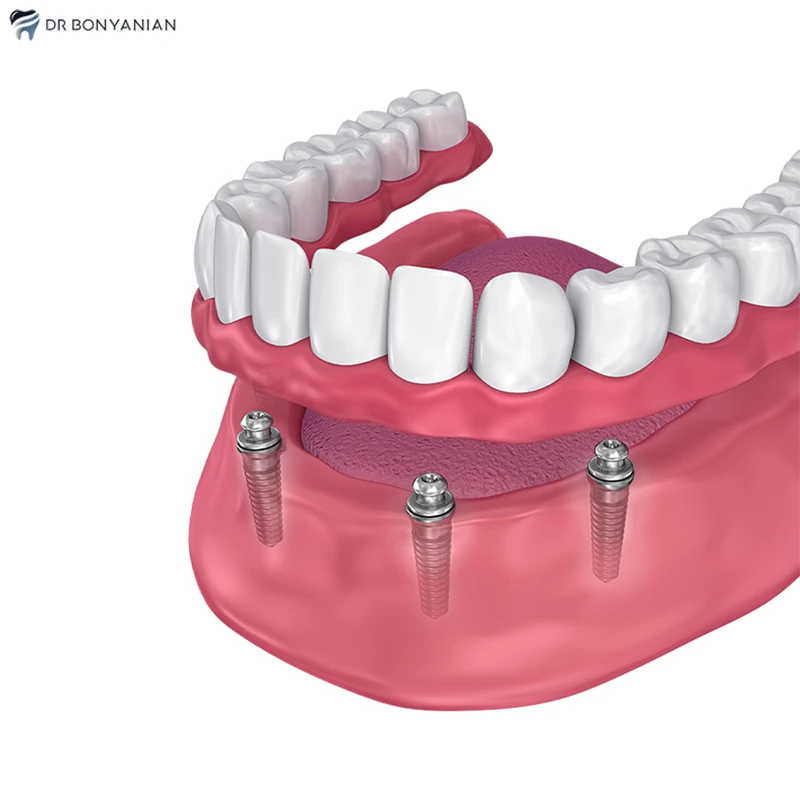
A special type of new denture where the artificial teeth are placed on implant bases.
Advantages of Using Implant-Supported Fixed Dentures:
- They are fixed in your mouth.
- Chewing food and speaking are easier for you than when using removable dentures.
- They are more aesthetically pleasing than removable prostheses.
- They feel natural.
- They prevent jawbone resorption.
What comes to your mind? Do you still think “dentures” are the first thing that comes to mind when you hear the word “artificial,” those one-piece teeth that need to be placed in a glass of water when removed from the mouth? Although this type of denture still exists, these days, a much better alternative has been created for it: implant-supported fixed dentures.
In this article from Dr. Bonyanian’s dental clinic, we intend to familiarize you with various types of implant-supported fixed dentures and provide you with the necessary explanations about this type of dental prosthesis. So, if you are interested in learning about this new type of denture, stay with us.
What are Implant-Supported Fixed Dentures? (Detailed Explanation)
An implant-supported fixed denture is a set of artificial teeth that, using an implant base (screw), this new denture easily attaches to your jawbone with a few implants. It always remains in your mouth. Your jawbone fuses with the implant, and it becomes firm for the dental implant, and over time, it will become part of your jawbone.
Implant-supported fixed dentures, unlike old dentures (which were placed on the gums and were mobile), are connected to your jawbone via screws. This means they are practically the same artificial teeth, but without the ability to be dislodged, and are completely similar to a real tooth.

What is an implant-based fixed denture?
An implant-based fixed denture is a type of dental prosthesis that is securely attached to dental implants, which are surgically placed into the jawbone. Unlike traditional removable dentures, this type of denture is permanently fixed in place and can only be removed by a dentist.
It is used to replace multiple missing teeth (often an entire arch) and offers greater stability, comfort, and chewing efficiency. Implant-based fixed dentures feel and function more like natural teeth and help preserve the jawbone by stimulating it through the implants.
Why Should We Use Implant-Supported Fixed Dentures?
Bone is a living tissue that requires constant stimulation to maintain its volume and density. This stimulation typically comes from the teeth. When teeth are lost, the bone that previously surrounded and supported them begins to resorb. If this problem persists, your face may start to sag, resulting in an older appearance. (See the example below).
Unfortunately, the use of removable dentures actually accelerates this process. However, the use of fixed dental prostheses supported by implants (which support facial features like cheeks and lips) stops bone structure deterioration. This is because this new method in dentistry rebuilds your jaw. Consequently, this makes you look younger. If you are looking for the best dentures for young adults, this method can be a suitable option.
Advantages of Using Implant-Supported Fixed Dentures
As we mentioned at the beginning of this article, implant-supported fixed dentures have many advantages. We have discussed this topic in detail in the article “Difference between Dental Prosthesis and Implant for Removable Dentures”. All the advantages of dental implants are observable in this method. Some of the most prominent advantages of dental implants include the following:
- Implant-supported fixed dentures are fixed in your mouth. Therefore, the process of chewing food and speaking is simpler for you than when you had removable dentures.
- This method is much more aesthetically pleasing than removable dental prostheses.
- Fixed implant-supported denture placement is very natural and looks like a real tooth.
- Fixed dentures prevent jawbone resorption.
For more information and a free consultation, you can fill out the form below so that Dr. Bonyanian’s dental clinic experts can contact you at the earliest opportunity.

Disadvantages of Implant-Supported Fixed Dentures
We do not deny that implant-supported fixed dentures are one of the best solutions for replacing lost teeth. However, we consider it our mission to familiarize you with the drawbacks of this method as well, so that you can make an informed decision about undergoing or not undergoing this treatment by carefully and completely reviewing the pros and cons of implant-supported fixed dentures.
According to Dr. Bonyanian’s explanations, the most important and main disadvantages of implant-supported fixed dentures include the following:
- Need for sufficient bone density.
- Possibility of implant failure (relative to the implant itself, not the denture).
- Lengthy treatment time.
- Need for special care.
- Higher cost compared to conventional dentures.
Quality and Durability of Implant-Supported Dentures
The stability of implant-supported dentures depends on various factors. Some of the most prominent of these include the longevity and lifespan of the artificial tooth, the quality of the implant bases, the quality of the prosthesis, the skill and expertise of the dentist in performing this procedure, and the individual’s care of their teeth.
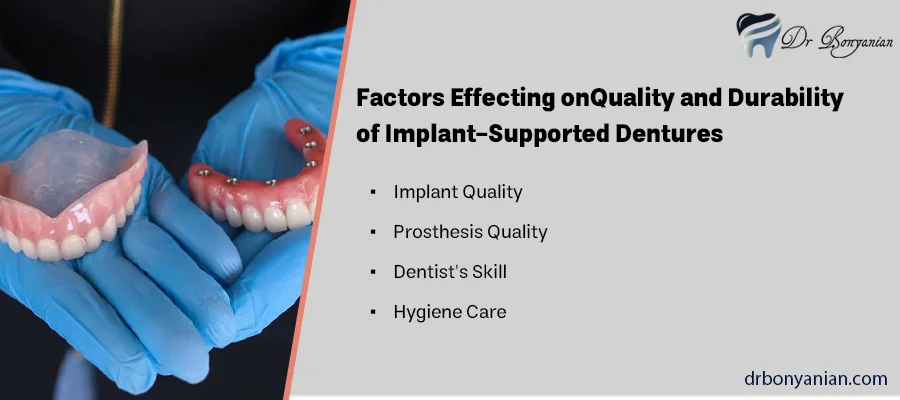
Implant Quality
The quality of the implant bases plays a very important role in the durability of implant-supported dental prostheses. As you know, implant bases are the metal screws that are placed in your jawbone and act as an anchor for your artificial teeth.
Therefore, naturally, the higher the quality of your implant bases, the greater the stability and lifespan of your implants will be. You can find more information in the article “Best Implant Brand”.
Prosthesis Quality
After placing the implant bases and establishing a firm connection with the jawbone, it is time to place the artificial dental prosthesis on these bases. These prostheses are made of different materials, and naturally, their quality differs from each other, and each has its own advantages, disadvantages, and specific durability.
Dentist’s Skill
The next influential factor in the durability of your implant-supported dentures is the level of expertise of the dentist performing this surgery. The more skilled the implant specialist is in performing this procedure, the longer the durability of your implant-supported dentures will be.
This is why choosing the best implant specialist is particularly important in this method.
Hygiene Care
Observing oral and dental hygiene after completing your treatment stages is the last effective factor in the durability of your fixed artificial teeth. If you want to use implant-supported dentures for a long time (even for life), you must be diligent in maintaining your teeth.
Regular visits to the dentist for check-ups and cleanings, maintaining a healthy diet, avoiding hard and tough foods and snacks, brushing, flossing, using mouthwash, etc., are essential for maintaining fixed implant-supported dentures. We suggest you definitely read the article related to how to care for dental implants.
How Do Implant-Supported Fixed Dentures Work?
A dental implant is a small, screw-like post that acts as a replacement tooth root. This screw, like a natural tooth root, is placed in the jawbone beneath the gum line. Implants are made of titanium, which has the unique ability to fuse with bone in a process called osseointegration. This is what makes implants very strong and reliable.
Advanced modern implant systems allow for the minimum number of implants to support the maximum number of teeth. This means that four implants can be used to support a full arch (upper or lower jaw) of fixed, non-removable replacement teeth. Moreover, this remarkable, life-changing procedure can often be completed in just one day.
Implant-supported fixed dentures offer an efficient and cost-effective strategy for permanent tooth replacement. Instead of using one dental implant for each missing tooth (which is impractical and not recommended), you use an implant-supported denture.
To restore the natural proportions of your teeth and gums with less bone volume, we need to create a more realistic (replacement) denture that includes both teeth and gums. Otherwise, any permanent replacement tooth would look excessively long.

Types of Implant-Supported Fixed Dentures
One of the most important factors in determining the type of fixed denture is the type of connection of the artificial tooth to its metal base, which is divided into two main categories: bar-retained and ball-retained.
Fixed Dentures with Bar Attachment
In this type of denture, a thin, long metal bar is screwed into the jawbone. The bar, which acts as a strong base for the denture, follows the shape of the jaw and gum. Then, the artificial teeth are directly attached to this bar.
This type of attachment is very strong and stable and minimizes the movement of the denture. For this reason, bar-retained dentures are usually used to replace all teeth in one jaw and are more suitable for individuals with sufficient bone density.
Advantages:
- Lower cost.
- Simpler surgery.
- Possibility of replacing or repairing the prosthesis.
Disadvantages:
- Less stability and strength.
- Inability to rotate the dental prosthesis.
- Need to remove the dental prosthesis for daily cleaning.
Fixed Dentures with Ball Attachment
Another type of attachment in dentures is the ball-shaped metal base attachment in the jawbone. In this type of attachment, there is one metal attachment per implant, and since the attachment on the implant is ball-shaped, it is also called a ball-retained implant-supported fixed denture.
This type of attachment offers more flexibility than the bar attachment and also has greater strength and durability. It also allows for slight movement of the denture for the wearer.

Advantages:
- High stability and strength.
- Ability to rotate the dental prosthesis for cleaning.
- No need to remove the dental prosthesis for daily cleaning.
Disadvantages:
- Higher cost.
- Need for more complex surgery.
- Need for greater precision in prosthesis fabrication.
You can also find good information about “special implant toothbrush” and “best age for dental implants” by reading articles about dental implant surgery.
Are Implants Better, or Implant-Supported Dentures?
Implants are usually better than traditional dentures because:
- They are more stable and durable and are implanted in the jawbone like natural teeth.
- They have higher chewing power and help in eating more naturally.
- They have a more natural appearance and give the individual more self-confidence.
- They prevent jawbone resorption because, like tooth roots, they stimulate the bone.
- They do not require adhesives or daily removal.
| Features | Implant-Supported Denture (Fixed or supported by 4-6 implants) | Single Implant (Single or multiple teeth) |
|---|---|---|
| Type of Replacement | Replaces a full arch or multiple teeth with a complete prosthesis. | Replaces one or a few teeth independently. |
| Number of Implants Needed | Usually 4 to 6 implants for one jaw. | Usually 1 implant per tooth. |
| Stability and Comfort | Fixed and comfortable, but not as much as single implants. | Very high and similar to natural teeth. |
| Appearance | Natural and beautiful, but depending on the type of prosthesis, it might be less personalized. | Very natural, like a real tooth. |
| Cost | More cost-effective for replacing all teeth in a jaw. | Higher (for replacing many teeth). |
| Treatment Duration | Shorter, as fewer implants are needed. | Longer for multiple implants. |
| Care and Maintenance | Requires more precise hygiene for the prosthesis and bases. | Similar to natural teeth. |
| Replaceability and Repair | Repairing the entire prosthesis might require complete removal. | Each unit can be checked and repaired separately. |
Stages of Implanting Fixed Dentures on Implants
From your jaw, the location of anatomical structures such as bone, sinuses, and nerves may be identified by preparing a 3D X-ray. This allows us to determine the required number of implants and their ideal location.
A small channel must be created in the bone for each implant. During implant placement surgery, which usually only requires local anesthesia, you will not feel anything. We will discuss all your anesthesia options with you before surgery and ensure that you have no problems.
Once your implants are in place, we attach a temporary set of teeth to them, which will remain in your mouth for approximately three months until the implants fully fuse with your bone and heal completely.
When the osseointegration process is complete, we attach the permanent teeth, which are more precisely compatible with your gum tissues than the temporary teeth. With these teeth, you can eat whatever you want and enjoy their attractiveness and similarity to natural teeth.
What is a Screw-Retained Denture?
If you have come across the term “screw-retained denture” somewhere, know that this denture is a type of tooth that is placed on screw-like metal bases. This is exactly why it is called screw-retained.
These bases are the same titanium fixtures that are screwed into the jawbone. After that (and the fusion of the screw with the jawbone), the artificial teeth are connected to these bases and act as a replacement for lost teeth.
So, a screw-retained denture is practically the same as an implant-supported denture because its base is connected to the tooth via a screw fixture; it is also called a screw-retained tooth.

Are Screw-and-Abutment Dentures the Same as Implant-Supported Dentures?
Screw-and-abutment dentures and implant-supported dentures are two different types of artificial teeth, although they may seem similar at first glance. In both types, the goal is to replace lost teeth, but their method of attachment to the jaw is different.
Screw-and-abutment dentures (sometimes also called implant-supported dentures) use screw-like metal bases that are screwed into the jawbone. These bases act as an anchor for the artificial teeth.
In contrast, implant-supported dentures use titanium implants that are directly placed in the jawbone. After fusing with the bone, dental crowns are placed on them.
Therefore, in implant-supported dentures, the connection between the artificial tooth and the jaw is much stronger and more stable. For this reason, this type of artificial tooth has a more natural appearance, feels more comfortable, and has a longer lifespan.
You can get good information about “implant crowns and their types” and the “best type of implant crown” by reading the article.
Can Dentures Be Fixed with Implants?
Yes, dentures can be fixed in the mouth using implants. This type of prosthesis is known by various names such as All-on-4, fixed implant-supported prosthesis, or fixed overdenture systems.
In this method, usually between 4 to 6 implants are placed in the jawbone, and then the denture is fixed on them. This causes the denture to:
- Not loosen.
- Not move in the mouth.
- Be used without adhesive or daily removal.
- Have much better chewing power than removable dentures.
Consequently, this method combines the advantages of dentures and implants; it is more cost-effective than placing individual implants for each tooth, and also much more stable than conventional dentures.
How to Choose the Number of Implants per Person
As mentioned above, the number of implants required for fixed implant-supported dentures varies from person to person. The specialist dentist, after a clinical examination, observation, and review of X-rays and sometimes a full mouth scan, determines the number of implants you need.
However, generally, the number of implants in the implant-supported fixed denture method depends on various factors including the condition of the jawbone, the type of denture, and the dentist’s opinion (e.g., all-on-6 implant or all-on-4 implant).
Who is a Suitable Candidate for Implant-Supported Fixed Dentures?
- Individuals who have lost many of their teeth and are looking for a quick and comprehensive replacement solution.
- Those who are not interested in conventional and removable dentures or are tired of their current conventional dentures.
- Individuals who have good quality jawbone.
- Individuals in their youth to middle age (and do not have advanced old age).
We have discussed the “best age for dental implants” and also in separate articles about “who should not get implants”.
Cost of Implant-Supported Fixed Dentures
The cost varies. On one hand, implant-supported fixed dentures and the cost of dental prostheses, and generally the cost of dental implants, are a combination of both these methods. Therefore, determining the exact final cost is not a simple task.
The cost of implant-supported fixed dentures will be determined based on various factors such as the condition and status of the jawbone, the number of jaws you intend to use this method for, the number of implant bases, and the quality of the artificial teeth.
You can use Dr. Bonyanian’s clinic to have an implant specialist assess your condition. For a price quote, you can get a free dental consultation. An experienced and skilled professional will review your situation and calculate a more accurate price for this procedure for you.
Factors Affecting the Cost of Implant-Supported Fixed Dentures
- Amount of bone reconstruction needed for the patient’s lost bone.
- Need for adjunctive services such as sinus lift, bone grafting, vestibuloplasty, etc.
- Selected implant brand for the denture bases.
- Number of selected bases for placing the denture on them.
- Number of crowns and pontics for the fixed denture.
- Type of crowns and prostheses for the fixed denture.

Caring for Implant-Supported Fixed Dentures
Implant surgery is a very precise and well-planned procedure. Therefore, individuals usually do not experience discomfort or pain during or after the surgery. However, there are a few important recommendations for caring for implant-supported fixed dentures, which we will explain further.
- It is best to avoid eating crunchy, chewy, or hard foods for at least six to eight weeks.
- In the initial days after installing the dentures, drink water and beverages with a straw.
- Avoid eating sticky foods like gum or taffy.
- Take prescribed pain medications on time.
- If you feel pain, take a pain reliever.
- Use a cold compress to reduce facial swelling.
These teeth will be no different from real teeth. Therefore, the care process for them is completely similar to caring for real teeth. Try to maintain your oral and dental hygiene to the highest possible extent and do not neglect using dental floss and mouthwash.
[Image/Content Placeholder]
Receiving Implant-Supported Fixed Denture Services
Implant-supported fixed dentures are the best way to achieve a large number of teeth at once. With this method, you can speak easily, eat food, and have a beautiful appearance.
The procedure for implant-supported fixed dentures can only be performed in some specialized dental clinics because its execution requires special and digital equipment.
It is a matter of pride for Dr. Bonyanian’s Dental Clinic, known as the best dentistry in Argentin Square, and one of the few dental clinics in Iran and Tehran, to perform the implant-supported fixed denture procedure with the highest quality and at an affordable price for you. Our specialists, with the highest level of experience and skill (even with suitable installment payment options), will bring you beautiful, healthy teeth that look and feel like real teeth.
Do not forget that the correct and principled execution of this method is very important. Because improper installation of the bases will lead to them loosening and falling out, and ultimately, the loss of the bases.
If you are a resident of Tehran, you can also benefit from the implant-supported fixed denture services of Dr. Bonyanian’s dental clinic. To book an appointment, please contact us by phone at 00982188539720 or visit us at our address: Argentin Square, Ahmad Qasir (Bokharest) Street, Sixth West Street, No. 22, Unit 7.
Final Summary
For years, the old style of removable dentures has been set aside, and people have turned to implant-supported fixed dentures as a new type of artificial tooth. This method, by fixing the artificial teeth in one piece in your mouth, helps maintain the appearance and function of your teeth.

Dr. Nazi Bonyanian
Dental Surgeon (DDS) — Medical Council Number: 138662
Graduate of Isfahan University of Medical Sciences with over 15 years of experience in implants, laminates, and oral and dental surgery.
Address: No. 22, Unit 7, West Alley 6, Bokharest Street, Argentina Sq., Tehran, Iran
Phone: +98-21-88539720 | WhatsApp: +98-912-514-2202
Email: info@drbonyanian.com
Working Hours: Sat–Wed 09:00–20:00 | Thu 09:00–14:00 | Friday Closed
⚠️ اطلاعات این صفحه صرفاً برای آگاهی است و جایگزین معاینه و تشخیص تخصصی نمیباشد.
