



Caring for dental implants begins the moment you leave the dental office. In this regard, 7 important points should be followed:
- Do not drink alcohol
- Do not smoke
- Do not lie down flat (elevate head)
- Do not eat hard and tough foods
- Do not talk too much
- Rest
- Gargle with salt water
Post-Operative Care and Dental Implant Placement
After the surgical process and placement of the dental implant, it will be time to care for this new tooth. Post-implant care involves a set of correct, principled, and hygienic behaviors that must be observed after implant placement.
In this article from Dr. Bonyanian’s Dental Clinic, we intend to review all points related to post-implant care, from the first day after surgery until years after implant placement. So, stay with us until the end of this article.
Reasons for the Importance of Post-Implant Care
Dental implants have been introduced for years as one of the best methods for replacing missing teeth. These replacements can function completely like a real, natural tooth and, depending on the extent and volume of your care, can remain in your mouth for years.
Naturally, no one wants to spend another period of about 6 months just because of neglecting post-implant care after a few months or years, only to have a new implant placed in their mouth. Furthermore, the cost of dental implants is increasing daily. For this reason, going through this period of time and expense for a dental implant does not seem reasonable.
Observing some hygienic and nutritional tips will help keep the implant healthy in your mouth. In the continuation of this article, we will divide the care of the implanted tooth into 3 timeframes:
- Post-implant care from the day of surgery up to 48 hours later
- Post-implant care from the second day for up to three months
- Maintaining the implant for life
Remember that these post-implant care measures will have a significant impact on the longevity and lifespan of your dental implant. Just as mentioned in the article “Treatment strategies for dental implant removal: A literature review,” this issue has been pointed out.

Caring for Dental Implants After Surgery
After implant surgery, it is necessary to follow some care tips. Observing these tips will ultimately lead to the fixation of the implant screw within your jawbone.
Although the dentist you visit will explain the most important tips for post-implant care to you, we at Dr. Bonyanian’s Dental Clinic will also provide you with some of the most important care measures.
Of course, note that all these recommendations are related to post-implant care. Therefore, if you need to review the ” Pre-Implant Care” processes that you must undergo before getting your tooth implanted, you can refer to the article.
Swallow Your Saliva
It might be a bit difficult to swallow saliva in the first few hours after surgery. However, despite the difficulty, try to swallow your saliva. Spitting it out will lead to bleeding in your implant area.
Use a Cold Compress
Your face will be very swollen in the initial hours after the implant. Use a cold compress to reduce swelling and sensitivity in the area after the implant. It is best to use ice packs or ice bags with indirect contact on the skin.
Do Not Brush
This advice is one of the few tips you’ll hear from a dental team! It’s best to forget about brushing until the inflammation in the implanted area has subsided. Our suggestion for brushing after an implant is to wait for a period of 48 to 72 hours.
After this time, if you decide to brush your teeth, it is better to use a soft-bristled toothbrush.
Gargle with Salt Water for Implant Care
Using a saltwater solution after the implant and swishing it in the mouth is one of the specific care measures for the first 48 hours after dental implant surgery. This will significantly help reduce your pain. We have answered the question of whether implants are painful or not in a separate article.
Eat Soft and Moderate Temperature Food
One of the frequently asked questions about post-implant care is what to eat after an implant. In response to this question, we must say that another necessary measure in the days after dental implant surgery is the consumption of soft foods and drinks. As much as possible, try to use fully cooked foods at a moderate temperature (neither too cold nor too hot). Additionally, it is better to use a straw for drinking water in the first two days.
Smoking is Prohibited
Of course, smoking is generally not a good habit. However, if you ask how many hours after an implant one can smoke, we say that in the initial days after surgery, smoking is completely prohibited. This is because smoking will cause renewed bleeding in the affected tooth.
Do Not Consume Alcohol
Alcohol consumption after dental implant surgery is strictly prohibited. Because alcohol negatively affects your healing process, it creates serious and severe complications for your implant and gums. Furthermore, alcohol reduces blood flow to the surgical area, which delays the tissue repair process and the implant’s fusion with the bone.
Moreover, alcohol has anticoagulant properties and can worsen your bleeding. Therefore, to ensure the success of the implant and prevent potential complications, do not consume alcohol at all during the recovery period after dental implant surgery.
Finally, if you have had your tooth implanted, you should know that alcohol weakens your body’s immune system and increases the risk of infection at the surgical site.
Rest
A dental implant is considered a relatively major surgery. It is best to rest for the first two days after the screw is placed inside the jawbone. Try to talk less, lie down more, and avoid strenuous activities.
Other care measures needed in the first days after implant surgery include the following:
- Take your medications and painkillers on time.
- Do not touch the implant area with your hand or tongue.
- Do not pick at the blood clot formed on the surgical site.

Post-Implant Care for Three Months
After passing the main stage of dental implant surgery, other care measures will also be needed. Because after this, it will be time to create a bond between the jawbone and the implant screw. Therefore, your care during this period will help accelerate the bonding process and reduce the chance of implant rejection.
Next, we will review some of the main strategies for dental implant care during this several-month period.
Use a Soft Toothbrush
For dental implant care, you should check your toothbrush. If your toothbrush bristles are hard and stiff, it’s better to replace them with a softer one. Hard toothbrushes, in addition to scratching the implant surface, will also cause inflammation in the sensitive area.
We also suggest brushing regularly twice a day and flossing. Using a toothbrush specifically for implants allows you to care for your implant properly.
Avoid Abrasive Products
Buy sensitive cleaning products as much as possible, as very abrasive products can cause severe discomfort. You should also avoid oral hygiene products with strong flavors like mint or cinnamon, as these can cause a burning sensation in your mouth.
Floss
Did you know that only 16% of American adults floss daily? This means that 84% of people don’t floss enough! If you are part of this statistic, it’s time to change some things now that you’ve received dental implants.
After dental implants, flossing becomes more important than ever. Plaque and dental bacteria can easily accumulate around your implant, which can lead to other oral and dental health problems.
Another important point regarding dental implant care is to know that there are different types of floss, one of which is specially designed for those with dental implants. So, you really have no excuse not to care for your dental implant.
Do Not Eat Sticky and Hard Foods
Hard and sticky foods can damage your implant. Not to mention, these foods can also damage opposing teeth. Some foods to avoid during implant care include:
- Hard snacks like ice, nuts, toasted bread, candy;
- Hard fruits like apples, pears, carrots;
- Sticky snacks like gum or taffy.
Of course, this restriction will be for a short period. That is, after the implant stabilization period, you can return to your normal eating routine. This (returning to a normal diet sooner) is considered one of the advantages of implants over dentures. You can find useful information about it on the relevant page.
No Smoking and Alcohol
Avoiding smoking and alcohol consumption is a good idea for caring for your implanted tooth. However, avoiding these substances is especially important when you have received a dental implant. Remember that the healing of your dental implants takes up to 6 months.
Therefore, smoking during this period can have double the harm. Also, alcohol consumption slows down the healing process of dental implants. So, you should avoid these as much as possible.
Visit the Dentist
In the very early days after surgery, appointments will be set for your follow-up visits to the dental clinic staff. Your presence at the scheduled times will help the dentist assess the condition of the implant and review your healing process.
Showering After Dental Implant
Showering or bathing after a dental implant is not problematic, provided you follow the precautions below:
- Try to avoid showering or bathing for the first 48 hours after surgery. This period is essential for blood clot formation at the surgical site and the start of the healing process.
- After 48 hours, you can take short showers with lukewarm (not too hot) water.
- High heat can increase your swelling and bleeding. So, do not make the bathroom environment like a steam sauna.
- When showering after an implant, do not bend your head down too much.
- Take a quick shower and avoid standing for long periods to prevent a drop in blood pressure.
- Until the surgical site is fully healed, avoid bathing in a tub or going to a swimming pool. This is essential to prevent infection.
- When washing your hair, use baby shampoo and lukewarm water. Be careful that shampoo does not enter your mouth.
You need to rest a bit more after your implant surgery to recover sooner. However, if your rest includes sleeping, you must do so with great care and follow tips on how to sleep after an implant to avoid damaging your dental implant.
For example, you should place a few extra pillows under your head so that your head is higher than your heart. Also, you should sleep on your side (on the side where the implant was not placed) so that no pressure is applied to your surgical site.
Do not sleep on your stomach under any circumstances. Do not use a hard pillow and try to keep the ambient temperature where you rest cool. Finally, be sure to take your pain medication on time so that you do not have problems during sleep and rest.
Following the tips below will also help you avoid problems when sleeping (after dental implant placement) in the first week or two:
- Use one or two extra pillows under your head.
- Strictly avoid sleeping on the operated side.
- Firm mattresses prevent excessive pressure on you. So, use firm mattresses for two weeks.
- Preferably use medical pillows for a few days.

Is Nosebleed After Dental Implant Normal?
Nosebleeds after dental implants are normal in some cases, especially if the implants are placed in the upper jaw. The reason for this bleeding is the proximity of the implant base placement site to the blood vessels of the nose.
Nosebleeds after dental implants are usually mild and short-lived and should stop within a few hours or 1-2 days.
If this occurs, try to gently press your nostrils with a tissue or sterile gauze for 10-15 minutes and avoid blowing your nose into a handkerchief.
Also, as a final dental implant care tip, be careful not to be in a hot and dry environment that could dry out your nasal passages.
Is Eating Ice Cream Harmful After Implant Surgery?
Eating ice cream after implant surgery is not only not harmful but can also have many benefits. The coldness of the ice cream reduces swelling and inflammation in your surgical area and creates a cool and comfortable feeling for you.
Of course, the important point to observe in this regard is that you should not eat ice cream immediately after surgery. Because a blood clot has formed on the surgical site, eating ice cream or any other food can dislodge that clot.
So, don’t rush to eat this tasty and delicious dessert and wait at least 6 hours after your dental surgery.
Finally, note that it is better to consume ice cream slowly and at a suitable temperature so as not to damage your gums.
Exercise After Implant
Strenuous physical activity and exercise after dental implant surgery are not recommended until the surgical site heals. Intense activity can increase blood pressure, increase blood flow to the surgical site, and lead to bleeding, swelling, and implant displacement. Now, if the intended exercise involves high-impact sports like boxing, wrestling, or karate, performing them will be generally prohibited.
If you want to start exercising after your dental implant surgery, be sure to return to the field gradually and slowly! For example, start with short walks and smooth paths that do not put pressure on you.
Try to avoid lifting heavy objects. Also, ask your dentist for advice on the type and intensity of exercise you intend to do.

Care After Implant Screw Placement
Placing the implant screw is the most crucial step in the tooth replacement process. However, the success of this stage greatly depends on your meticulous care after the procedure. Naturally, with proper care, the gum and bone around your implant will heal faster.
Of course, maintaining oral hygiene also prevents infection in that area. So, you practically need to provide special and double care for your dental implant screw.
Given that placing the screw (implant fixture) is one of THE first stages of implant placement, we recommend that in the initial days after the procedure, you rest sufficiently and avoid strenuous activities.
Try to reduce swelling by using a cold compress on your cheek. Also, it is better to avoid eating hard and chewy foods in the initial days. For example, it is better to eat soft and lukewarm foods so that your gums and the area under surgery are not damaged or irritated.
Finally, be sure to take all medications prescribed by your dentist regularly to avoid post-surgical infection and similar problems.
Care After Implant Crown
After placing the dental implant crown, it is also necessary to observe some care measures in a special and sensitive way. This set of care measures is considered the last group of care; of course, before permanent care of your new tooth!
The most important care for an implant crown after its placement is not to apply pressure to the crown. Because excessive pressure can cause the crown to fall off your tooth. So, do not eat hard and sticky foods at all for a few days after the procedure.
Usually, an implant crown is not allergenic. However, be careful if you experience any unusual symptoms such as severe pain, excessive swelling, prolonged bleeding, or discoloration of the gums, inform your dentist immediately.
Post-Extraction Care for Implants
| Care Type | Explanation |
|---|---|
| Sterile gauze on the wound | Keep on the extraction site for 30 to 60 minutes to stop bleeding. |
| No rinsing of the mouth | Avoid rinsing or gargling for the first 24 hours. |
| Avoid sucking or spitting | This can dislodge the blood clot and cause a dry socket; do not use a straw either. |
| Use of cold compress | In the first 24 hours, apply to the face in the surgical area to reduce swelling. |
| Medication as prescribed | Take antibiotics and painkillers according to the doctor’s prescription. |
| Avoid hot and hard food | Use soft, cool, and liquid foods for a few days. |
| No smoking | Refrain from smoking cigarettes or hookah for at least 72 hours. |
| Care Type | Explanation |
|---|---|
| Careful oral hygiene | Brush around the surgical site carefully. Do not use floss in that area temporarily. |
| Follow-up and regular visits | Visit on time to check the healing of the extraction site and plan for the implant. |
Post Gum Surgery and Implant Care
- Use of sterile gauze
- Avoid vigorous rinsing of the mouth
- Use of cold compress
- Take prescribed medications
- Sleep with head elevated
- Avoid hot, hard, and spicy foods
- No consumption of tobacco and alcohol
- No strenuous physical activity
- Careful oral hygiene
- Use of prescribed mouthwash (if necessary)
- Do not disturb the surgical site
- Regular visits to the dentist

Caring for an Implanted Tooth for Life
If you have successfully navigated the first two to three weeks after dental implant placement and crown installation, you should know that the story of caring for your teeth is not over! Because now is the time for permanent care of your dental implant.
You must care for the implant in your mouth just like a natural, real tooth. Perhaps even more than a natural tooth, because this foreign body has more sensitivities and weaknesses compared to a natural tooth.
If you want to have healthy and long-lasting implant(s), you must put all your effort into maintaining oral and dental hygiene. This means brushing regularly and using dental floss to help prevent plaque and bacteria buildup around the implant.
Regular visits to the dentist for professional cleaning and check-ups, maintaining a healthy, low-sugar, non-sticky diet, avoiding hard foods, and refraining from any tobacco use are all part of long-term care whose observance is of special importance.
Finally, if you have implanted one or more of your teeth and at the same time suffer from a condition such as bruxism (teeth grinding), you must protect your implant(s) by using a mouthguard.
By following these simple tips, you can ensure a beautiful smile and natural teeth for years to come.
Necessary Tools for Maintaining Dental Implants
- Implant-specific toothbrush
- Dental floss
- Antibacterial mouthwash
- Non-abrasive toothpaste

How Many Hours After Implant Can We Eat?
Your dentist is the best person to tell you when you can start eating. Because they will determine the appropriate time for you based on your condition and the type of surgery. However, the usual recommendation from most dentists is to consume food 8 hours after surgery.
To start eating, it is also better to initially use soft and liquid foods and avoid eating hard and chewy foods.
Soup, porridge, rice pudding, and soft foods at a moderate temperature are the best foods you can eat after dental implant surgery.
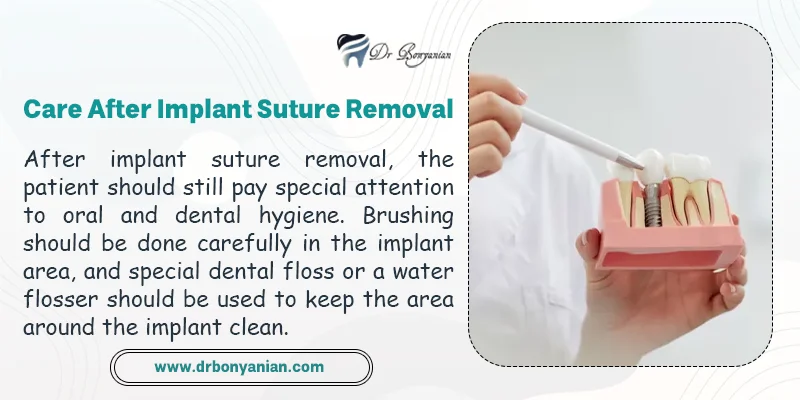
Care After Implant Suture Removal
Dr. Bonyanian recommends the following regarding post-implant care (after suture removal):
After implant suture removal, the patient should still pay special attention to oral and dental hygiene. Brushing should be done carefully in the implant area, and special dental floss or a water flosser should be used to keep the area around the implant clean. Also, avoid eating very hard or sticky foods in the surgical area for a few days, and report any abnormal symptoms such as bleeding, swelling, or severe pain to the dentist. Regular check-ups are also essential to monitor the process of bone formation and implant integration with the bone.
Performing Dental Implant Surgery in One of Tehran’s Top Implant Centers
Given the proliferation and abundance of clinics offering dental implant services to their patients, choosing a reliable and professional clinic for this surgery is of utmost importance. The best implant specialist will be crucial because low-quality surgery will have very bad and irreparable consequences.
At Dr. Bonyanian’s Dental Clinic, in addition to focusing on the high quality of our services, we also offer reasonable prices and the possibility of installment payments to you, our dear clients.
Also, our professional team of doctors and specialists is ready to provide you with the necessary guidance regarding post-implant care. For a free dental consultation, you can use the form below.
Our specialist dentists, with the necessary experience and skills in this field, will provide you with advice and guidance from the moment of implant fixture base placement to post-implant care, so that all your stages proceed without any problems.
By following daily oral hygiene recommendations, optimal implant cleaning methods, consuming appropriate foods, and self-care, you can contribute to the longevity of dental implants. If you reside in Tehran and intend to benefit from dental implant services at Dr. Bonyanian’s Dental Clinic, which is known as one of the best dental clinics in North Tehran, you can make a reservation by calling 00982188539720 or visit us at our address: Arjantin Square, Ahmad Qasir St. (Bokharest), Sixth St. West, No. 22, Unit 7.
Final Summary
In this article from Dr. Bonyanian’s Dental Clinic, we divided post-dental implant care into three stages: post-surgery care, 3-month care, and long-term care. Observing post-implant care measures will lead to improved surgical outcomes and the long-term durability of this new tooth in your mouth.

Dr. Nazi Bonyanian
Dental Surgeon (DDS) — Medical Council Number: 138662
Graduate of Isfahan University of Medical Sciences with over 15 years of experience in implants, laminates, and oral and dental surgery.
Address: No. 22, Unit 7, West Alley 6, Bokharest Street, Argentina Sq., Tehran, Iran
Phone: +98-21-88539720 | WhatsApp: +98-912-514-2202
Email: info@drbonyanian.com
Working Hours: Sat–Wed 09:00–20:00 | Thu 09:00–14:00 | Friday Closed
⚠️ اطلاعات این صفحه صرفاً برای آگاهی است و جایگزین معاینه و تشخیص تخصصی نمیباشد.
