



In this article, we plan to introduce you to one of the methods of orthodontics called Damon braces. We will discuss its mechanism, features, types, and the cost of Damon braces.
Confirmed by Dr. Bonyanian’s Dental Specialists
The content of this article is solely for your information. Before taking any action for treatment, please consult with Dr. Bonyanian’s dental clinic.
If you are thinking about straightening your teeth, you can try the Damon orthodontic method. Among the various orthodontic methods performed at the dental clinic, using Damon orthodontics is a beneficial alternative to different types of invisible and traditional braces available in the market today. In this article, we intend to familiarize you with one of the orthodontic methods called Damon braces and discuss its mechanism, features, types, and the cost of Damon braces.
In reality, because there are various types of braces available, determining which one is best for you (or your child) can seem a bit confusing.
But don’t worry, we’re thinking of you!
Read the rest of this article to understand everything about the Damon braces system, including:
- Damon braces versus traditional braces and Invisalign (invisible orthodontics).
- Different types of Damon braces like Damon Clear and other colored options.
- Reviews and before-and-after photos from Damon users.
- The cost of Damon orthodontics.
- The pros and cons of Damon braces.
We hope this information helps you make the best decision about your orthodontic treatment method based on your needs.
What are Self-Ligating Braces?
Self-ligating braces are essentially a device for orthodontics with the Damon method that makes limited use of special clips or metal doors that hold the archwires of the braces in place. A sliding mechanism gradually moves the teeth to straighten them. This system does not require the small rubber bands used in traditional braces.
Manufacturers of self-ligating braces and their affiliated companies claim that treatment with self-ligating braces is faster and less painful. They also claim that installing these braces does not require other preparations like tooth extraction.

What is Damon Orthodontics?
These braces are an answer to all the unpleasant aspects of traditional braces. They are installed exactly like traditional braces but use self-ligating technology to straighten your teeth. This means that, in theory, they are easier to clean, create less pain, and require fewer visits to the clinic. These braces can be used to treat the following cases:
- Crooked teeth
- Overcrowding of teeth
- Mild to severe cases of malocclusion
The manufacturers of Damon braces and their affiliated companies also claim that the Damon system brings the following benefits:
- A fuller smile
- Better facial balance
- Smoother cheek lines
- Reduction of dark triangles in the corners of your mouth
- More youthful profiles
Why is the Damon Orthodontic Method Suitable?
The Damon system braces have steadily gained popularity since their inception for the following reasons:
- Faster Treatment: It is said that treatment with Damon braces is faster than with traditional braces. A study conducted by Bristol Hospital and Dental School in England concluded that these braces require fewer visits and less time for treatment compared to traditional braces.
- Aesthetics: With the Damon system, you can get clear or metal braces. The clear brackets are not fully visible, making them a great option for adults and teenagers who don’t want their braces to be too noticeable.
- Fewer Clinic Visits: The aforementioned study from Bristol Hospital and Dental School also showed that the number of clinic visits for Damon braces is lower.
- Less Pressure: Since they are self-ligating, they are also less painful, or at least, the intensity of the pain is less because they have more stretch than traditional braces.
- Easier to Clean: Because these braces have fewer parts and accessories than traditional ones, there are fewer places for plaque to accumulate, making brushing and flossing easier.
- Less Friction: Less friction with the Damon system means less damage to the teeth and tooth enamel.

How Do Damon Braces Work?
Getting these braces for you begins just like traditional braces with a visit to the orthodontist. The dentist or orthodontist takes a mold of your teeth and plans your treatment based on it.
As mentioned above, these braces are self-ligating. Self-ligating means these braces use a sliding mechanism that connects the wires to the brackets, so the brackets gradually move on their own towards the other teeth.
So, what’s the big deal?
Well, the addition of a special memory wire and the sliding mechanism means you don’t have to visit the orthodontist frequently to get your braces tightened. And if you’ve ever had braces, you know that this can be a painful experience.
Since these braces tighten slowly over time, less force is used when talking about the Damon system versus traditional braces. Plus, there are no uncomfortable elastic bands that occasionally snap inside your mouth and cause stimulating pain.
The manufacturers of the Damon system also claim that there is no need for any tooth extraction, palatal expanders, or other extra methods.
Sometimes, orthodontists need to use a power chain. A rubber band that connects your brackets together. This band pulls the teeth with much more pressure than self-ligating braces. Some patients feel a little pain with the power chain.
After Damon Orthodontic Treatment
After your orthodontic treatment with the Damon method is completed, you may have to use a retainer at night, just like with traditional braces. Depending on the diagnosis of the dentist or orthodontist, you may also have to use the retainer during the day.
Retainers come in various types that you can choose from, such as Hawley and Essix retainers. Also, if you are looking for something less visible, Invisalign offers a clear retainer called Vivera.
Your dentist or orthodontist might also recommend a permanent retainer that you use for the rest of your life. These retainers are bonded to the back of the teeth, so they are only visible if you open your mouth completely.
How much do Damon braces cost?
How much do Damon braces cost? The price of Damon braces is between $3,800 and $8,000. The price heavily depends on your malocclusion and the amount of correction needed. The cost of Damon braces is higher than traditional metal braces, but the good news is that if you have private insurance, it will likely help with the cost of treatment with the Damon system. You can also ask your orthodontist about payment plans. However, government insurance will most likely not cover the cost of this type of braces.
If you find that your insurance does not cover this type of braces or only covers a portion of it, you might consider a dental savings plan. These plans are the result of collaboration between dentists and insurance companies to help uninsured and underserved individuals access the dental services they need.
Types of Damon Braces
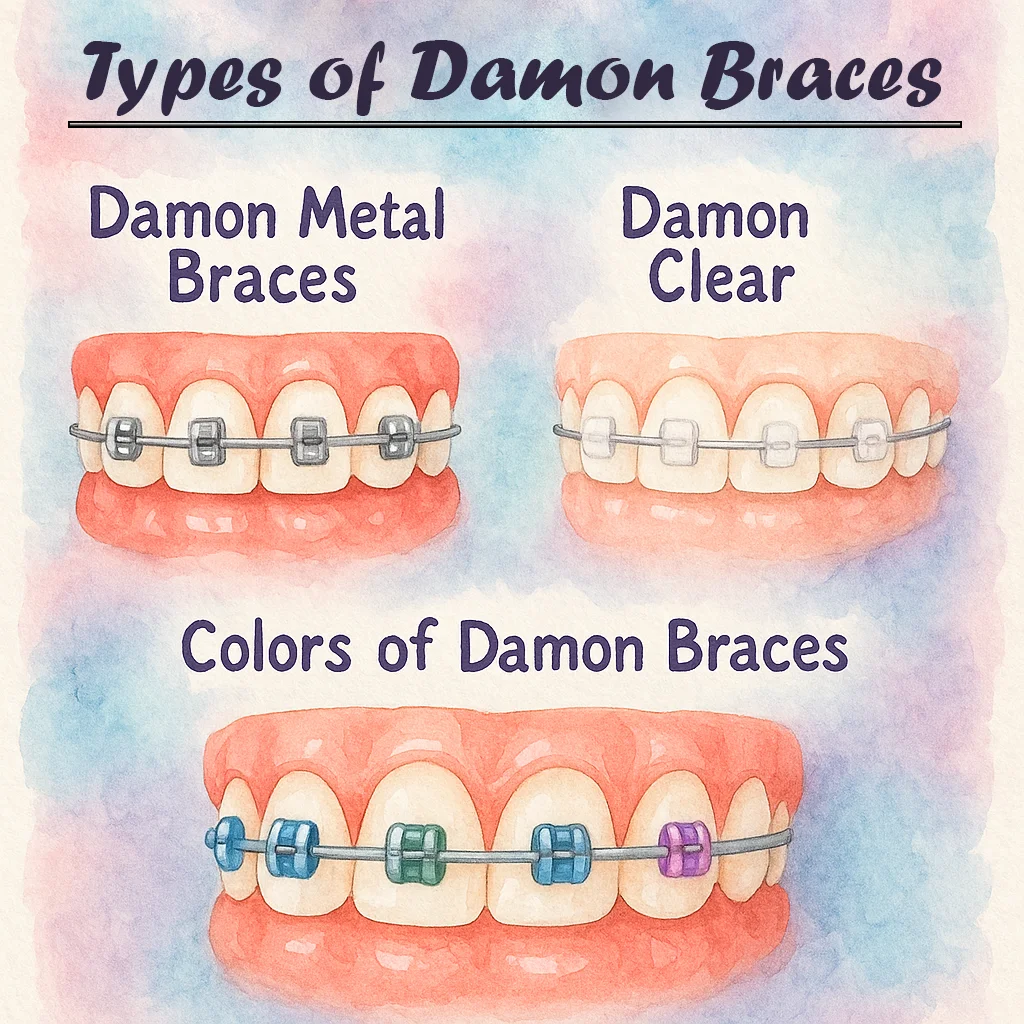
There are similarities between Damon braces and traditional braces. One of these similarities is that just like traditional braces, there are different types of Damon system braces, which include:
- Damon Metal Braces: Damon metal braces are very similar to traditional metal braces. The obvious difference is that traditional braces often have small hooks for elastic bands, whereas Damon braces do not. With the Damon system, you can also see the self-ligating sliding mechanism – but only if you look very closely.
- Damon Clear Braces: Damon clear braces are made of ceramic and are similar to traditional clear braces—the bracket is clear, so the braces are less visible on your teeth. The difference between Damon ceramic braces and other brands is the lack of visible metal parts and elastic connections, which makes them less noticeable. We will talk more about this below, but if you are looking for a discreet way to straighten your teeth, you might also consider at-home clear aligners, like those made by Candid. They are much more affordable, and the average treatment time is only six months.
- Colors of Damon Braces: Can you get Damon braces in color? Definitely! The clear option is attractive for those who don’t want their braces to be noticed, but if you want to show them off, your dentist can show you a wide range of colors for Damon braces.
Damon Braces vs. Traditional Braces
As mentioned above, there are differences between the Damon system braces and traditional braces. The main difference is that Damon braces are self-ligating, while traditional braces require periodic visits to the orthodontist for tightening. The Damon system tightens gradually using a sliding mechanism to straighten your teeth. And in many cases, this treatment method can reduce discomfort and pain.
Another difference is that Damon system braces are on average more expensive than traditional braces, with Damon braces costing between $3,800 and $8,000, while traditional metal braces cost between $2,500 and $7,500.
Both options come with colored bands and are available in a clear version. Damon self-ligating braces may be less noticeable than other clear brackets because they lack metal hooks and elastic bands.
Damon Braces vs. Invisalign (Invisible Orthodontics)
So, what’s the difference between Damon braces and Invisalign? Actually, quite a lot.
Clear aligners, like Invisalign, are another invisible method for straightening teeth. In fact, aligners are much less noticeable than clear brace brackets.
Another difference is that clear aligners are removable, so you can take them out for a few hours a day if needed. Damon braces are fixed on the teeth. This means they work 24 hours a day, but they also make cleaning your teeth and braces much easier.
However, depending on the case (patient), the cost of these two can be quite similar: the price of Damon system braces varies from $3,800 to $8,000, while invisible braces cost between $3,500 and $8,500.
There is a cheaper option that you might not be aware of: at-home clear aligners. The price of brands like Candid, NewSmile, Byte, and ALIGNERCO is under $2,500. The reason they are so affordable is that instead of needing regular visits to the dental clinic, the entire treatment is monitored remotely. At-home aligners cannot treat more severe cases of malocclusion, but you can quickly check if you are a suitable candidate and compare suitable offers by answering a few questions about your teeth below:

Review of Orthodontics with the Damon Method
So, do Damon braces really work?
Let’s take a look at some reviews of the Damon brace system to see what patients are saying:
Nafnang’s Review: Fast but not comfortable results
“I am a Damon brace user and have been using the braces for 1 year and 8 months.”
At the time of this review, the patient had been using their braces for one year and eight months. It is not clear if they are completely satisfied with their treatment or not, but they do a good job of presenting the pros and cons of Damon braces. Here are some of the points they mentioned:
- Fast: They say the Damon system works quickly and they noticed results in the first month of treatment.
- Bigger smile: They now have a wider smile from using these braces.
- Bigger gums: Their gums are much more noticeable than before.
- Uncomfortable: According to the reviewer, the claim that they are more comfortable than traditional braces is not true.
Jennifer’s Review: Damon braces work.
“It’s never too late to get the smile you’ve always wanted!”
Jennifer’s review of Damon clear braces is mostly positive… maybe she’s a very positive person? If she feels that way, there’s a reason for it. She is a cheerleader for Damon braces – someone who makes up for it by spending time sharing her experience with the Damon system.
So, with that in mind, she has a lot to say about Damon orthodontics, and her experiences seem genuine. Some of the positive experiences she had include:
- Efficiency: Getting her braces, including seeing images, photos, and molds of her teeth, took only an hour and a half in total.
- Pain-free: This view is not about the installation of the braces, but rather related to their use – she reports an overall pleasant experience at the orthodontic clinic.
- More self-confidence: At the time of the review, Jennifer has only had her braces on for a little over a month, but she has noticed a difference. Instead of hiding her smile like she used to, she now laughs without any hesitation.
Chanoon’s Review: Damon Braces vs. Invisalign
“I’m really happy with my result.”
This blogger has documented a long and detailed journey as part of her Damon braces review. She has been using Damon braces for two and a half years, mostly to correct an overbite. She reported being very happy after the braces were removed from her teeth. However, her teeth did not straighten as much as she wanted, so after treatment with the Damon system braces, she decided to get Invisalign retainers as well. In the end, she had to have teeth extracted, including her wisdom teeth. Her experience included:
- Extraction of four teeth
- Small screws in the gums
- Laser treatment
- Invisalign treatment for minor adjustments
Given the things mentioned, it seems she is satisfied with her overall experience.
Christopher’s Review: No tooth extraction is needed.
Watch this short video of Christopher’s experience with Damon braces, including his before and after photos of using Damon braces.
Pros and Cons of Damon Braces
As mentioned above, these braces are very popular because they are said to be more efficient and less painful than traditional braces. But there are also disadvantages. Some of the disadvantages of Damon braces include:
- Visibility: Although Damon clear is less noticeable than traditional metal braces, there is still a metal wire that other people might be able to see.
- Irritation: Any system that can move your teeth will, at least at the beginning of treatment, cause some irritation or discomfort in your mouth.
- Cost: The price of Damon braces is higher than traditional braces.
Alternatives to Damon Braces
Invisible Braces
We mentioned these above, so we will cover them briefly!
Invisible braces like Invisalign use clear plastic aligners that gradually guide the teeth to their proper position. They are suitable for up to 90% of cases of teeth straightening.
You can go to a dentist for brands like Invisalign and Clear Correct, but—if you only need mild to moderate teeth straightening—cheaper at-home aligner options like Candid, New Smile, and Byte exist. Their cost is significantly lower, and you can complete the entire treatment from home. Candid also has physical locations called Candid Studios where you can go for a free consultation and to get a 3D scan of your teeth instead of doing it at home. Take a quick assessment to see if you are a candidate; you can also study the best invisible braces here.
Traditional Metal Braces
In traditional metal braces, stainless steel brackets are attached to each tooth. A flexible archwire connects each bracket, and small elastic bands secure the wire. During in-office visits, an orthodontist tightens the wire to move the teeth to the desired position.

Lingual Braces (including Incognito)
Lingual orthodontics is another option for those who want to straighten their teeth without them being too visible. Lingual braces are installed on the back of the teeth, so seeing them from the outside is more difficult.
Ceramic Braces
Ceramic braces have brackets that are either clear or colored to match your teeth. They are less visible than traditional metal braces, but they work in the same way.
Other Self-Ligating Braces
Speed Braces
Speed braces are for those who want to straighten their teeth but are determined not to have their braces installed for one to two years. It is said that they work in just six months.
Only a dentist licensed by this company can treat with Speed braces. These self-ligating braces are only suitable for those whose jaw and teeth are fully grown and do not require severe corrections. These braces cannot be used for severe malocclusion.
In-Ovation Braces
In-Ovation braces, like traditional braces, use brackets and wires to straighten teeth. The difference is that they are self-ligating, like the Damon system. In fact, there seems to be no significant difference between these two types of self-ligating braces.
But, in order not to have a monopoly, it is better that there are options.
Molly explains this well, stating why her dentist prefers In-Ovation to Damon, while confirming that both brands have good results.
In fact, it seems the main difference is in what your orthodontist prefers.
Conclusion
If you are an adult or teenager and are looking for an alternative to traditional metal braces, you may find that Damon braces are a good option for you. Positive reviews and research results claim that due to the self-ligating nature of these braces, tightening happens gradually, resulting in less pain and pressure. And the clear option makes them less visible. They are also supposed to work without extracting teeth.
However, some studies show that this type of braces does not actually have a shorter overall time compared to traditional braces. And in this article, you saw the review of a patient who needed to have several teeth extracted with Damon braces.
Ultimately, when the issue is not just straightening teeth but also general oral health, you should talk to your dentist or orthodontist to determine the best option for you.

Dr. Nazi Bonyanian
Dental Surgeon (DDS) — Medical Council Number: 138662
Graduate of Isfahan University of Medical Sciences with over 15 years of experience in implants, laminates, and oral and dental surgery.
Address: No. 22, Unit 7, West Alley 6, Bokharest Street, Argentina Sq., Tehran, Iran
Phone: +98-21-88539720 | WhatsApp: +98-912-514-2202
Email: info@drbonyanian.com
Working Hours: Sat–Wed 09:00–20:00 | Thu 09:00–14:00 | Friday Closed
⚠️ اطلاعات این صفحه صرفاً برای آگاهی است و جایگزین معاینه و تشخیص تخصصی نمیباشد.
